Trademark Marked for Show Cause Hearing? Don’t Give Up on Your Brand.
Received an email from the Trademark Registry stating that your application has been marked for Show Cause Hearing? Your trademark is not automatically rejected. The Registry has found that certain objections remain unresolved and is providing an opportunity to present your case.
This is an important stage. Simply repeating your earlier examination reply may not be enough. You need clear legal arguments, relevant judgments, proper supporting documents and a well-prepared response addressing each outstanding objection.
- Review of examination objections under Sections 9 and 11.
- Strong legal arguments with relevant trademark judgments.
- Evidence of brand originality, prior use and distinctiveness.
- Professional hearing preparation and representation across India.
Share your hearing communication with our trademark team. We will review the available documents and explain the appropriate next steps.
Get Your Trademark Hearing Reviewed
Our Trademark Show Cause Hearing support includes reviewing examination objections, identifying relevant legal precedents, preparing supporting documents and arranging professional representation before the Trademark Registry. Whether your application faces objections under Section 9 or Section 11, our team helps you prepare a case based on your brand’s actual facts.
What Does “Marked for Show Cause Hearing” Mean in Trademark?
When your trademark application status shows “Ready for Show Cause Hearing” or you receive an email stating that it has been “Marked for Show Cause Hearing”, it means the Trademark Registry has not accepted the earlier examination reply as sufficient to resolve the outstanding objections.
The application has moved to an important hearing stage. The Registrar will provide an opportunity to explain why your trademark should be allowed to proceed towards registration.
No. A show cause hearing communication is not itself a final refusal order. You still have an opportunity to present your legal arguments and supporting evidence before the Registry decides the matter.
Why Did the Trademark Registry Schedule a Hearing?
Usually, the Registry schedules a hearing when the response to the examination report does not adequately resolve the objections. These may relate to lack of distinctiveness, descriptive words or similarity with an earlier trademark.
The applicant must now address the actual reasons recorded by the Examiner rather than simply repeat the earlier reply.
What Happens After an Examination Reply?
In a communication dated 2 November 2026, the Registry stated that the examination reply was not satisfactory and maintained objections under Sections 9(1)(a), 9(1)(b) and 11(1) of the Trade Marks Act, 1999. The application was consequently marked for a show cause hearing.
This illustrates why an applicant needs a fresh review of the objections and a properly prepared hearing submission.
Do not ignore the communication or wait until the last moment. Check the hearing notice, preserve your earlier reply and collect evidence supporting your brand. Have the objections reviewed by an experienced trademark professional before the scheduled hearing.
Why Did the Trademark Examiner Not Accept Your Reply?
Receiving a communication stating that your Trademark Examination Reply Is Not Satisfactory can be worrying. But before giving up on your brand, understand exactly why the Registry has maintained its objections.
Three common objections under the Trade Marks Act, 1999 are explained below. Each requires a different legal approach and supporting evidence.
1. Trademark Lacks Distinctiveness
The Examiner believes that your proposed brand name does not sufficiently distinguish your goods or services from those of other businesses.
Example: A common expression or ordinary business name may be considered incapable of identifying one particular commercial source.
We examine the complete brand name, its unique combination of words or logo, its commercial identity and supporting evidence. Where applicable, we establish acquired distinctiveness through genuine use before the application date.
2. Trademark Is Considered Descriptive
The Registry believes that your brand name directly describes the nature, quality, purpose, geographical origin or other characteristics of the goods or services.
Example: A restaurant brand using words that directly describe the type of food or service offered may face a descriptiveness objection.
We examine whether the mark is exclusively descriptive or whether its overall combination creates a distinctive commercial identity. Relevant brand usage, market evidence and the actual services covered are considered.
3. Similarity With an Earlier Trademark
The Examiner has identified an earlier trademark that may be identical or similar to your proposed mark, creating a likelihood of confusion among customers.
Example: Two businesses applying for similar brand names in overlapping goods or services may face an objection even if their logos or business locations differ.
We compare the competing marks visually, phonetically and conceptually. We also examine their respective goods and services, actual market circumstances and relevant legal precedents. Where appropriate, an NOC or evidence of honest concurrent use may also be considered.
The legal position depends on the exact brand, application, earlier marks, relevant evidence and the services covered. A strong hearing submission must address each objection separately instead of using a common explanation for all cases.
Why Does Your Hearing Need a Different Approach?
If your earlier examination reply has already been found unsatisfactory, simply submitting the same explanation again may not resolve the issue. The next step is to identify the weakness in the earlier reply and prepare a focused legal argument supported by relevant documents and precedents.
Is Your Trademark Facing These Objections?
Let our trademark team examine the Registry communication, earlier reply and cited objections. We will help you understand the available legal grounds before your hearing.
Send Your Trademark Details on WhatsAppHow to Prepare a Strong Trademark Show Cause Hearing Case
When your trademark is marked for Show Cause Hearing, simply repeating your earlier examination reply may not be sufficient. You need to explain why your brand deserves protection with relevant legal arguments and supporting documents.
Our approach is to examine the actual objections, identify the weaknesses in the earlier reply and prepare a case based on the facts of your trademark application.
Establish Your Brand’s Distinctiveness
We examine the complete brand name, logo, word combination and overall commercial identity. Where the mark has acquired distinctiveness through use before the application date, we assess evidence such as sales, advertisements and customer recognition.
Prove Genuine Prior Use
If your business was using the brand before filing the trademark application, dated invoices, GST records, packaging, advertisements and customer transactions may support your claim. The evidence must establish the relevant dates and connection with the applied mark.
Examine Geographical and Market Usage
We investigate how the brand is actually used in the market, including its geographical reach, customer base, business activities and channels of trade. Such evidence can help explain the commercial identity of your brand, although geographical use alone does not automatically overcome a similar-mark objection.
Compare Similar Existing Trademarks
We examine the earlier trademarks cited by the Registry and compare their visual appearance, pronunciation, meaning, distinctive elements and respective goods or services. The objective is to establish whether a likelihood of confusion genuinely exists.
Study Brand Coexistence and NOC Possibilities
Where similar trademarks coexist, we examine their ownership, registration history, goods or services and market circumstances. If appropriate, we explore obtaining a No Objection Certificate (NOC) or consent from the earlier proprietor.
Support Arguments With Legal Precedents
We identify relevant Supreme Court and High Court judgments and use their legal principles to support the specific objections raised against your application. Every judgment must be relevant to the facts rather than simply added as a list of citations.
- Section 9: Distinctiveness, descriptive marks and acquired distinctiveness.
- Section 11: Earlier trademarks and likelihood of confusion.
- Section 11(4): Consent of an earlier proprietor and the statutory conditions for registration.
- Section 12: Honest concurrent use and other special circumstances.
- Section 34: Protection of qualifying prior users.
In its judgment dated 14 August 2025, the Supreme Court examined trademark similarity, the overall impression of competing marks, the anti-dissection rule, dominant features and the average consumer’s imperfect recollection.
These principles are relevant when preparing arguments against a similarity objection under Section 11, depending on the facts of the application.
An NOC does not automatically guarantee trademark registration. Similarly, the existence of other registered similar brands does not by itself establish your right to registration. The Registrar must consider the statutory requirements and the particular facts of your case.
Our Objective: Present a Case the Registrar Can Properly Evaluate
We bring together the relevant documents, statutory provisions, supporting evidence and written arguments into a structured hearing submission. Our team then prepares to explain the case clearly and respond to the questions raised during the hearing.
Let Us Review Your Trademark Hearing Case
Already received a Show Cause Hearing communication? Send your application number and earlier examination reply. Our team will identify the objections and explain the next steps.
Get Your Case Reviewed on WhatsAppSupreme Court Judgments That Can Help in Trademark Hearings
A strong Trademark Show Cause Hearing requires more than an explanation. Relevant court judgments can help establish why your brand deserves consideration under the Trade Marks Act, 1999.
Issue: Descriptive trademarks and acquired distinctiveness.
Relevance: Evidence of commercial use and customer recognition may help establish that an otherwise descriptive expression has acquired a distinctive identity.
Issue: Similarity and likelihood of confusion.
Relevance: The nature of the marks, goods, customers and surrounding circumstances are important when assessing confusing similarity.
Issue: Trademark reputation and territorial goodwill.
Relevance: Evidence of reputation in the relevant Indian market can be important when evaluating competing trademark claims.
Our trademark team reviews your examination objections, selects relevant judgments and prepares supporting arguments based on your actual brand and evidence. Every case is different, and no judgment guarantees registration.
Documents Required for Trademark Show Cause Hearing
Proper documentation is essential when responding to a Trademark Show Cause Hearing. The Registrar needs to understand why your brand qualifies for registration and how you have addressed the outstanding objections.
Keep These Documents Ready
Not necessarily. The documents depend on your objections, application details and whether you claim prior use or acquired distinctiveness. Our team will identify the relevant evidence after reviewing your case.
Why Is Document Preparation Important?
Submitting documents without connecting them to the legal objections may not help. Each important document should support a specific argument, such as brand distinctiveness, genuine prior use or the difference between competing trademarks.
You do not need to prepare everything yourself. Share your Registry communication and previous reply. Our team will guide you on the additional documents required.
Share Documents on WhatsAppTrademark Hearing Procedure in India – What Happens Next?
Once your trademark application is marked for Show Cause Hearing, the next step is to prepare your response and attend the hearing as scheduled by the Trademark Registry.
Here is how the process generally works.
Before the Trademark Hearing
Our team reviews the examination report, earlier reply and hearing communication. We identify unresolved objections, collect supporting evidence and prepare written legal submissions with relevant judgments.
During the Trademark Hearing
The authorised representative presents the applicant’s arguments before the hearing officer, explains the distinctive features of the brand and responds to questions raised by the Registry. Hearings may be conducted through video conferencing or other notified arrangements.
After the Trademark Hearing
The Registrar considers the submissions and passes an appropriate order. We monitor the application status and advise the applicant on the next steps based on the order received.
Your trademark may proceed towards acceptance and Journal advertisement, receive further directions or conditions, or face refusal depending on the merits of the case.
Check the hearing notice carefully and ensure timely attendance. If you need an adjournment or have a genuine difficulty, seek advice and follow the Registry’s applicable procedure. An adjournment is not automatic.
Why Choose Professional Trademark Hearing Representation?
A hearing is an opportunity to explain your case, not simply repeat your earlier reply. A properly prepared representative can present the relevant facts, legal provisions and supporting evidence in a clear and structured manner.
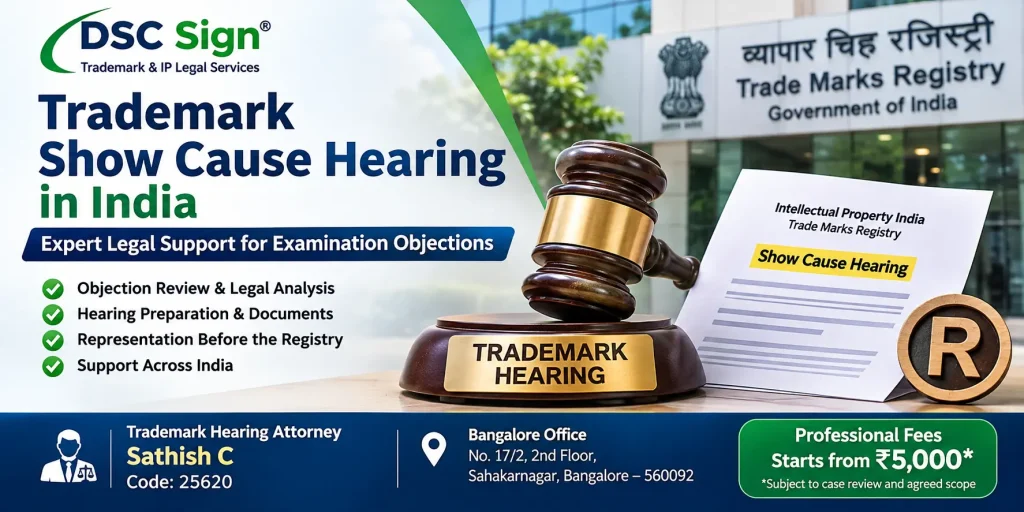
DSC Sign provides trademark hearing preparation and representation support across India, with professional fees starting from ₹5,000, subject to case review and scope.
Contact Our Trademark TeamCan a Trademark Be Accepted After a Show Cause Hearing?
Yes. A trademark application can proceed towards registration even after being marked for Show Cause Hearing. The outcome depends on the applicant’s legal arguments, supporting evidence and whether the objections are satisfactorily addressed.
The hearing is an important opportunity to explain your brand’s identity and respond to the concerns raised by the Trademark Registry.
If the objections are resolved, the application may be accepted and proceed to advertisement in the Trade Marks Journal, subject to the applicable procedure.
The Registry may issue further directions or impose permissible conditions or limitations, depending on the facts and applicable law.
If the objections remain unresolved, the Registrar may refuse the application by passing an appropriate order with reasons.
A refusal order may be challenged through the appropriate legal remedy, including an appeal under Section 91 of the Trade Marks Act, 1999, subject to limitation and applicable procedural requirements. Obtain legal advice promptly because the time limit is important.
After advertisement, third parties may oppose the application within the prescribed opposition period. Registration follows only after the applicable statutory requirements are satisfied.
Don’t Lose Your Brand Without Presenting Your Case
Before your hearing, get your application, earlier examination reply and outstanding objections reviewed. A focused legal submission supported by relevant evidence gives the Registrar a proper basis to consider your application.
DSC Sign provides trademark hearing preparation and representation across India. Professional fees start at ₹5,000, subject to case assessment.
Discuss Your Trademark CaseWhy Choose DSC Sign for Trademark Show Cause Hearing?
When your trademark application reaches the hearing stage, you need more than routine filing assistance. You need a professional team that understands trademark objections, prepares relevant legal arguments and handles the hearing process carefully.
1. Experienced Trademark Professionals
Our trademark team works on examination objections, show cause hearings, trademark documentation and legal representation, with attention to the specific facts of each application.
2. Application-Specific Legal Preparation
We do not rely on standard replies for every applicant. We examine the outstanding objections, earlier trademarks, supporting evidence and relevant judgments before preparing the hearing submission.
3. Nationwide Hearing Coordination
Whether your trademark application is filed in Bangalore, Chennai, Mumbai, Delhi, Kolkata or another Registry location, our team can coordinate hearing assistance across India, subject to applicable authorisation and availability.
4. Clear Fees and Professional Guidance
Our trademark hearing professional fees start from ₹5,000, subject to application review and agreed scope. We explain the requirements before taking up the matter.
5. Bangalore-Based Professional Office
Our office at Sahakarnagar, Bangalore, provides a local point of contact for trademark applicants and business owners requiring professional assistance.
Meet Our Trademark Professional
Sathish C – Trademark Attorney, Code 25620
Our trademark hearing team supports applicants with objection analysis, legal research, document preparation and hearing representation. The representative handling each matter will be identified based on the applicable professional authorisation.
Received a Show Cause Hearing communication? Let our team examine your application before the scheduled hearing.
DSC Sign – Trademark Hearing Support
No. 17/2, 2nd Floor, Sahakarnagar, Bangalore – 560092
WhatsApp: 6362877942
Email: one@dscsign.com
Trademark Show Cause Hearing – Frequently Asked Questions
Have questions about your trademark hearing? Find answers to common concerns about examination objections, hearing dates, legal representation and registration.
1. What does “Trademark Marked for Show Cause Hearing” mean?
2. Is my trademark rejected if it is marked for Show Cause Hearing?
3. Why was my Trademark Examination Reply not satisfactory?
4. Can I get my trademark registered after a Show Cause Hearing?
5. Can a Trademark Attorney attend the hearing on my behalf?
6. What documents are required for a Trademark Hearing?
7. Can I attend a Trademark Hearing online?
8. What happens if I miss my Trademark Hearing date?
9. Can an NOC from another trademark owner help in my hearing?
10. How much does Trademark Show Cause Hearing representation cost?
11. How long does it take to receive a decision after the hearing?
12. Is a Trademark Opposition Hearing the same as a Show Cause Hearing?
Send your Registry communication and application number to our trademark team. We will review the matter and explain the next steps.
DSC Sign | Trademark Hearing Support Across IndiaWhatsApp: 6362877942 | Email: one@dscsign.com
Ask Our Trademark Team
Received a Trademark Show Cause Hearing Email? We Are Here to Help.
Your trademark application is not automatically rejected. Don’t lose valuable time worrying about the Registry communication. Get your application reviewed and prepare your legal arguments before the scheduled hearing.
Our trademark team provides examination objection review, legal research, supporting document preparation and hearing representation across India.
Share your hearing communication today. Our team will review the available documents and aim to provide an initial update within one working day after receiving the necessary information.
Trademark Hearing Professional
Sathish C
Trademark Attorney Code: 25620
Trademark examination objections, hearing preparation and representation support.
Service: Bangalore and across India, subject to applicable authorisation and availability.
DSC Sign – Bangalore Office
Address: No. 17/2, 2nd Floor, Sahakarnagar, Bangalore – 560092.
Phone / WhatsApp: 6362877942
Email: one@dscsign.com
Website: www.dscsign.com
How to Get Started – 3 Simple Steps
01. Share: Send your show cause hearing communication, application number and earlier examination reply.
02. Review: Our trademark team examines the objections and identifies the documents and legal arguments required.
03. Proceed: Once you approve the scope and professional fee, we prepare your case and coordinate the hearing representation.
Don’t leave your brand’s future to an unprepared hearing. Get professional advice, present your case properly and focus on growing your business.
Trademark registration and acceptance are subject to the Trade Marks Act, 1999 and the decision of the competent authority. Professional assistance does not guarantee registration or acceptance.