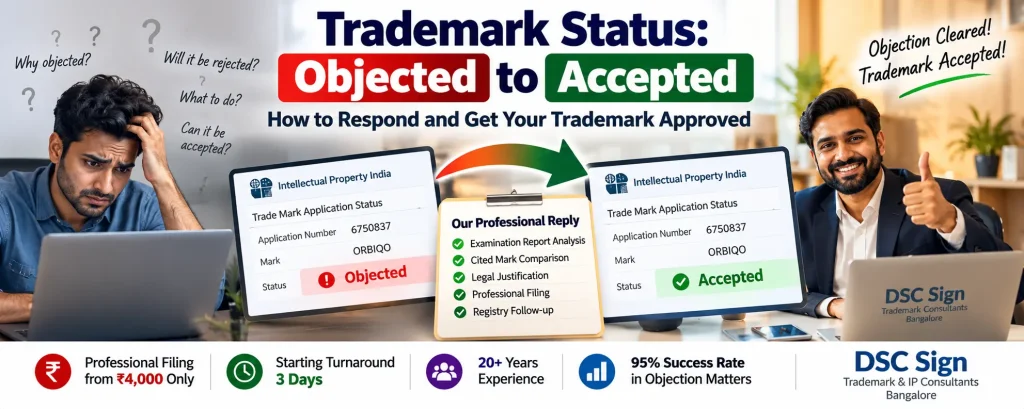
If your trademark status shows “Objected” and you want to move it towards
“Accepted”, the first thing to understand is that an objection does not
necessarily mean that your trademark has been finally rejected. It means that the Trademark
Registry has raised an objection during examination and the applicant has an opportunity to
respond properly.
The outcome largely depends on what objection has been raised, how the cited marks and
relevant goods or services are analysed, and how effectively the Examination Report is answered.
A professionally prepared response can help move the trademark status objected to accepted.
Seeing “Trademark Status: Objected” after applying for your brand can be worrying.
An examination objection gives the applicant an
opportunity to understand the Registrar’s concerns and submit a proper response to move the application
towards acceptance.
At DSC Sign, Bangalore, we have more than 20 years of experience
handling trademark registration, examination reports, trademark objections and related intellectual
property matters. Our work includes responding to substantive objections, including objections raised
under Section 11 of the Trade Marks Act, 1999. Our stated track record reflects a
95% success rate in the trademark objection matters handled by us — giving applicants
a practical reason to properly defend their trademark rather than give up when the status shows
“Objected”.
“Objected” Does Not Mean “Rejected”
The important question is not simply “Why was my trademark objected?”
The real question is:
“What exactly has the Examiner objected to, and how should that objection be properly answered?”
Under Rule 33 of the Trade Marks Rules, 2017, the Registrar examines a trademark
application and may communicate objections through an Examination Report. The applicant is given
an opportunity to respond. Where the response satisfactorily addresses the objection, the
application may proceed towards acceptance.
How to Move Trademark Status Objected to Accepted
Changing a trademark status from “Objected” towards
“Accepted” is not achieved by submitting a routine reply. The Examination Report
must first be carefully reviewed and the objections raised by the Examiner must be answered with
appropriate facts, legal reasoning and supporting justification.
This becomes particularly important when the Examination Report raises a
Section 11 Trademark Objection. The Examiner may have identified an earlier mark
and formed the view that the marks and their associated goods or services are sufficiently similar
to create a likelihood of confusion. A professionally prepared response should therefore deal with
the Examiner’s reasoning point by point, rather than relying on a generic template.
01
Examination Report Review
02
Cited Mark Comparison
03
Legal Reply & Justification
04
Professional Filing & Follow-up
05
Acceptance / Hearing Strategy
How a Section 11 Objection Was Taken Towards Acceptance: The ORBIQO Case
This is not merely a theoretical process. We recently handled a real matter for
Akash Agrawal trading as WiseKraft, Bengaluru, involving the trademark
“ORBIQO”, Application No. 6750837, filed in Classes
25 and 35.
The application received a substantive examination objection dated
22 May 2026 under Section 11(1), with the Examiner raising
similarity with earlier marks and the alleged likelihood of confusion. The objection was treated
as a matter requiring a proper legal response rather than as a final rejection.
A detailed comparison was undertaken, a point-wise legal justification was prepared and the final
response was filed before the Trademark Registry by
Sathish C, Trademark Attorney (Attorney Code: 25620). Video Conferencing was
indicated as the preferred mode in case a hearing became necessary. The Registry subsequently
accepted the application without requiring the anticipated hearing.
ORBIQO — What Happened?
Trademark Application: 6750837
Mark: ORBIQO
Classes: 25 & 35
Objection: Section 11(1)
Examination Report: 22-05-2026
Our Response: Point-wise legal justification and comparison
Result: Trademark Application Accepted
The lesson is simple:
an objection should be analysed, answered and professionally defended — not simply feared.
Trademark Status Showing “Objected”? Get It Reviewed.
If your Trademark Registry status has changed to “Objected”, send us your
Examination Report and application details. We can review the objection, identify the legal
issue, examine the cited marks and advise you on the appropriate response strategy.
Professional Trademark Objection Reply – Starts from ₹4,000
Starting turnaround: 3 days
DSC Sign – Trademark Consultants, Bangalore
20+ Years of Trademark & Intellectual Property Experience
Trademark Attorney: Sathish C | Attorney Code: 25620
Sahakar Nagar, Bangalore – 560092
WhatsApp / Phone: 7019827351
Email: one@dscsign.com
Get Your Trademark Examination Report Reviewed
What Does “Trademark Status: Objected” Actually Mean?
If your trademark application is showing “Objected”, do not immediately assume that
the Trademark Registry has rejected your brand. In most cases, this status means that the Registrar has
examined your application and has identified one or more issues that need to be answered before the
application can proceed.
This is where the quality of your Trademark Examination Report Reply becomes important.
The Registry has raised a legal or procedural concern. Your job is to address that concern with a
clear factual and legal response. A well-prepared reply can persuade the Registrar to accept the
application without requiring the matter to go through a contested hearing.
Objected Does Not Automatically Mean Rejected
Think of an examination objection as a question from the Trademark Registry that requires
a legally supported answer, rather than as the final refusal of your trademark.
Under Rule 33 of the Trade Marks Rules, 2017, the Registrar examines the application,
including a search of earlier trademarks, and may communicate objections through an examination report.
If the applicant responds within the prescribed period, the response is considered before the Registrar
decides the next course of action.
Why Does the Trademark Registry Raise an Objection?
During examination, the Registrar may identify an issue under the Trade Marks Act, 1999
or the applicable Rules. The objection may relate to the inherent nature of the proposed mark, its
distinctiveness, similarity to an earlier trademark, or another issue identified during examination.
Two of the most important grounds encountered by applicants are
Section 9 and Section 11 of the Trade Marks Act, 1999.
The legal strategy for responding to these two objections can be very different.
SECTION 9
Is the Mark Registrable?
The objection generally concerns the inherent registrability or distinctiveness of the mark,
including whether it is descriptive, generic or otherwise caught by the absolute grounds
specified in the Act.
SECTION 11
Could the Mark Cause Confusion?
The objection generally concerns an earlier trademark and whether similarity between the marks
and the relevant goods or services creates a likelihood of confusion or association.
What Happens After an Examination Report Is Issued?
Once an examination report containing objections is communicated, the applicant should not simply
upload a standard reply and wait. The report should first be studied carefully to understand
exactly what the Examiner has objected to.
For a Section 11 objection, for example, a professional review should examine the cited trademark,
the applicant’s mark, the respective classes, the specification of goods or services and the overall
commercial impression. The response should then address the Examiner’s reasoning rather than merely
asserting that the two marks are “different”.
What We Do When a Client Sends Us an Examination Report
-
Read the complete examination report and identify every objection raised.
-
Identify the cited trademarks and understand why they have been referred to.
-
Compare the marks and goods/services from the relevant legal perspective.
-
Determine the appropriate legal defence based on the actual facts of the application.
-
Prepare a point-by-point examination report reply, supported by appropriate legal
reasoning and authorities wherever required.
-
Share the proposed response with the client for confirmation before final filing.
-
File the final response and monitor the application for further Registry action.
The Biggest Mistake: Treating Every Objection as a Template Exercise
One of the biggest problems we see in trademark matters is treating an examination report as a
routine compliance document. A Section 11 objection is not necessarily defeated by simply writing
that the applicant’s trademark is “unique”.
The response needs to answer the specific objection raised against the specific trademark.
Where an earlier mark has been cited, the comparison should be meaningful and legally relevant.
Depending on the facts, this may involve the visual, phonetic and conceptual aspects of the marks,
the nature of the goods or services, the relevant consumers and the likelihood of confusion.
REAL BANGALORE CASE
ORBIQO: A Section 11 Objection That Was Successfully Defended
Our recent ORBIQO matter demonstrates why the examination report should be treated
as a legal issue requiring analysis, not as a simple formality.
Application No. 6750837, filed for Classes 25 and 35 by
Akash Agrawal trading as WiseKraft, received a substantive examination objection
dated 22 May 2026. The objection was specifically raised under
Section 11(1) on the ground of similarity with earlier marks and alleged likelihood
of confusion.
After the client approached us, we immediately reviewed the examination report, carried out the
necessary comparison, prepared the legal justification and finalised the response with the client.
The response was filed before the Trademark Registry with Video Conferencing
indicated as the preferred mode if a hearing became necessary.
The result was exactly what an applicant wants from a well-handled examination objection:
the Trademark Registry accepted the application without requiring the proposed hearing.
The Registry communication records that the “above-said application has been accepted.”
This is a useful real-world example of why an “Objected” status should be addressed strategically
rather than treated as the end of the trademark application.
How Quickly Should You Act?
Immediately. Do not wait until the last few days to find a trademark professional,
study the cited marks and prepare the reply.
Rule 33(4) provides that if the applicant does not respond within one month from the date of
receipt of the examination report, the Registrar may treat the application as abandoned.
The prescribed period therefore matters even when the objection appears straightforward.
Important: Do Not Ignore the Examination Report
Objected → No response → Application at risk of abandonment.
The safest approach is to have the examination report reviewed as soon as it is received and decide
the response strategy well before the deadline.
For Bangalore applicants, this is especially relevant because Karnataka falls within the
territorial jurisdiction of the Chennai Trade Marks Registry. You do not need to personally
travel to Chennai merely because the Registry handling your matter is there. A properly managed matter
can be handled through the applicable electronic and virtual processes, including hearing arrangements
where provided.
Received a Trademark Examination Report?
Send the report to DSC Sign. Our Bangalore trademark team can examine the objection,
identify the real issue and advise whether a strong reply can be prepared to move the application
towards acceptance.
DSC Sign | Trademark Consultants, Bangalore
Trademark Attorney: Sathish C | Attorney Code: 25620
Sahakar Nagar, Bangalore – 560092
Phone: 7019827351
Email: one@dscsign.com
Section 9 vs Section 11 Trademark Objection: What Is the Difference?
Not every Trademark Examination Report raises the same legal problem.
Before preparing a reply, the first question we ask is:
“What exactly is the legal ground on which the Registrar has objected to this trademark?”
Two of the most common grounds are Section 9 and Section 11
of the Trade Marks Act, 1999. They may both appear as an “objection” on the Trademark Registry
portal, but they address very different issues. A strong response therefore begins by identifying
the correct ground and building the defence around it.
| Point of Comparison |
Section 9 Objection |
Section 11 Objection |
| Nature of objection |
Absolute grounds for refusal |
Relative grounds for refusal |
| Main question |
Is the proposed mark inherently capable of functioning as a trademark?
|
Is the proposed mark sufficiently similar to an earlier mark to create a likelihood of confusion?
|
| Earlier trademark involved? |
Not necessarily.
|
Usually involves an earlier trademark or earlier application identified by the Registry.
|
| Typical concern |
Lack of distinctiveness, descriptive character, customary or generic expressions and other
absolute grounds covered by Section 9.
|
Similarity between the applicant’s mark and an earlier mark, together with similarity of
goods/services and likelihood of confusion or association.
|
| Typical defence |
Establish distinctiveness, explain the nature of the mark and rely on relevant statutory
exceptions or evidence where applicable.
|
Compare the marks, goods/services, consumers, trade channels and overall commercial impression,
and address why the alleged likelihood of confusion does not arise on the facts.
|
| Evidence may matter? |
Yes. Evidence of use and acquired distinctiveness can become important where legally relevant.
|
Yes. Prior use, market circumstances and other evidence may become relevant depending on the
facts of the matter.
|
Section 9: The Registry Is Questioning the Nature of the Mark
Section 9 deals with absolute grounds for refusal. Among other things, Section 9(1)
addresses marks that are devoid of distinctive character, marks that exclusively describe certain
characteristics of goods or services, and marks that have become customary in the current language
or established trade practices.
In simple terms, the question can be:
“Can this particular sign actually distinguish your goods or services from those of other businesses?”
A Section 9 response therefore needs to deal with the particular reason for the objection. Depending
on the facts, the legal strategy may involve explaining the distinctive character of the mark,
challenging the Examiner’s interpretation, relying on the statutory exception where applicable,
or producing appropriate evidence of use and acquired distinctiveness.
Simple Example
Suppose a business applies for a trademark that directly describes the nature or quality of the
goods it sells. The Examiner may question whether other traders should be free to use that
descriptive expression.
The response must therefore address distinctiveness and the precise statutory objection,
rather than simply saying that the applicant has already invested money in the brand.
Section 11: The Registry Is Comparing Your Mark With Earlier Marks
Section 11 is different. Here, the issue generally arises because the Registry has
identified an earlier trademark and considers that the applicant’s mark may be identical or similar
in relation to identical or similar goods or services, creating a likelihood of confusion
or association on the part of the public.
This means that a Section 11 response should not stop at:
“Our spelling is different.”
The comparison needs to consider the marks as a whole and the relevant commercial circumstances.
Depending on the facts, this can include visual similarity, phonetic similarity, conceptual
impression, nature of goods or services, relevant consumers, trade channels and the likelihood of
confusion.
For Section 11, We Ask the Right Questions
- How does the applicant’s mark look compared with the cited mark?
- How are the two marks pronounced?
- Do the marks convey the same or a similar commercial idea?
- Are the goods or services actually identical or similar?
- Who are the relevant consumers?
- Are the trade channels or commercial circumstances similar?
- Would an ordinary consumer realistically believe that the two businesses are connected?
- What other facts support or weaken the alleged likelihood of confusion?
Why a Section 11 Objection Needs a Proper Comparison
The existence of an earlier trademark does not mean that every later trademark containing a remotely
similar word must automatically be refused. The statutory question is more specific: whether the
relevant similarity and circumstances create the prohibited likelihood of confusion or association.
At the same time, applicants should not assume that a minor spelling change automatically defeats a
Section 11 objection. Courts have repeatedly emphasised that trademark similarity has to be assessed
from the perspective of the relevant consumer and on the overall impression created by the marks.
That is why our approach at DSC Sign is to examine the actual cited marks and the
relevant goods or services before deciding how the reply should be framed. We do not recommend using
the same paragraph for every examination report.
OUR REAL SECTION 11 CASE
ORBIQO — Application No. 6750837
This distinction was directly relevant in our recent ORBIQO matter for
Akash Agrawal trading as WiseKraft, Bengaluru.
The examination report dated 22 May 2026 raised a substantive objection under
Section 11(1), stating that the applied-for mark was considered identical or
similar to earlier marks in respect of identical or similar goods or services and that such
similarity created an alleged likelihood of confusion.
We therefore treated it as a mark-comparison and likelihood-of-confusion issue.
The response was prepared after examining the objection, carrying out the necessary comparison
and developing the legal justification. The final response was filed by
Sathish C, Trademark Attorney, Attorney Code 25620.
The Registry subsequently communicated that the application had been
accepted.
Section 9 or Section 11 — The Reply Must Match the Objection
This is one of the most important points for a business owner:
do not start drafting the reply before understanding the objection.
A technically polished response can still be ineffective if it does not answer the Examiner’s
actual concern. Our first task is therefore to identify the statutory ground, understand the
Examiner’s reasoning and then build the response around the facts of that particular application.
Quick Guide for Trademark Applicants
If the objection is Section 9:
Focus on registrability, distinctiveness and the precise absolute ground raised.
If the objection is Section 11:
Focus on the cited mark, similarity, goods/services and the alleged likelihood of confusion.
If both are raised:
Address each objection separately. Do not combine different legal grounds into one generic reply.
Received a Section 9 or Section 11 Objection?
Before filing a reply, have the examination report properly analysed. At
DSC Sign, Bangalore, our trademark team handles examination reports and objection
matters with a focus on the specific legal ground raised by the Trademark Registry.
20+ Years of Trademark Service Experience | 95% Stated Success Track Record
Sathish C – Trademark Attorney | Attorney Code: 25620
Sahakar Nagar, Bangalore – 560092
Phone: 7019827351
Email: one@dscsign.com
How to Reply to a Trademark Examination Report: Our Step-by-Step Process
Receiving a Trademark Examination Report is the point where the next step matters.
A weak or generic reply may fail to address the Examiner’s actual concern. A properly prepared reply,
on the other hand, gives the Registrar a clear legal and factual basis to reconsider the objection and
proceed with the application.
At DSC Sign, Bangalore, we do not treat an examination report reply as a routine
form-filling exercise. Our approach is to first understand why the trademark has been objected,
identify the evidence and legal arguments available to the applicant, and then prepare a response
specifically for that trademark application.
Our Objective Is Simple
Take the Registry’s objection → understand the legal issue → prepare the right response
→ file it correctly → pursue the application towards acceptance.
Our stated track record is approximately 95% success in the trademark objection matters
handled by our team. This is a record of past matters, not a guarantee of acceptance in
every application. The outcome of an individual trademark depends on its facts, the cited marks,
the evidence available and the Registrar’s assessment.
01
We First Read the Entire Examination Report
The first mistake applicants make is reading only the word “Objected” on the
trademark portal. The real information is inside the examination report.
We review the complete report and identify the application number, classes, trademark description,
formal objections, substantive objections, cited trademarks and the specific statutory provisions
relied upon by the Examiner.
This establishes the starting point for the legal response.
02
We Identify the Exact Reason for the Objection
The next question is:
“What exactly is the Examiner asking the applicant to answer?”
If the report raises Section 9, we examine the particular absolute ground relied
upon by the Registry. If the report raises Section 11, we examine the earlier
trademark or trademarks cited against the application and analyse the alleged conflict.
Where multiple objections are raised, each objection is dealt with separately. This prevents a
generic response from overlooking an important issue.
03
We Compare the Applicant’s Mark With the Cited Mark
This becomes particularly important in a Trademark Objection under Section 11.
The response should not merely say that two trademarks are “different”.
We examine the relevant aspects of the marks and the commercial circumstances, including:
- Visual comparison – how the marks appear when seen by consumers.
- Phonetic comparison – how the marks are spoken and heard.
- Conceptual impression – whether the marks convey a similar idea or meaning.
- Goods and services – whether the relevant commercial offerings are identical or similar.
- Consumer profile – who is likely to purchase or encounter the goods/services.
- Trade channels – whether the commercial routes and circumstances overlap.
- Overall impression – whether the circumstances support the alleged likelihood of confusion.
The purpose is to convert a general allegation of similarity into a structured legal
comparison.
04
We Build the Legal Grounds for the Reply
Once the factual comparison is complete, we determine which legal arguments can properly support
the applicant’s position.
Depending on the objection, the response may address the distinctiveness of the mark, the
interpretation of the cited provision, differences between the marks, differences in goods or
services, the relevant consumer, likelihood of confusion and other facts or evidence relevant
to the particular application.
Where appropriate, the reply can also refer to relevant judicial precedents.
Case law is not included merely to make the response look technical. It is used where the
principle actually assists the applicant’s position.
05
We Prepare a Point-by-Point Trademark Examination Report Reply
A professional response should make it easy for the Registrar to understand
what the objection is and why the applicant says it should not prevent acceptance.
Our response is structured around the actual examination report rather than copied from a standard
template. The relevant objection is identified and answered with the supporting facts, legal
reasoning and documents applicable to that particular trademark.
A Strong Reply Generally Covers
- Application and applicant particulars.
- The specific objection raised by the Examiner.
- The applicant’s point-wise response.
- Comparison and factual explanation wherever required.
- Relevant statutory provisions and legal principles.
- Supporting documents or evidence where appropriate.
- A clear request to consider the reply and proceed with the application.
06
The Client Reviews the Draft Before Filing
We believe the trademark owner should understand the response being submitted in the owner’s name.
Therefore, after preparing the draft, we share the proposed response with the client for review
and finalisation.
This is particularly important where the response depends on facts such as the nature of the
business, actual use of the mark, date of adoption, business activities or supporting documents.
The legal response must match the actual facts.
07
We File the Final Response With the Trademark Registry
Once the response is approved by the client, the final filing is completed through the applicable
Trademark Registry procedure.
The filing should not be left until the last moment. Under Rule 33(4) of the Trade Marks
Rules, 2017, where the applicant does not respond within one month from the date of receipt
of the examination report, the Registrar may treat the application as abandoned.
Therefore, our practical advice is straightforward:
send the examination report for review as soon as you receive it.
08
We Prepare for the Next Stage — If a Hearing Is Required
Filing the reply is not the end of professional handling. The application needs to be monitored
for the Registry’s next action.
If the Registrar requires a hearing or the matter proceeds to a hearing stage, the applicant
should be prepared to explain the legal and factual grounds already raised in the response.
Depending on the applicable Registry procedure, Video Conferencing can be used
where available.
Our objective is therefore not simply to file a document. It is to keep the matter prepared for
the next possible stage until the application reaches a clear outcome.
REAL CASE HANDLED BY OUR TEAM
How We Applied This Process to the ORBIQO Trademark
The practical value of this process can be seen in the ORBIQO application filed by
Akash Agrawal trading as WiseKraft, Bengaluru.
Application No. 6750837 was filed in Classes 25 and 35.
The Trademark Registry issued a substantive examination report dated
22 May 2026, raising an objection under Section 11(1).
After the client approached us, we did not respond with a generic statement that ORBIQO was a
different trademark. We immediately reviewed the objection, carried out the necessary comparison,
prepared the legal justification and discussed the proposed response with the client before filing.
The response was filed by Sathish C, Trademark Attorney, Attorney Code 25620.
The response also indicated Video Conferencing as the preferred mode of attendance
if a hearing became necessary.
RESULT
The anticipated hearing was not required. The Trademark Registry subsequently communicated:
“The above-said application has been accepted.”
The application therefore moved from the examination objection stage to acceptance.
The ORBIQO matter is a useful illustration of our approach: understand the objection first,
build the defence around the actual issue, file a reasoned response and remain prepared for the
next Registry stage.
Why Our Approach Is Different From a Standard Template Reply
Generic Approach
- Uses the same reply format for different marks.
- Provides limited analysis of cited trademarks.
- Focuses mainly on completing the filing.
- May not adequately prepare for a hearing.
DSC Sign Approach
- Reviews the actual examination report.
- Analyses the cited marks and relevant goods/services.
- Builds a matter-specific legal response.
- Keeps the next Registry stage in view.
Received a Trademark Examination Report? Let Us Analyse It.
If your application currently shows “Trademark Status: Objected”, do not guess
what the Examiner wants. Send us the examination report and let our trademark team assess the
objection and explain the practical response strategy.
DSC Sign – Bangalore Trademark Consultants
20+ Years of Trademark Service Experience
95% Stated Success Track Record in Trademark Objection Matters
Sathish C | Trademark Attorney | Attorney Code: 25620
Sahakar Nagar, Bangalore – 560092
Phone: 7019827351
Email: one@dscsign.com
Get Your Examination Report Reviewed
ORBIQO Trademark — Case at a Glance
| Applicant |
Akash Agrawal trading as WiseKraft |
| Business Location |
WeWork, Salarpuria Sattva Magnificia, Old Madras Road,
Bengaluru, Karnataka
|
| Trademark |
ORBIQO |
| Application Number |
6750837 |
| Classes |
25 & 35 |
| Application Date |
11-12-2024 |
| Use Status |
Proposed to be Used |
| Examination Report |
22-05-2026 |
| Substantive Objection |
Section 11(1), Trade Marks Act, 1999 |
| Final Outcome |
Application Accepted |
01
The Problem: ORBIQO Received a Section 11(1) Objection
The application for ORBIQO was examined by the Trade Marks Registry.
The examination report was dated 22 May 2026.
The formal examination had been completed without objection. However, the
substantive examination raised an objection under
Section 11(1) of the Trade Marks Act, 1999.
The Examiner’s concern was that the applied-for mark was considered identical or similar to
earlier marks in relation to identical or similar goods or services and that, because of that
similarity, there could be a likelihood of confusion among the public.
In practical terms: the Registry was asking the applicant to explain why
ORBIQO should be allowed to proceed despite the earlier marks identified during examination.
DOCUMENT 01
Trademark Office Examination Report
The actual examination report records the application particulars and the Section 11(1)
substantive objection. The report identifies Application No. 6750837,
Classes 25 and 35 and the applicant as Akash Agrawal trading as WiseKraft.
View the Actual Examination Report
02
The Client Approached Us Instead of Ignoring the Objection
After receiving the examination report, the applicant approached our team for assistance.
At this stage, the most important thing was not to panic about the word
“Objected”, but to understand the exact legal issue raised by the Examiner.
We immediately started reviewing the examination report and the earlier marks referred to
in the objection. The matter was treated as a Section 11 comparison and legal
justification exercise, rather than as a routine formality.
What Did DSC Sign Actually Do?
Our intervention followed a clear sequence:
01
Immediate Review
We examined the examination report and identified the precise Section 11(1) objection.
02
Detailed Comparison
We conducted the necessary comparison of the applicant’s mark and the earlier marks
referred to by the Registry.
03
Legal Justification
We prepared a point-wise legal justification addressing the objection and the relevant
circumstances of the application.
04
Client Finalisation
The proposed response was shared with the client, reviewed and finalised before filing.
05
Registry Filing
The final response was filed before the Trademark Registry.
06
Hearing Preparedness
Video Conferencing was indicated as the preferred mode if the Registry required a hearing.
The Response Was Filed by a Registered Trademark Attorney
The response was filed by Sathish C, Trademark Attorney, Attorney Code 25620.
This is important because a trademark objection response should be more than a generic business
letter. It should present the applicant’s position in a manner appropriate to the legal objection
raised by the Registry.
Our objective was straightforward:
give the Registrar a clear and properly reasoned basis to consider the objection and
proceed with the application.
DOCUMENT 02
Our Trademark Objection Response
The response prepared for Application No. 6750837 sets out the applicant’s
justification in response to the examination objection. The filing also addressed the possibility
of a hearing and indicated Video Conferencing as the preferred mode if required.
View Our Actual Response
03
The Result: The Trademark Application Was Accepted
After the response was filed, the Registry considered the applicant’s position.
The expected hearing did not become necessary.
The Trademark Registry subsequently sent an acceptance communication stating:
“The above-said application has been accepted.”
This is the outcome every applicant hopes to achieve after receiving an examination objection:
the application moves beyond the objection stage and is accepted by the Registry.
DOCUMENT 03
Trademark Office Acceptance Communication
We are showing the actual Registry communication because we believe clients should be able to
see the evidence behind a successful case study rather than simply read a marketing claim.
View the Acceptance Communication
What Does the ORBIQO Case Teach a Trademark Applicant?
1. Do Not Treat “Objected” as “Rejected”
The ORBIQO application received a substantive objection. The application was not abandoned.
A response was prepared and the matter proceeded to acceptance.
2. A Section 11 Objection Requires Analysis
Where the Registry relies on earlier marks, the response needs to address the alleged similarity
and likelihood of confusion. A generic statement that the marks are different is rarely the
level of analysis a serious objection requires.
3. Speed Matters
Once an examination report is received, the applicant should act promptly. Time spent finding
the report, understanding the objection and preparing the response reduces the available
margin before the statutory response period expires.
4. Be Prepared for a Hearing — Even If It Never Happens
A professional response should anticipate the possibility that the Registrar may require
further clarification or a hearing. In ORBIQO, Video Conferencing was identified as the
preferred hearing mode, but the application was ultimately accepted without that hearing
becoming necessary.
5. Acceptance Is Not the Same as Registration
One important legal distinction should be understood. The Registry’s communication established
that the application was accepted. Acceptance should not be described as the
final trademark registration itself. The application must continue through the applicable
statutory process before registration is completed.
We Prefer to Show the Work, Not Just Talk About It
A trademark objection service should be judged by the quality of the legal work performed on the
actual examination report. That is why this ORBIQO matter is presented with the relevant
examination report, response and acceptance communication.
At DSC Sign, our experience of more than 20 years in trademark-related
services, combined with our stated 95% success track record in the objection
matters handled, reflects our focus on solving the applicant’s actual Registry problem.
No trademark professional can honestly guarantee acceptance in every case.
What we can do is examine the objection properly, identify the strongest available grounds,
prepare a professional response and manage the matter with the objective of achieving the best
possible outcome.
Your Trademark Is Objected. What Should You Do Now?
Do not wait for the application to become difficult to recover. Send us the
Trademark Examination Report. Our team will review the objection and explain
what needs to be addressed in your particular case.
DSC Sign – Trademark Consultants in Bangalore
20+ Years of Trademark Service Experience
Sathish C | Trademark Attorney | Attorney Code: 25620
Sahakar Nagar, Bangalore – 560092
Phone: 7019827351
Email: one@dscsign.com
Send Your Examination Report for Review
Karnataka and the Chennai Trade Marks Registry
Karnataka falls within the territorial jurisdiction of the Chennai Trade Marks Registry.
Therefore, a Bangalore applicant may receive examination communications from the Chennai Registry
even though the business, founders and trademark professionals handling the matter are located in
Bengaluru.
This is why local Bangalore representation combined with familiarity with the applicable Registry
process can be particularly convenient for business owners who do not want to manage a Chennai
Registry matter on their own.
What Does a Bangalore-Based Trademark Professional Actually Give You?
The advantage is not simply geographical proximity. The real benefit is having a professional team
available to understand your business, examine your trademark objection, communicate with you
directly and manage the Registry process without making you figure out every procedural step yourself.
01
Easy Access for Bangalore Business Owners
Your trademark belongs to your business. The person preparing the response should understand
what your business actually does, the goods or services covered by the application and the
commercial context in which the brand is being used.
Being based in Sahakar Nagar, Bangalore allows our team to work directly with
local founders, MSMEs, startups and established businesses when the matter requires detailed
discussion or supporting information.
02
We Deal With the Actual Examination Report — Not Just the Status
A portal showing “Objected” does not tell the whole story. The examination report
contains the legal reason for the objection.
Our first task is therefore to obtain and examine the actual report. We identify the statutory
provision relied upon by the Examiner, review the cited marks where applicable and determine what
the response needs to establish.
03
20+ Years of Trademark-Related Service Experience
DSC Sign has been providing trademark-related services for more than 20 years.
Over this period, our work has involved trademark applications, objections, examination reports
and related intellectual property requirements for businesses.
That experience helps us approach an examination report as a legal and commercial problem rather
than merely as an online filing task.
04
Trademark Attorney Handling
Our trademark objection work includes handling through
Sathish C, Trademark Attorney, Attorney Code 25620.
Where a matter requires a reasoned legal response, the objective is to present the applicant’s
position clearly and professionally before the Trademark Registry.
05
Hearing Preparation Is Part of the Strategy
A professional should not prepare an examination report reply assuming that the matter will
necessarily end there. The Registry may require further clarification or a hearing depending
on the matter.
We therefore prepare the response with the next possible stage in mind. Where the applicable
procedure permits a virtual hearing, Video Conferencing can be used rather
than making the applicant unnecessarily travel.
06
End-to-End Handling Instead of a One-Time Reply
A trademark objection should not be treated as a transaction that ends immediately after a
response is uploaded.
Our process is designed to cover:
- Examination report review
- Objection analysis
- Cited trademark comparison
- Legal response drafting
- Client review and finalisation
- Registry filing
- Application monitoring
- Hearing preparation where required
- Follow-up towards the next stage of the application
95%
Stated Success Track Record
Our Track Record Gives Applicants a Reason to Act With Confidence
DSC Sign has a stated 95% success rate in the trademark objection matters handled by
our team. We mention this because business owners want to know whether the professional
they approach has actually dealt with examination objections before.
But a responsible trademark professional should also be clear about what this number does
not mean. It is not a promise that every future trademark will be accepted.
Trademark outcomes depend on the particular mark, cited marks, goods or services, evidence,
legal grounds and the Registrar’s decision.
What we can control is the quality of the work:
proper analysis, precise drafting, timely filing and preparedness for the next stage.
WHY LOCAL EXPERIENCE MATTERED
The applicant did not need to personally manage the Registry process. Our team reviewed the
examination report, conducted the trademark comparison, prepared the legal justification,
finalised the response with the client and filed it.
The response also anticipated a possible hearing through
Video Conferencing. Ultimately, the anticipated hearing was not required and
the Registry communicated acceptance of the application.
Section 11(1) Objection
↓
Legal Analysis & Comparison
↓
Point-by-Point Response
↓
Registry Filing
↓
Application Accepted
What Should You Expect From a Trademark Objection Consultant?
Before appointing anyone to handle your examination report, ask these simple questions:
Will you read my actual examination report?
Yes. The response must be based on the objection actually raised.
Will you check the earlier marks cited by the Examiner?
Where the objection is based on earlier marks, the relevant comparison should form part of
the analysis.
Will I see the response before it is filed?
Our process includes sharing the proposed response with the client for review and finalisation.
What happens if the Registry calls for a hearing?
The matter should already be prepared for the next stage, including virtual hearing arrangements
where applicable.
Will you monitor the application after filing?
The application should continue to be monitored for further Registry communication and action.
Looking for the Best Trademark Consultants in Bangalore for Handling an Examination Report?
If your trademark application is showing “Objected”, the most important decision
is choosing someone who will first understand the objection before preparing the reply.
DSC Sign has been providing trademark-related services in Bangalore for
20+ years. Our team handles examination report replies, Section 9 and Section 11
objections, hearing preparation and related Trademark Registry procedures.
Sathish C | Trademark Attorney | Attorney Code: 25620
DSC Sign, Sahakar Nagar, Bangalore – 560092
Phone: 7019827351
Email: one@dscsign.com
Speak to Our Trademark Team
Frequently Asked Questions About Trademark Objection & Examination Report
Find clear answers to the most common questions about a trademark application showing
“Objected” status and how a professional reply can help move the application
towards acceptance.
1. Can a trademark status be changed from “Objected” to “Accepted”?
Yes, an application showing “Objected” can move towards acceptance when
the objections raised in the Examination Report are properly addressed. The applicant
should study the exact objection, prepare a legally supported response and file it within
the prescribed time. Acceptance depends on the facts of the application and the Registrar’s
consideration; it cannot be guaranteed in advance.
2. Is a trademark objection the same as rejection?
No. An “Objected” status generally means that the Trademark Registry has
raised objections during examination. It is not the same as the final rejection of the
application. A properly prepared reply can address the objections and may help the
application proceed further.
3. What is a trademark Examination Report?
The Examination Report is issued by the Trademark Registry after examination of the
application. It may contain formal or substantive objections, including objections under
Section 9 or Section 11 of the Trade Marks Act, 1999. The exact contents
of the report should be reviewed before preparing the reply.
4. What is a Section 11 trademark objection?
A Section 11 objection generally concerns an earlier trademark or trademarks which the
Registry considers identical or similar in relation to identical or similar goods or
services, with a potential likelihood of confusion or association. The response should
therefore deal with the cited marks and the relevant legal and factual differences.
5. How much time do I have to reply to a Trademark Examination Report?
The applicant should act promptly. Under the applicable examination procedure, the
applicant is generally required to submit the response within one month from
receipt of the Examination Report. If no response is filed within the applicable
period, the Registrar may treat the application as abandoned. Do not wait until the last
day to start preparing the reply.
6. Can the trademark objection be cleared without attending a hearing?
In some matters, yes. Where the written reply adequately addresses the Registry’s
concerns, the application may proceed without a hearing. However, a hearing may still be
scheduled depending on the Registrar’s consideration of the matter. Therefore, the reply
should be prepared as a complete legal submission rather than assuming that a hearing
will automatically be granted or avoided.
7. How much does professional trademark objection reply filing cost?
At DSC Sign, professional trademark Examination Report reply filing starts from
₹4,000. The final professional fee may depend on the nature and complexity of the
objection and the work required. Any applicable government fee, if relevant to the
particular filing or subsequent proceeding, should be confirmed separately before filing.
8. How quickly can DSC Sign prepare and file the trademark objection reply?
Our professional filing service starts with a 3-day turnaround for suitable
cases, subject to receiving the complete Examination Report, application details and
necessary information from the applicant. Complex matters may require additional review
before filing.
9. Can I prepare and file the trademark objection reply myself?
An applicant may handle certain trademark filings personally. However, an Examination
Report should not be treated as a simple form-filling exercise. The response may require
analysis of the cited trademarks, goods/services, facts of use, statutory provisions and
supporting legal arguments. Professional review can help ensure that the response addresses
the actual objection rather than merely repeating the application details.
10. What documents should I send for a trademark objection reply?
Usually, start by sending the Examination Report and your trademark
application number. Depending on the objection, we may also require details regarding
business activity, use of the mark, invoices, website or social-media presence,
advertisements, packaging, prior registrations, user claims and other supporting
documents.
11. Can I send my Examination Report to DSC Sign on WhatsApp or email?
Yes. You can initially share the Examination Report and application details
with us for review. You may contact our trademark team on
WhatsApp: 7019827351 or email the documents to
one@dscsign.com. We can then review the matter and explain the next
appropriate step.
12. Can I meet the trademark consultant face-to-face in Bangalore?
Yes. Applicants who prefer a face-to-face discussion can visit our
Sahakar Nagar, Bangalore – 560092 office with a prior appointment.
For appointment coordination, please contact our manager on
6362877942. Prior appointment is recommended so that the concerned
professional is available to discuss your matter.
13. Does DSC Sign handle trademark objections for applicants outside Bangalore?
Yes. The initial consultation and document exchange can be handled electronically through
email and WhatsApp. Our Bangalore office location does not prevent us from handling
trademark examination matters for applicants in other cities, subject to the requirements
of the particular matter.
14. Does an “Accepted” trademark status mean that my trademark is already registered?
No. Accepted and Registered are different stages. Acceptance means the
application has cleared the relevant examination stage. The application may still proceed
through advertisement and the applicable opposition period before registration is granted.
15. What happens if I ignore the trademark objection?
Ignoring an Examination Report can put the application at risk. If the required response
is not submitted within the applicable period, the Registrar may treat the application as
abandoned. The safer approach is to obtain the report, understand the objection and take
timely action.
16. What if my trademark has a Section 9 and Section 11 objection together?
The response should address each objection separately. Section 9 concerns
absolute grounds, while Section 11 generally concerns relative grounds involving earlier
trademarks and possible confusion or association. A point-by-point response is usually
preferable to a generic reply.
17. Who handles trademark objection matters at DSC Sign?
Trademark matters are handled under the professional guidance of
Sathish C, Trademark Attorney, Attorney Code 25620. Our team has been
assisting businesses with trademark-related matters for more than 20 years.
18. What is DSC Sign’s success rate in trademark objection matters?
DSC Sign states a 95% historical success rate in trademark objection matters
handled by the firm. This is a track-record statement, not a guarantee that every
individual application will be accepted. Each matter depends on the Examination Report,
cited marks, facts, evidence and the decision of the Trademark Registry.
19. How can I get my trademark objection reviewed by DSC Sign?
The simplest way is to send us your Examination Report + Trademark Application
Number by WhatsApp on 7019827351 or email
one@dscsign.com. You can also contact our office for a face-to-face
appointment in Sahakar Nagar, Bangalore.
Trademark Status Showing “Objected”? Act Before the Deadline.
Send your Examination Report to DSC Sign for professional review and a
legally structured response.
Professional filing starts from ₹4,000 |
Starting turnaround: 3 days
WhatsApp: 7019827351 |
Email: one@dscsign.com
Face-to-face appointment:
Sahakar Nagar, Bangalore – 560092
Manager: 6362877942
Sathish C | Trademark Attorney | Attorney Code 25620
Don’t Give Up on Your Trademark Because of an Objection
Every trademark objection deserves a proper legal response.
A carefully analysed and professionally filed reply can give your application the
best possible opportunity to move towards acceptance.
A common or poorly prepared response may simply become a
“piece of paper” in the Registry record without effectively addressing
the real objection. For your brand, choose the right trademark professional,
respond on time, and build your case properly from the beginning.
The right objection response can make the difference.
Choose the right TM professional. File correctly. Expect a better result.
Sathish C
Trademark Attorney | Attorney Code 25620
DSC Sign | Sahakar Nagar, Bangalore – 560092
Last Updated: October 2026
ROC Filing Services in Bangalore
Doorstep CA services in Bangalore
Doorstep Legal Services