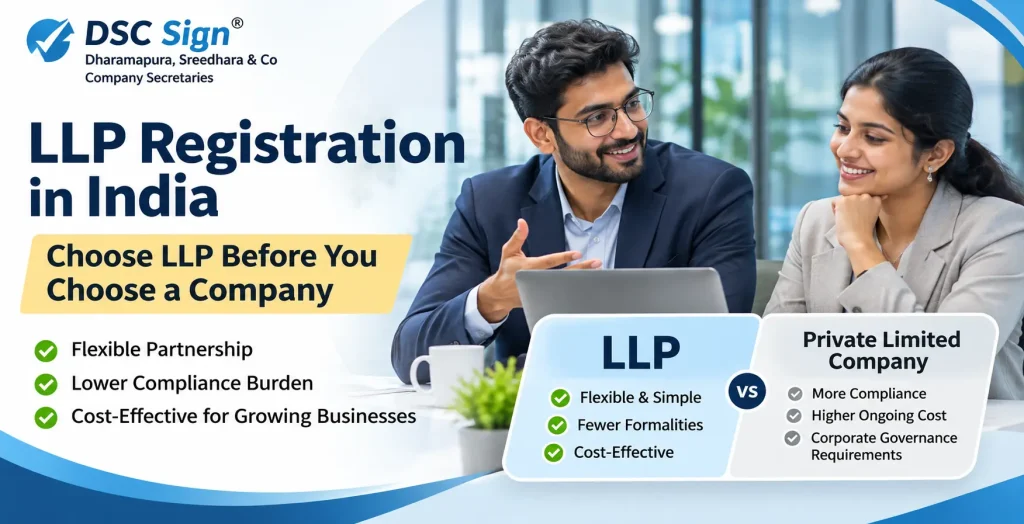
LLP Registration in India – Why Build Your Business with More Freedom and Less Compliance Burden?
Imagine investing your savings, leaving a comfortable job, finding a business partner and finally starting the business you have always wanted. You are ready to work hard, find customers and grow. Then comes the first decision: which legal structure should you register?
Someone recommends a Private Limited Company. It sounds professional. It sounds bigger. You assume it must be the best option. But nobody has shown you what you will spend every year to maintain it, whether you actually need investors, or whether an LLP could give you the protection and flexibility your business needs.
This is where we want you to stop and think. The money you spend on registration and compliance is your business money. Every unnecessary expense reduces what you can invest in employees, marketing, technology and expansion.
Choose a structure that works for your business, protects your interests, allows you to share profits sensibly and keeps recurring compliance costs under control.
That is why DSC Sign openly recommends considering LLP registration before making a decision. An LLP is not a compromise or a second-choice structure. It is a separate legal entity with limited liability and flexible partner arrangements. For many business owners, it can be a practical way to start, operate and expand.
Why Are You Not Told About LLP First?
There is a commercial reality behind business registration advice that deserves an honest explanation.
A Private Limited Company generally involves statutory audit every financial year, annual ROC filings and applicable Board and AGM formalities. An eligible LLP has fewer routine corporate formalities and may qualify for statutory audit exemption under the LLP Rules.
Company audits, annual filings and corporate compliance may generate continuing professional fees for a CA or consultancy practice. Where these assignments form a significant part of a firm’s revenue, there may be a commercial preference for company-related work.
We are not saying every CA, CS or business consultant recommends a company for financial reasons. A Private Limited Company is genuinely suitable for many businesses. But why should you make a decision without being properly informed about the LLP alternative?
You deserve to see both options, their costs and their long-term implications before paying for registration.
What Can an LLP Do for You?
Think beyond the incorporation certificate. An LLP gives business partners a framework to organise ownership, responsibilities, profit sharing and management through an LLP Agreement.
An LLP has a separate legal identity. Partners generally enjoy limited liability, subject to statutory exceptions, personal guarantees and their own wrongful acts.
Agree on profit-sharing ratios, responsibilities and management rights through a properly drafted LLP Agreement.
Admit new partners as the business grows, or allow existing partners to retire, following the LLP Agreement and prescribed filings.
The LLP Act requires at least two partners but does not prescribe a general upper limit on the number of partners.
LLPs generally have fewer routine corporate formalities. Eligible LLPs may also qualify for statutory audit exemption.
Organise different lawful business activities and partner responsibilities, subject to licences and sector-specific requirements.
Can You Keep More Money in Your Business?
This is one of the most important questions for a new entrepreneur. You need money to acquire customers, hire people, purchase equipment, develop products and expand. Spending more than necessary on recurring compliance does not automatically make your business stronger.
An LLP may help control routine compliance expenditure compared with a Private Limited Company, depending on the business and its applicable obligations. It also offers tax-planning opportunities through eligible working-partner remuneration and interest on capital, subject to the LLP Agreement and applicable Income-tax limits.
However, an LLP is not automatically tax-cheaper in every situation. The actual tax position depends on profits, remuneration, partner arrangements and the applicable tax regime. Proper planning matters more than attractive promises.
Is an LLP Suitable for Your Business?
You do not have to be a large company to register an LLP. It can be considered by people starting a new venture, existing business owners, professionals, service providers, family businesses and entrepreneurs bringing together different skills and investments.
Whether you are starting a consultancy, running a digital agency, providing IT services, trading, manufacturing or expanding an existing business, the suitability of an LLP should be assessed against your actual activity, ownership plans and applicable industry rules.
For businesses planning conventional equity investment, issuing shares or offering ESOPs, a Private Limited Company may be more suitable. The right answer depends on your plans—not on a standard package offered by a consultant.
An LLP still requires proper accounts, annual filings, income-tax returns and applicable GST and TDS compliance. Changes in partners must be documented and filed as prescribed. Limited liability is not immunity from fraud, personal guarantees or statutory violations.
Why Does DSC Sign Speak So Openly?
At DSC Sign – Dharamapura, Sreedhara & Co, we believe professional advice should protect the business owner’s interests, not simply generate recurring assignments.
We do not want you to register a Private Limited Company just because it may create more audit and compliance work. If your plans genuinely call for investors, shares or ESOPs, we will explain why a company may be the better option. If an LLP is suitable, we will tell you openly.
Our interest is in helping you create a properly structured business and supporting it as it grows. That may mean registration today, an LLP Agreement, accounting, GST, tax planning, annual filings or other professional services when you actually need them.
Our long-term relationship should come from useful advice, transparent fees and practical support—not from recommending unnecessary work.
Before you register, ask the right questions. Compare the yearly costs. Understand your rights and responsibilities. Choose the structure that gives your business room to grow.
LLP vs Private Limited: Where Does Your Money Go?
Both structures provide a separate legal identity and limited liability, but their ongoing compliance requirements are different. Here is a simple comparison to help you understand the difference.
| Annual requirement | LLP | Private Limited |
|---|---|---|
| Statutory audit | Exempt where prescribed LLP audit conditions are satisfied | Generally mandatory every financial year |
| Annual filings | Form 11 and Form 8 | Annual financial statements and annual return filings |
| Board meetings | No routine company-style Board Meetings | Applicable Board Meeting requirements |
| Annual general meeting | No company-style AGM | AGM requirements apply |
| Ownership structure | Partners and profit-sharing under LLP Agreement | Shareholders and shareholding |
| Accounting and tax | Books, income-tax return and applicable GST/TDS compliance | Books, income-tax return and applicable GST/TDS compliance |
When an LLP qualifies for audit exemption, it may avoid the recurring statutory audit expense that a company generally carries. It also has fewer routine corporate governance formalities. That can help keep professional and administrative costs manageable.
But remember, an LLP is not a no-compliance structure. It must maintain proper accounts and complete its annual filings. If audit is applicable, that expense must also be considered.
Ask both consultants for a written estimate covering incorporation, annual filings, accounting, audit where applicable, tax returns and other likely compliance costs. That is the real cost of choosing a business structure.
Our advice: Keep your business money available for business growth. Choose an LLP when its flexibility and compliance framework suit your plans—not merely because its initial registration price is lower.
How an LLP Helps You Grow, Add Partners and Share Profits
Your business may start with two partners today. Tomorrow, you may want to bring in a skilled professional, a family member or another business partner. An LLP gives you a flexible framework to manage these arrangements through an LLP Agreement.
You Decide How the Partnership Works
The LLP Agreement can clearly define:
- Each partner’s capital contribution and profit-sharing ratio.
- Roles, responsibilities and decision-making powers.
- Partner remuneration and interest on capital, where applicable.
- How a partner can join, retire or exit the LLP.
- How disputes and important business decisions will be handled.
Bring in Partners as Your Business Expands
An LLP has no general statutory maximum limit on the number of partners. You can plan for new partners as the business develops, subject to the LLP Agreement, designated partner requirements and applicable MCA filings.
Before registering your LLP, get the agreement right. A carefully drafted agreement can prevent confusion over money, responsibilities and exit arrangements when the business becomes more valuable.
LLP Tax Benefits: What Should Business Owners Know?
One important advantage of an LLP is that its partners can agree on how business profits are shared and how working partners are compensated. This creates scope for structured tax planning, provided the arrangement is properly documented and complies with income-tax rules.
Can an LLP Pay Remuneration to Working Partners?
Yes. An LLP may provide remuneration to eligible working partners and interest on their capital, subject to the applicable tax conditions and limits. The LLP Agreement should authorise these payments and clearly explain the arrangement.
Is the Profit Distributed to Partners Tax-Free?
LLP income is generally taxed at the LLP level. A partner’s share of profit, where it qualifies under the applicable income-tax provisions, is generally exempt in the partner’s hands. However, remuneration and interest received by a partner are treated separately for tax purposes.
At DSC Sign, we encourage founders to consider the tax impact alongside ownership, compliance costs and future business plans—not just the registration fee.
Documents Required for LLP Registration in India
LLP registration is straightforward when partner documents, address proofs and the proposed business name are ready. Here is the usual checklist for an Indian LLP.
For Each Individual Partner
- PAN card.
- Aadhaar card or other valid identity proof.
- Recent address proof, such as a bank statement or utility bill.
- Recent passport-size photograph.
- Email ID and mobile number.
- Digital Signature Certificate (DSC), wherever required for signing MCA forms.
For the Registered Office
- Latest electricity bill or other accepted address proof.
- Rent agreement or lease deed, if the premises are rented.
- Owner’s No Objection Certificate (NOC), wherever applicable.
For the Proposed LLP
- Proposed LLP name and business activity.
- Details of partners, designated partners and their contributions.
- Proposed profit-sharing arrangement.
- Draft terms for the LLP Agreement.
Once the documents are checked, the incorporation application can be prepared and filed through the MCA portal.
How Is an LLP Registered?
1. DSC: Arrange digital signatures for the designated partners who need to sign the incorporation documents.
2. Name approval: Check name availability and apply through RUN-LLP or propose the name as part of the FiLLiP incorporation filing.
3. Incorporation filing: Submit FiLLiP with partner details, registered office information and the required declarations and attachments.
4. Certificate of Incorporation: After approval by the Registrar, the LLP receives its Certificate of Incorporation and LLP Identification Number (LLPIN).
5. LLP Agreement: Finalise and execute the agreement, arrange applicable state stamp duty and file it with the MCA in Form 3 within 30 days of incorporation.
Do not treat the Certificate of Incorporation as the final step. The LLP Agreement is a key legal document, and its timely filing is an essential part of completing the registration process.
LLP Registration Fees in India – What Does It Actually Cost?
Before you compare registration packages, understand what you are paying for. A genuine LLP registration quotation should separate government fees from professional services and other expenses.
1. MCA Government Filing Fees
The incorporation fee depends on the total contribution declared by the partners. The following are the principal FiLLiP fee slabs:
| Total LLP Contribution | FiLLiP Government Fee |
|---|---|
| Up to ₹1 lakh | ₹500 |
| Above ₹1 lakh up to ₹5 lakh | ₹2,000 |
| Above ₹5 lakh up to ₹10 lakh | ₹4,000 |
| Above ₹10 lakh up to ₹25 lakh | ₹5,000 |
| Above ₹25 lakh | Higher applicable contribution slabs |
2. Other Registration Expenses
- Name reservation: Applicable MCA fee if a separate RUN-LLP application is used.
- Digital Signature Certificates: Cost depends on the number of signatories and the DSC provider.
- LLP Agreement stamp duty: Payable under the relevant State Stamp Act. It is separate from the MCA Form 3 filing fee.
- Professional charges: Depends on name assistance, incorporation filing, drafting the LLP Agreement and post-incorporation support included in the assignment.
3. Get a Clear Quote Before You Register
At DSC Sign, we believe you should know what is included before making a payment. Share your proposed LLP name, number of partners and contribution details so the registration requirements and applicable costs can be assessed clearly.
The objective is simple: complete your LLP registration correctly, without unexpected charges or avoidable filing mistakes.
What to Do After LLP Registration?
Once your LLP receives its Certificate of Incorporation, complete these important steps before starting regular business operations.
- PAN and TAN: Confirm the LLP’s PAN and TAN details issued through the incorporation process. Check the certificate and related records.
- Bank account: Open a current account in the LLP’s name and complete the bank’s KYC requirements.
- LLP Agreement: Execute the agreement, pay applicable state stamp duty and file Form 3 within 30 days of incorporation.
- GST registration: Obtain GST registration where required under the applicable turnover, supply and other registration provisions.
- Accounting system: Maintain proper books of account and record partner contributions, business expenses and transactions from the beginning.
- Other licences: Check whether your business needs Shops and Establishments registration, trade licence, FSSAI, IEC or any sector-specific approval.
Plan Your Annual Compliance from Day One
Every LLP must keep its statutory records and complete applicable annual filings. These generally include:
- Form 11: Annual Return, generally due within 60 days from the close of the financial year.
- Form 8: Statement of Account and Solvency, generally due within 30 days from the end of six months after the financial year closes.
- Income-tax return: File the applicable ITR-5 within the due date relevant to the LLP.
GST, TDS, tax audit and other filings may also apply depending on the LLP’s business activities and financial position.
A well-managed LLP starts with good compliance habits. Setting up accounting, tax and filing systems early helps avoid last-minute corrections, additional fees and unnecessary notices.
Why Choose DSC Sign for LLP Registration?
Choosing an LLP should begin with the right advice—not a package price or a ready-made incorporation form. At DSC Sign – Dharamapura, Sreedhara & Co, we focus on helping business owners understand the structure before proceeding with registration.
What You Can Expect from Our Service
- Structure guidance: Understand whether an LLP or Private Limited Company is more suitable for your business plans.
- Name assistance: Check the proposed name and help with the MCA name reservation process.
- Document preparation: Coordinate partner documents, registered office proofs and incorporation details.
- LLP Agreement: Prepare the agreement based on the partners’ contribution, profit-sharing and operating arrangements.
- MCA filing support: Handle the incorporation application and applicable post-incorporation filings.
- Compliance guidance: Explain the annual filing and tax responsibilities that continue after registration.
Our objective is to help you make an informed decision, complete the registration properly and understand the responsibilities that come with running the LLP.
Need help deciding between an LLP and a Private Limited Company? Speak with our team before committing to a registration package.
Before You Register a Company, Give LLP One Serious Consideration
Your business structure will affect ownership, profit sharing, compliance responsibilities and future expansion. Do not make this decision only because someone recommends a Private Limited Company or offers a low registration package.
At DSC Sign – Dharamapura, Sreedhara & Co, we help you compare the available structures, understand the applicable costs and complete LLP incorporation with the required documentation and filings.
Tell us about your business idea. We will help you understand whether an LLP is the right starting point.
Enquire About LLP Registration Chat on WhatsAppPhone / WhatsApp: 7019827351
Website: DSC Sign