Before You File Your Trademark, Check Whether Your Brand Can Stand.
Your brand name may be new to you. But that does not mean it is available for trademark registration.
Every day, businesses spend money filing trademark applications after doing little more than a basic Google search or a quick name check. Later, they discover an existing similar mark, the wrong trademark class, a conflicting business category, or an objection from the Trademark Registry. By then, the filing fee is paid, time is lost, and the brand strategy may have to change.
This is why a proper trademark search should come before trademark registration—not after it.
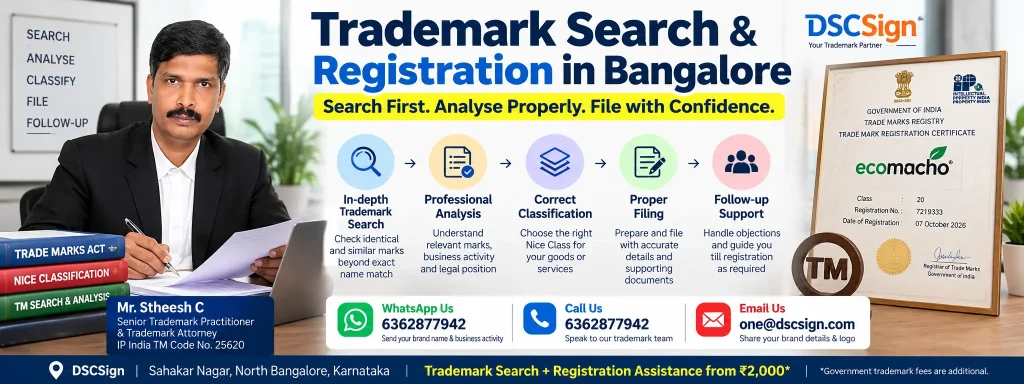
At DSCSign, we follow a different approach. We do not treat trademark registration as simply filling and submitting Form TM-A. We first understand your proposed brand, what your business actually does, the goods or services you intend to offer, the relevant Nice Classification, and the trademark records that may create a conflict. Our team then analyses the search results before recommending the filing approach.
Our principle is simple:
Search first. Analyse properly. File with confidence.
This does not mean that anyone can guarantee a trademark will ultimately be registered—the final decision rests with the Trade Marks Registry. What professional trademark assistance can do is identify avoidable risks before you commit your money and your brand to the application process.
That difference matters particularly for startups, MSMEs, proprietors, manufacturers, technology companies, restaurants, D2C brands and other businesses that have already invested time and money in building a name in the market.
Mr. Stheesh C, Senior Trademark Practitioner and Trademark Attorney, IP India TM Code No. 25620, leads the trademark professional assistance at our office. The objective is not to make the filing look complicated. It is to make the decision clearer for the business owner before the application is filed.
Have a brand name in mind?
Send us your proposed trademark and business activity. We can start by checking the mark and explaining what the search means for your proposed registration.
WhatsApp: 6362877942 | Email: one@dscsign.com
A REAL TRADEMARK REGISTRATION — APPROVED TODAY
What Proper Trademark Search Can Lead To: A Real Client Registration
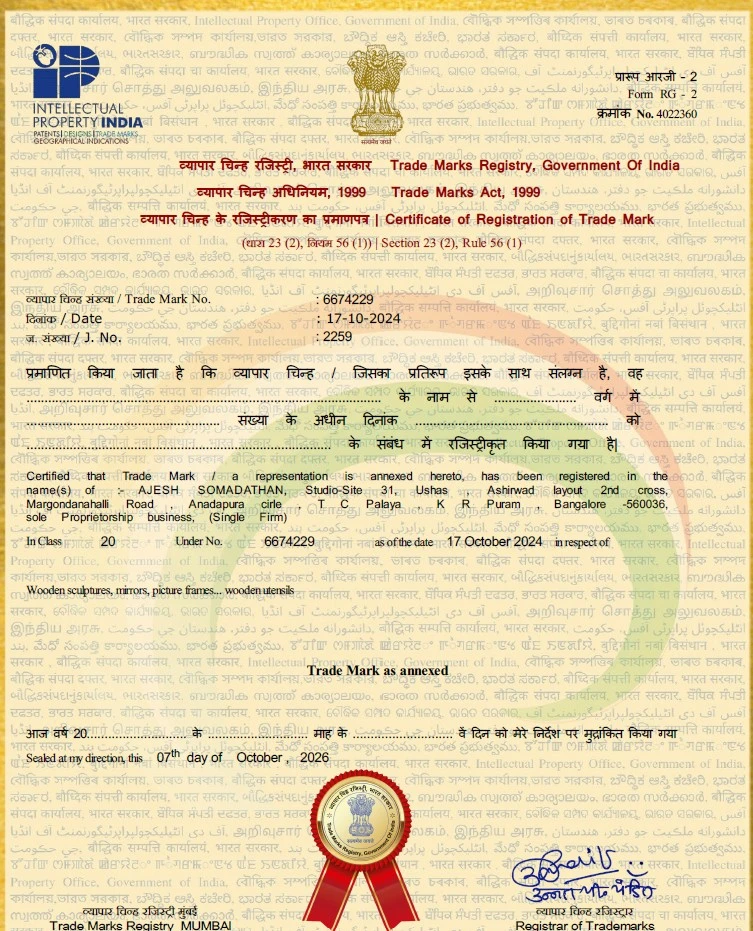
We are writing this article on 7 October 2026, and today our team received another successful outcome for a client whose trademark registration process was handled through our office.
We are showing the actual registration certificate here for one simple reason: we want our clients to see the difference between merely submitting a trademark application and professionally handling a brand through the registration process.
This Is Why We Search Before We File
A trademark application can be filed relatively quickly. The more important question is: was the brand properly evaluated before the application was submitted?
In this case, the client’s brand was not treated as just another name to be entered into an online form. The proposed mark was considered in the context of the client’s business, the relevant goods or services and the appropriate trademark classification before proceeding with the registration process.
The result is now visible in an official document issued by the Trade Marks Registry, Government of India.
THE RESULT
Trademark registered.
The certificate records the client’s mark in Class 20. The registration certificate was sealed on 7 October 2026.
But the Certificate Is Not Where Our Work Begins
For a business owner, the most valuable part of professional trademark assistance happens before the application reaches the Registry.
We first need to understand what the proposed brand represents. Is it a product, service, retail brand, technology business, manufacturing activity or something else? Which Nice Class is relevant? Is the proposed mark sufficiently distinctive? Are there earlier marks that may create a concern? Are there similar names that require closer examination?
These questions matter because the official trademark process itself requires the applicant to check existing trademarks, assess similarity and conflicts, identify the appropriate Nice Class and prepare the relevant application information before filing. IP India’s published filing process reflects this sequence.
That is the thinking behind DSCSign’s Trademark Search + Registration service.
TRADEMARK PROFESSIONAL ASSISTANCE
Handled With the Experience of a Senior Trademark Practitioner
Trademark work requires more than knowing where to upload an application. Mr. Stheesh C, Senior Trademark Practitioner and Trademark Attorney, IP India TM Code No. 25620, is associated with our trademark professional assistance and brings practical experience in handling trademark search, classification, filing and related registration matters.
For a business owner, that means you can discuss the brand itself, not just the application form.
THE SEARCH IS MORE THAN TYPING YOUR BRAND INTO A SEARCH BOX
What Do We Actually Check Before Filing Your Trademark?
If someone searches your proposed brand and tells you “No exact match found”, that is only the beginning. It is not, by itself, a professional trademark assessment.
A brand can face difficulty even when another business has not registered the exact same spelling. Similarity can arise from the way a mark looks, sounds, is written, or is used in relation to similar or connected goods and services. That is why our trademark search is followed by human analysis before we recommend proceeding with the application.
Our question is not simply “Is this name showing in the search?”
Our question is: “What could this search result mean for this particular business if we file this brand?”
1. We Search the Proposed Brand Name
We begin with the proposed word, name or brand supplied by the business owner. Where a logo or device mark is involved, the visual representation is also considered as part of the filing strategy.
The purpose is to identify relevant existing marks and understand whether the proposed brand enters an already crowded trademark space.
2. We Don’t Stop at an Exact-Match Search
This is where a professional search becomes more useful than a simple name checker. We look for potentially similar marks, including variations that may sound or appear similar to the proposed brand.
- Similar spelling or word structure
- Phonetically similar names
- Similar-looking words or combinations
- Relevant variations of the proposed mark
- Marks that may create a likelihood of confusion in the relevant market
A business owner may see two names as different. A trademark professional has to ask whether the Registry or another proprietor could consider them sufficiently similar in the relevant circumstances.
3. We Connect the Search With Your Actual Business
The same word can have very different trademark implications depending on what the business actually sells or provides.
That is why we ask a simple question that many low-cost filing services overlook: “What exactly does your business do under this brand?”
An IT company, clothing brand, restaurant, manufacturer and financial consultancy do not necessarily face the same trademark landscape merely because they use similar words.
Your proposed business activity therefore becomes an important part of our search and filing analysis.
4. We Check the Relevant Nice Classification
Trademark protection is linked to the goods and services for which the mark is applied. India follows the Nice Classification system for this purpose.
Selecting a class merely because another business used it, or because it appears popular online, is not a proper filing strategy. The class and specification should reflect the actual business activity and the protection being sought.
We therefore consider your business activity before finalising the proposed class and description for filing.
Wrong class = wrong protection.
Filing quickly in an unsuitable class can create a false sense of security. The application may exist, but the business may not receive the protection it actually expected.
5. We Look at the Competitive Trademark Landscape
A good search is not conducted in isolation. We also consider what is already present around the proposed brand in the relevant commercial space.
If several similar marks already exist in a particular sector, that information can change the way we assess the proposed brand and its filing strategy.
This is particularly important for startups. A founder may have spent months building a name, domain, packaging and social-media presence before discovering that the trademark landscape is more complicated than expected.
6. We Consider Whether Prior Use Needs Attention
If you have already been using the brand, tell us. Do not simply select “proposed to be used” or claim an earlier date without understanding the evidence required.
Depending on the circumstances, prior-use claims can require supporting evidence, including a user affidavit and relevant documents. We therefore ask about the history of the brand before finalising the filing approach.
7. We Don’t Hide an Uncomfortable Search Result
This is one of the most important differences in our approach.
If the search identifies a meaningful concern, we will tell you. We would rather lose a filing fee today than see a business owner spend years building a brand around a name that was never properly evaluated.
Depending on the search findings, the practical recommendation may be to proceed, modify the specification, consider a different class strategy, strengthen the filing documentation, or reconsider the brand before filing.
THE DSCSign DIFFERENCE
We don’t sell you a trademark application.
We help you make a better decision about the brand you are asking us to protect.
Mr. Stheesh C, Senior Trademark Practitioner and Trademark Attorney (IP India TM Code No. 25620), and our trademark support team use this search-and-analysis approach before proceeding with the registration process.
THE BRAND NAME MAY BE RIGHT — BUT THE CLASS CAN STILL GO WRONG
Choosing the Right Trademark Class Is Part of the Search Strategy
Finding a suitable brand name is only one part of trademark registration. The next question is equally important: “For what exactly are you seeking trademark protection?”
A trademark is not registered simply for a word in isolation. Protection is sought in relation to specified goods or services, under the applicable Nice Classification. India follows the international Nice Classification system, with Classes 1 to 34 generally covering goods and Classes 35 to 45 covering services.
This is why we do not ask a client to simply select a class from a list and proceed. We first understand the business and then connect the business activity with the appropriate trademark class and specification.
A SIMPLE EXAMPLE
Suppose you have created a new brand for your business and plan to sell products through your own website as well as through online marketplaces.
Your first thought may be: “I need Class 35 because I sell online.”
But that may not tell the complete story. What exactly are you selling? Are you manufacturing the products? Are you providing services? Are you selling third-party products? Is there a separate class relevant to the actual goods?
The answer depends on the real business activity.
We Start With Your Business, Not With the Class Number
When you approach DSCSign, we want to know what you actually do under the proposed brand.
- What product or service are you offering?
- Are you manufacturing, trading, distributing or providing a service?
- Are you selling directly to customers or through another platform?
- Are you planning to expand into related products or services?
- Is the brand already being used?
- Do you have more than one category of goods or services?
These answers help us assess the appropriate filing strategy rather than treating the trademark class as a checkbox on an application form.
The Class Number Alone Is Not Enough
Another common mistake is to assume that choosing the correct class automatically means the application is correctly prepared.
The description of goods or services also matters. It should accurately reflect the business and the protection being sought. An unnecessarily broad or poorly drafted description can create avoidable questions later, while an overly narrow description may not reflect what the business actually intends to protect.
That is why our filing process considers both:
Where your goods or services fall within the Nice Classification.
How the goods or services should be described for the proposed application.
What If Your Business Covers More Than One Class?
Some businesses operate across multiple categories. A brand may be used for products today and related services tomorrow. A company may manufacture goods, operate an online retail channel and also provide associated services.
In such situations, we examine whether one class is sufficient or whether protection in additional classes should be considered.
This is particularly important for growing businesses. The objective is not to unnecessarily increase the filing cost, but also not to save a small amount today at the expense of leaving an important part of the brand strategy unaddressed.
Our approach is therefore:
Understand the business → Identify relevant goods/services → Assess the appropriate class → Review the specification → Proceed with filing
Why This Matters for Your Brand
Imagine spending two years building a successful brand and then discovering that the original trademark application did not adequately address the business activity you are actually carrying on.
Trademark registration should support your business strategy, not merely create an application number.
That is why our trademark team, under the professional guidance of Mr. Stheesh C, Senior Trademark Practitioner and Trademark Attorney, IP India TM Code No. 25620, considers classification as part of the search-and-filing exercise itself.
Don’t ask only, “Is my brand name available?”
Ask the more important question: “If I register this brand, am I filing it in the right place and for the right business?”
ALREADY USING YOUR BRAND? DON’T LEAVE THAT HISTORY UNEXAMINED.
Already Using Your Brand? Your Prior Use May Be Important
Many business owners come to us after using their brand for months or even years. They may already have a website, invoices, packaging, advertisements, social-media pages and regular customers—but they have never formally protected the brand.
When such a business decides to apply for trademark registration, one important question is: “When did you actually start using this trademark?”
This is not a question we ask merely to complete a form. The history of your brand can influence the way the application is prepared, particularly where a prior-use claim is proposed.
DON’T GUESS YOUR FIRST-USE DATE
If you claim that your trademark was used from an earlier date, that claim should be supported by genuine evidence. A convenient date entered into an application without proper records can create unnecessary problems later.
What Can Help Establish the History of Your Brand?
The exact evidence depends on the circumstances of the business and the nature of the prior-use claim. Depending on the case, useful records may include:
- Earlier sales invoices
- Tax invoices and business records
- Product packaging or labels
- Website records showing the brand
- Advertising and promotional material
- Purchase orders or customer documents
- Online marketplace records
- Business correspondence carrying the brand
- Other genuine dated evidence demonstrating use
Not every document is relevant in every matter. The important point is that the claimed history should be supported by authentic records that relate to the actual trademark and its use.
Why Do We Ask for a Prior-Use Affidavit?
Where a prior-use claim is being made, the trademark filing may require a user affidavit and supporting evidence in accordance with the applicable trademark procedure.
This is why we do not simply ask a client: “Do you want to claim prior use?”
We first try to understand the history of the brand and the documents available to support that history. The filing should reflect the facts of the business, rather than creating a claim simply because it appears advantageous on paper.
What If You Have Not Used the Brand Yet?
That is also perfectly normal.
A new business may be preparing to launch its brand and therefore may not have years of invoices or advertising records. In such a case, the filing strategy should reflect the actual circumstances rather than manufacturing a prior-use history.
Tell us the truth about the brand’s history. We will help determine the appropriate filing approach based on the information and documents available.
Before we file, we may ask you:
“When did you first use this brand, where did you use it, what did you sell or provide under it, and what documents can demonstrate that use?”
These questions may take a few minutes to answer now. They can save much more trouble later.
We Also Help You Understand What Documents Are Actually Needed
One reason clients prefer handling their trademark through a professional office is that they do not have to work out every filing requirement themselves.
Depending on the applicant and circumstances, we review the identity documents, business details, trademark representation, prior-use material where applicable, authorisation and other filing requirements before proceeding.
Where an authorised representative is filing on behalf of the applicant, the appropriate authorisation documentation also needs to be handled correctly.
Under the professional assistance of Mr. Stheesh C, Senior Trademark Practitioner and Trademark Attorney, IP India TM Code No. 25620, our team reviews these practical aspects before moving ahead with the filing.
Your brand already has a history.
If you have genuinely built that history, don’t let it remain undocumented. Tell us when your brand started, show us what you have, and let the filing strategy be built around the actual facts.
SEARCH IS ONLY THE FIRST STEP — THE FILING HAS TO BE RIGHT TOO
Once Your Trademark Search Is Clear, We Take Care of the Filing
A good trademark search gives you information. The next job is to convert that information into a properly prepared trademark application.
This is where many business owners prefer professional assistance. They do not want to spend their time understanding every form, class description, supporting document and procedural requirement. They want someone who understands the process and takes responsibility for getting the application prepared correctly.
At DSCSign, once the proposed mark has been searched and the filing approach is discussed with you, our team moves through the registration process step by step.
Confirm the Brand
We confirm the exact trademark you want to protect, including the word mark and logo/device representation where applicable.
Confirm Your Business Activity
We understand what you actually sell or provide so that the application is connected to the real business rather than a generic description.
Finalise the Appropriate Class
The relevant Nice Classification and goods/services description are reviewed before the application is prepared.
Review the Documents
Applicant details, identity documents, business information, trademark representation and prior-use material, where applicable, are checked.
Prepare the Application
The information is converted into the appropriate trademark application and supporting documentation.
File and Track
The application is submitted through the applicable trademark filing process and the application details are retained for subsequent tracking.
We Don’t Treat the Application Form as a Copy-Paste Exercise
Your business is different from the business that filed a trademark yesterday. Therefore, the application should not simply be prepared by copying a previous client’s details or selecting a generic description from a list.
The proposed mark, applicant, business activity, classification, goods/services, use history and supporting documents should all tell the same factual story.
A properly prepared application should make sense from beginning to end:
Brand → Applicant → Business → Class → Goods/Services → Use History → Supporting Documents
What We Need From You Is Surprisingly Simple
For a straightforward proprietor application, we normally start with basic information such as:
- Your name and contact details
- PAN and identity/address proof
- Your proposed trademark name
- Logo, if you are filing a logo/device mark
- A clear description of your business activity
- Information about prior use, if applicable
From there, our team handles the professional part of the process and tells you if any additional document or clarification is required.
What Happens After Filing?
Filing the application does not mean that the trademark has immediately become a registered trademark. The application enters the trademark examination and registration process.
Depending on the application, the Registry may examine the mark and raise an objection or seek clarification. There may also be publication and opposition stages before registration.
That is why we do not describe an application number as a registration certificate.
IMPORTANT
Our search and professional filing process is designed to identify and reduce avoidable risks. It cannot guarantee the final decision of the Trade Marks Registry, because registration remains subject to examination and the applicable legal and procedural process.
Our Job Does Not End With “Your Application Has Been Filed”
This distinction is important when choosing a trademark consultant.
A filing service can end the moment an application number is generated. A professional trademark service should help the client understand what was filed, what the application means, what happens next and what should be done if the Registry raises an issue.
This is the approach followed by our trademark team under the professional assistance of Mr. Stheesh C, Senior Trademark Practitioner and Trademark Attorney, IP India TM Code No. 25620.
We make the process simple for the business owner without making the professional work simplistic.
You give us your brand and business details. We handle the search, analysis, classification, documentation and filing process with you at each important decision point.
DON’T COMPARE TRADEMARK SERVICES ONLY BY THE FILING PRICE
Why the Cheapest Trademark Filing Can Become an Expensive Mistake
When business owners search online for trademark registration, the first thing they often compare is price.
“Who will file my trademark for the lowest amount?”
It is a reasonable question. But there is another question that can be far more important:
“What exactly am I getting for that fee?”
A trademark application can look inexpensive when the service is limited to entering your name into a form and submitting it. But if the brand was not properly searched, the wrong class was selected, the specification was poorly prepared or an important filing fact was overlooked, the initial saving may become a much larger business cost.
The Application Fee Is Only One Part of the Decision
Think about what happens when a business chooses a new brand.
The owner may spend money on a logo, website, domain name, packaging, signboards, social-media promotion, advertising, product development and customer acquisition.
The trademark is connected to all of that investment.
Therefore, spending a little less on the initial filing while ignoring the quality of the search and filing strategy may not be a genuine saving.
YOUR BRAND IS MORE THAN A TRADEMARK APPLICATION
Brand Name + Logo + Website + Marketing + Customer Recognition = Business Value
DSCSign Is Not Trying to Win the “Cheapest Filing” Competition
Our objective is different.
We want a business owner to understand what is being searched, what is being analysed, what is being filed and why the filing is being made in that manner.
That is why our Trademark Search + Registration service combines the preliminary search and professional analysis with the registration process rather than treating the search as an unnecessary extra charge.
Our value comes from the work behind the application:
- Trademark name search
- Similarity and conflict analysis
- Business activity assessment
- Nice Classification review
- Goods/services specification review
- Prior-use assessment where applicable
- Document and filing review
- Trademark application preparation and filing
Our Professional Service Starts From ₹2,000*
We have deliberately kept our professional assistance accessible to small businesses, proprietors and startups that want to protect their brand without paying an unnecessary premium for basic professional support.
Trademark Search + Registration professional service starts from ₹2,000*, subject to the nature of the application and services required.
Government trademark fees are separate and depend on factors such as the applicant category, number of classes and applicable government fee structure. We explain the applicable government charges before proceeding rather than hiding them inside an apparently low headline price.
What You Are Really Paying For
You are not paying merely for someone to press the “Submit” button.
You are paying for the work that should happen before that button is pressed: understanding your brand, checking the relevant trademark landscape, assessing the appropriate class, reviewing your documents and preparing the filing based on the actual facts of your business.
Under the professional assistance of Mr. Stheesh C, Senior Trademark Practitioner and Trademark Attorney, IP India TM Code No. 25620, our focus is on delivering that value without making trademark assistance unnecessarily expensive for the business owner.
Don’t ask only, “How cheaply can I file my trademark?”
Ask: “How confidently can I build my brand after I file it?”
START WITH YOUR BRAND — WE WILL GUIDE YOU THROUGH THE REST
What Do You Need to Start a Trademark Search?
You do not need to prepare a complicated file before speaking to us. If you have a brand name, business idea or logo that you want to protect, that is enough to start the conversation.
In fact, we prefer that you contact us before you spend heavily on branding, packaging or marketing. A preliminary trademark assessment at the beginning can help you make a more informed decision about the name you are planning to build.
FOR THE INITIAL SEARCH, TELL US:
Your Name
Tell us who will own the proposed trademark.
Your Mobile Number
So our team can contact you regarding the search and filing.
Your Email
Useful for sharing search observations, documents and filing information.
Your Brand Name
Send the exact word, name or proposed trademark you want to protect.
Your Business Activity
Tell us what you sell, manufacture or provide under the brand.
Your Logo
If a logo is ready, send it to us. If not, the word mark can be discussed first.
Already Using the Brand?
Tell us that as well.
If the brand has already been used in the market, let us know approximately when the use started and what records you have. We can then discuss whether prior use needs to be considered in the filing strategy.
Do not worry if you do not have every document ready at the first stage. We will tell you what is required once we understand your case.
How to Send Your Trademark Search Request
We have kept the first step deliberately simple. You can send your details directly to our trademark team instead of filling a long technical form.
WHATSAPP / CALL
Send your proposed trademark and business activity for an initial discussion.
What Happens After You Contact Us?
You don’t need to figure out the trademark procedure on your own. Once we receive your basic information, our team can understand what you are trying to protect and identify the next step.
ONE IMPORTANT REQUEST
Please do not pay anyone to file your trademark before you understand what has been searched and what is actually being filed.
Ask for the proposed class. Ask what business activity is being covered. Ask whether similar marks were considered. Ask whether prior use is being claimed and what evidence supports it.
A professional consultant should be comfortable explaining these points to you.
Need Help Choosing the Brand Itself?
You can also approach us before finalising your brand name. If you are still deciding between two or three names, tell us that at the beginning. It may be better to evaluate the options before your branding investment is made rather than discovering later that your preferred name presents a significant concern.
You bring the idea. We help you evaluate the trademark path.
Start with your proposed brand name and business activity. We will tell you what information and documents are needed for the next step.
WhatsApp / Call: 6362877942 | Email: one@dscsign.com
ONE OF THE MOST IMPORTANT THINGS A BUSINESS OWNER SHOULD KNOW
Trademark Application Is Not the Same as Trademark Registration
You receive a trademark application number. You see your brand name in the government’s trademark records. Your consultant tells you, “Your trademark has been filed.”
That is good progress—but it is not the same as receiving a registered trademark certificate.
This distinction is often missed by first-time applicants. A filing starts the trademark registration process; it does not by itself guarantee the final registration.
The trademark application enters the Registry process.
The application is examined under the applicable trademark provisions.
If an issue is raised, the appropriate response or further action may be required.
The application proceeds through the applicable publication and opposition process.
Subject to the applicable process, the registered trademark certificate is issued.
So What Does Your Application Number Actually Mean?
It means your application has been filed and entered into the trademark system. It is an important milestone, but it should not be described to customers, investors or business partners as though the mark has already been registered.
This is why we are careful with the words we use. “Applied”, “under examination”, “objected”, “accepted”, “advertised” and “registered” can represent very different stages of a trademark application.
A professional trademark consultant should help you understand the status rather than simply forward a screenshot from the Registry.
DON’T CONFUSE THESE TWO
Trademark Application
Your application has been submitted and is progressing through the applicable registration process.
Registered Trademark
The Registry has completed the applicable process and issued the registration certificate.
What If the Registry Raises an Objection?
This is where the quality of the original search and filing becomes particularly valuable.
An examination objection does not automatically mean that the brand is lost. The appropriate response depends on why the objection was raised, what grounds are stated, what was filed originally and what supporting facts and legal position are available.
The response therefore should not be copied from a generic template simply because another applicant received a similar notice.
The trademark application and the objection have to be read together.
Why Our Work Continues After the Filing
When you engage DSCSign for Trademark Search + Registration, our objective is not simply to send you an application number and disappear.
We help you understand the status and the next procedural step. If the Registry raises an issue, the matter can be examined based on the actual contents of the application and the objection.
This is one of the reasons we insist on doing the initial search and filing carefully. The quality of the information and strategy at the beginning can matter when the application reaches examination.
FROM TODAY’S REAL CLIENT RESULT
Earlier in this article, we showed an actual trademark registration certificate received by our client on 7 October 2026.
That certificate is the outcome of a registration process. It is very different from simply receiving an application number on the day a trademark is filed.
View the actual registration certificate shown in this article
We Will Never Tell You That Filing Alone Equals Approval
No genuine trademark professional should promise that the Registry must accept every application. The final decision remains with the competent authority and depends on the facts, applicable law, examination and the subsequent procedural stages.
What we can do is make the process more disciplined: search before filing, analyse the relevant information, prepare the application correctly and respond appropriately when further action is required.
That professional approach is led by Mr. Stheesh C, Senior Trademark Practitioner and Trademark Attorney, IP India TM Code No. 25620, with the support of our trademark team.
An application number tells you that you filed.
A registration certificate tells you that the registration process reached its required conclusion.
Our job is to help you move from the first stage towards the second with proper search, analysis, filing and professional follow-through.
BEFORE YOU TRUST YOUR BRAND TO A CONSULTANT, KNOW WHO IS HANDLING IT
Your Trademark Deserves More Than an Online Form
Trademark registration is now easy to find online. A business owner can search for “trademark registration” and find dozens of agencies offering registration services within minutes.
The difficult question is not “Who can file my trademark?” Almost anyone can help you complete a filing process.
The more important question is: “Who is actually analysing my brand before it is filed, and who will understand what to do if the Registry raises an issue?”
ASK THESE QUESTIONS BEFORE APPOINTING A CONSULTANT
- Who is conducting the trademark search?
- Is the search more than an exact-name check?
- Who decides the appropriate trademark class?
- Who reviews the goods/services description?
- Who examines a prior-use claim?
- Who will handle the matter if an examination objection arises?
- Can you speak to the actual professional handling your trademark?
- Does the office have a verifiable physical presence and professional identity?
At DSCSign, You Know Who Is Behind the Trademark Work
Our trademark professional assistance is associated with Mr. Stheesh C, Senior Trademark Practitioner and Trademark Attorney, IP India TM Code No. 25620.
His role is not simply to place a client’s name into an application form. The professional approach is to understand the proposed mark, examine the relevant search information, consider the business activity and classification, and then determine the appropriate filing approach.
TRADEMARK PROFESSIONAL
Mr. Stheesh C
Senior Trademark Practitioner & Trademark Attorney
IP India TM Code No.: 25620
Professional assistance covering trademark search, classification, registration filing and related trademark matters.
Local Access Makes the Conversation Easier
DSCSign’s trademark assistance is available from our office at Sahakar Nagar, North Bangalore.
This matters because a trademark is not merely an online transaction. Business owners often need to explain their brand, show how the mark is being used, discuss a proposed logo, understand the appropriate class or clarify documents relating to prior use.
Having a professional office and identifiable people behind the service gives you a better opportunity to discuss those matters rather than communicating only with an anonymous online ticket number.
DSCSign — SAHAKAR NAGAR, BANGALORE
Trademark Search + Registration Assistance
WhatsApp / Call: 6362877942
Email: one@dscsign.com
We Also Believe in Telling the Client When Not to File
Professional credibility is not built by accepting every proposed trademark.
If a search reveals a serious concern, the honest advice may be: “Let’s reconsider this name before you invest more money in it.”
That conversation may not generate an immediate filing fee, but it can save a business owner from building a valuable brand around a name that presents avoidable trademark difficulties.
Similarly, if the available information supports proceeding, we explain the filing path and take the matter forward rather than creating unnecessary fear.
OUR PRINCIPLE
We would rather give you an honest trademark assessment today than sell you a filing that creates a problem tomorrow.
Why This Matters for a Growing Business
Your trademark can eventually appear on your website, products, invoices, packaging, advertisements, social-media pages, investor presentations and customer communications.
As the brand becomes valuable, the cost of changing it becomes higher. The person you choose at the beginning therefore matters.
That is why DSCSign combines accessible pricing with a professional search → analysis → classification → filing approach rather than competing only on the lowest advertised registration fee.
Your trademark is your business identity.
Before giving that identity to an online filing service, know who is actually responsible for the professional work.
Talk to DSCSign’s trademark team in Sahakar Nagar, Bangalore.
DON’T JUST ASK FOR A SEARCH — ASK WHAT THE SEARCH TELLS YOU
What Do You Actually Get From a Professional Trademark Search?
When a business owner pays for a trademark search, the most common expectation is a simple answer: “Available” or “Not Available.”
But your business needs more than a green or red signal. A useful trademark search should help you understand what was found, how relevant it is, what the potential concern may be, and what you should consider before filing.
That is why at DSCSign, we treat trademark search as a decision-making exercise, not merely a database lookup.
THE QUESTION WE WANT TO ANSWER
“Based on the available trademark information and your proposed business, does this brand appear suitable to take forward for registration, and what should we consider before filing?”
We Help You Understand the Search Result
Suppose your proposed brand produces several search results. We do not expect you to understand trademark terminology, application status, class numbers and similar marks on your own.
Our team helps put those results into context.
We identify whether the same or substantially identical mark appears in relevant records.
We consider potentially relevant marks rather than ignoring them simply because the spelling is different.
We consider whether the identified mark is relevant to your actual goods or services.
The status of an identified application or registration is considered as part of the overall assessment.
We compare the search findings with the business you intend to operate under the proposed brand.
Not Every Search Result Is a Problem
This is an important point.
Seeing a similar word somewhere in the trademark database does not automatically mean that your proposed brand must be abandoned. Equally, not finding the exact word does not automatically mean that there is no risk.
The relevance of a search result has to be assessed.
That is why we avoid giving clients a misleading impression by treating every database result as either completely safe or completely dangerous.
TOO SIMPLE
“No exact match. File immediately.”
BETTER APPROACH
“Here are the relevant findings, here is why they may or may not matter, and here is what we recommend considering before filing.”
We Can Also Tell You When More Than One Option Should Be Considered
Suppose you have shortlisted three brand names for your new business. Instead of selecting one randomly and filing immediately, you can send all three names to us for consideration.
This can be particularly useful for startups that have not yet printed packaging, launched advertising or invested heavily in one particular brand.
Choosing a stronger candidate before the branding investment begins is usually easier than changing the brand after the market knows it.
START SMART
Have two or three possible brand names?
Send them before you finalise your branding.
We can help you understand which name deserves closer trademark consideration before you commit your business resources to it.
Why We Do Not Charge a Separate Search Fee
Our objective is to make the search a meaningful part of the registration decision, not an isolated service that ends with a list of search results.
Therefore, for our Trademark Search + Registration service, we do not charge a separate preliminary trademark search fee.
The search and analysis become part of the larger professional process:
CHECK YOUR BRAND BEFORE YOU FILE
Enter your basic details and proposed brand name.
Send the completed enquiry directly to our team by WhatsApp or Email.
COMMON QUESTIONS BEFORE FILING A TRADEMARK
Before filing a trademark, business owners usually have the same practical questions:
Is my name available? What class should I choose? What if a similar mark exists?
Here are the answers in simple terms.
A trademark search is a preliminary check of existing trademark records to
identify identical or potentially similar marks relevant to your proposed
brand. A professional search should go beyond an exact-name match and consider
similarity, relevant goods or services and classification before filing.
Filing a trademark without first checking the existing trademark landscape
can expose your business to avoidable objections, conflicts and wasted
filing costs. Searching first gives you an opportunity to understand the
position before investing heavily in the brand.
The proposed name should be searched against relevant trademark records,
followed by an assessment of potentially similar marks, their status,
relevant classes and goods or services. DSCSign combines the search with
professional analysis rather than relying only on an exact-name result.
A similar mark does not automatically mean that your application cannot
proceed. The relevance of the similarity depends on factors including the
marks, goods or services, classification and commercial context. The result
should be professionally analysed before deciding whether to proceed.
The appropriate class depends on what your business actually sells,
manufactures or provides. We first understand your business activity and
then consider the applicable Nice Classification and goods/services
specification rather than selecting a class simply from a generic list.
For a proprietor, basic documents generally include identity details,
PAN, address information, the proposed trademark name or logo and business
activity details. Additional documents may be required depending on the
applicant, prior-use claim and filing circumstances.
If you have genuinely used the trademark before filing, prior use may be
relevant to the filing strategy. The claimed use should be supported by
appropriate evidence. Where applicable, a user affidavit and supporting
documents may be required. Do not claim an earlier use date without genuine
records to support it.
DSCSign’s professional Trademark Search + Registration service starts from
₹2,000*. Applicable government trademark fees are separate
and depend on factors such as the applicant category, number of classes and
applicable government fee structure. We explain the applicable charges before
proceeding.
Preparing and filing a straightforward trademark application can be completed
quickly once the required information and documents are available. However,
filing within 1–2 days is not the same as obtaining final trademark
registration within 1–2 days. Examination, objections, publication,
opposition and other Registry processes can affect the overall timeline.
No. An application number confirms that an application has been filed.
Registration occurs only after the applicable examination and registration
process is completed and the Registry issues the registration certificate.
Yes. DSCSign provides a combined Trademark Search + Registration service.
We understand the proposed brand and business, conduct the relevant search,
analyse the findings, consider classification and filing requirements, and
then proceed with the application where the client decides to move forward.
YOUR BRAND DESERVES A PROPER START
Don’t spend money building a brand first and checking its trademark later.
Send us your proposed trademark and business activity.
We will help you understand the search, classification and registration path
before you commit to the filing.
Trademark Search + Registration Professional Service From ₹2,000*
Preliminary trademark search is included when you engage us
for the combined Search + Registration service.
*Government trademark fees are additional and vary according to the applicable
applicant category, number of classes and government fee structure.
For a quick trademark enquiry, send us:
That’s enough to start the discussion.
We will tell you what additional information or documents are required
for your particular case.
Important: Trademark registration is subject to examination
and the applicable process before the Trade Marks Registry. No consultant
can guarantee the final decision of the Registry. Our role is to provide
professional search, analysis, classification and filing assistance and to
help you make an informed decision before filing.
Send Your Trademark Search Request
Trademark Search & Registration — Frequently Asked Questions
What is a trademark search?
Why should I search my trademark before registration?
How do I check whether my trademark name is available?
Can I register my trademark if a similar name already exists?
How do I choose the correct trademark class?
What documents are required for trademark registration?
Can I claim prior use of my trademark?
How much does trademark registration cost?
How long does trademark registration take?
Is a trademark application the same as a registered trademark?
Can DSCSign handle trademark search and registration together?
Do you charge separately
Have a Brand Name in Mind? Search It Before You File.
Choose the Easiest Way to Reach Us