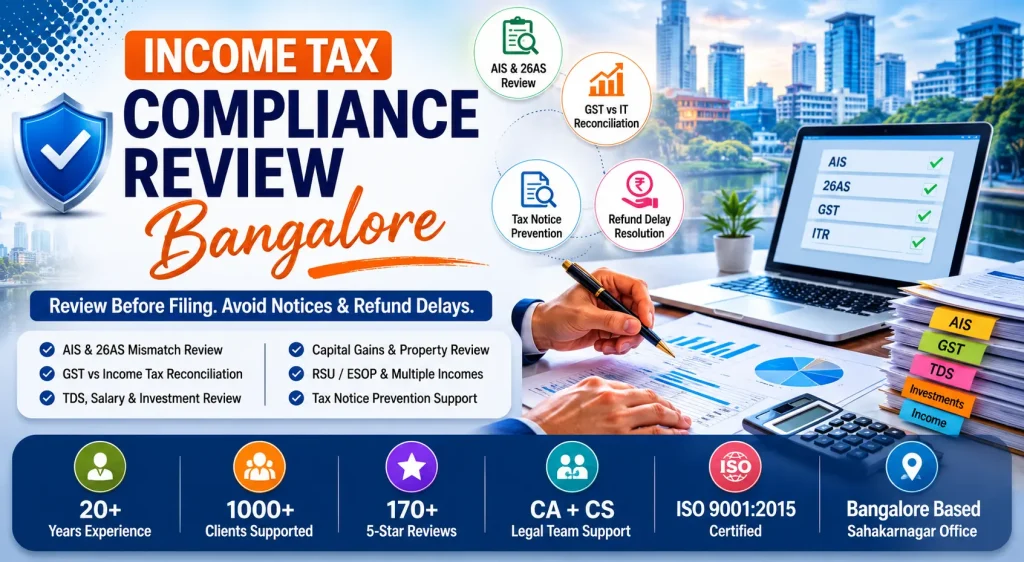
Income Tax Compliance Review Bangalore
Many salaried employees, business owners, freelancers, startup founders, and property investors in Bangalore file their Income Tax Returns only for submission purposes without properly reviewing AIS, 26AS, GST turnover, bank transactions, or investment disclosures. This creates practical compliance issues later when the Income Tax Department systems automatically identify mismatches between reported income and available financial records.
Today, Income Tax compliance is no longer limited to simply uploading an ITR form. Financial information from banks, GST filings, property transactions, stock market activity, mutual funds, TDS records, and even foreign investments are increasingly connected through automated reporting systems. Even genuine taxpayers may receive notices when data reported in the return does not properly match department records.
Practical Risk: Many taxpayers realize the issue only after receiving refund delays, defective return notices, AIS mismatch alerts, or scrutiny communications regarding property transactions, GST turnover, stock investments, or undisclosed income entries.
At DSCsign Bangalore, our CA, CS, and legal advisory team reviews the practical compliance position before filing returns. This includes reviewing salary income, GST records, capital gains, TDS credits, startup income, freelance receipts, property transactions, and AIS reporting so that potential mismatch risks can be identified earlier instead of after notices are issued.
For many Bangalore taxpayers working in IT companies, startups, contracting businesses, consulting services, ecommerce activities, or real estate investments, a proper Income Tax compliance review helps improve reporting accuracy, reduce future notice risks, and support smoother refund processing.
Practical Approach: Correct Income Tax filing is not only about tax calculation. Proper compliance review helps verify whether financial disclosures, GST turnover, TDS entries, investments, salary records, and high-value transactions are properly aligned before filing the return.
Common Income Tax Compliance Problems Seen in Bangalore
Many Income Tax compliance issues today are not caused by intentional tax mistakes. In most cases, problems happen because taxpayers are managing multiple financial activities such as salary income, GST turnover, stock investments, freelance receipts, property transactions, or online income sources without properly reconciling them before filing the return.
Bangalore professionals working in IT companies, startups, consulting businesses, ecommerce activities, contracting services, and real estate investments often handle transactions across different platforms and bank accounts. When these records are not properly reviewed together, the Income Tax Department systems may identify inconsistencies between reported income and available financial data.
Important Practical Issue: Many taxpayers believe their return is correct simply because the ITR portal accepted the filing. However, automated compliance checks usually continue after filing through AIS, 26AS, GST records, TDS data, property reporting, and banking information.
AIS & 26AS Mismatch Problems
One of the most common compliance problems today involves mismatch between disclosed income and entries appearing in AIS or 26AS. Fixed deposit interest, stock market transactions, dividend income, professional receipts, or TDS credits are sometimes missed while preparing returns, especially when taxpayers depend only on Form 16 or partial records.
These mismatches may result in refund delays, defective return notices, or requests for clarification from the department. A proper compliance review helps verify whether all reportable financial entries are correctly disclosed before filing.
GST Turnover & Income Tax Return Mismatch
Business owners, contractors, freelancers, and service providers in Bangalore frequently face GST and Income Tax turnover mismatches. This usually happens because GST returns may include advance receipts, gross billing values, or timing differences that are not properly reconciled with accounting records before filing the Income Tax Return.
When turnover reported under GST differs significantly from turnover disclosed in the Income Tax Return, automated compliance systems may flag the variation for further verification. Experienced CA review helps identify reconciliation differences and supporting explanations before filing.
Salary Income Filed Without Reviewing Other Financial Entries
Many salaried employees in Bangalore additionally earn from freelancing, consulting work, stock market investments, ESOPs, RSUs, rental income, or online platforms. However, while filing returns, taxpayers often consider only Form 16 salary details and ignore other taxable entries reflected in AIS or bank transactions.
This creates under-reporting risk and may later trigger compliance notices or tax demand issues. Practical review of all income sources together helps improve reporting accuracy and reduce future scrutiny complications.
Property & Capital Gains Reporting Mistakes
Property buyers and sellers often face compliance issues due to incorrect capital gains calculation, missing TDS reporting, inherited property confusion, or incomplete disclosure of property transactions. Many taxpayers are also unaware that high-value property transactions are independently reported to the department.
Without proper review of purchase documents, sale agreements, improvement costs, reinvestment eligibility, and TDS records, taxpayers may later face notices regarding mismatch in capital gains disclosure or property transaction reporting.
Why Practical Review Matters: Most Income Tax compliance problems are identified only after filing when notices, refund holds, or mismatch alerts are generated. Reviewing AIS, GST, TDS, investments, property transactions, and bank records together before filing helps reduce avoidable compliance risks later.
Why Income Tax Notices Are Increasing Even for Genuine Taxpayers
Many Bangalore taxpayers become concerned when they receive an Income Tax notice even though they believe they have filed returns correctly and paid taxes on time. In practical situations, a large number of notices today are generated because department systems identify mismatch in financial reporting rather than intentional tax evasion.
The Income Tax Department now receives financial information from multiple reporting sources including banks, GST returns, stock exchanges, property registration systems, mutual fund platforms, employers, foreign asset disclosures, and TDS filings. When the data available in these systems does not properly match the figures reported in the Income Tax Return, automated compliance alerts may be triggered.
Important Compliance Risk: Many notices are now system-generated within months after filing because AIS, GST, TDS, property transaction data, and bank reporting are automatically cross-verified with filed Income Tax Returns.
AIS-Based Compliance Alerts
AIS (Annual Information Statement) now captures large amounts of financial activity including stock trading, dividends, fixed deposit interest, foreign remittances, mutual fund transactions, professional receipts, and high-value banking entries. Taxpayers sometimes file returns based only on Form 16 or partial accounting records without verifying these AIS entries carefully.
When AIS information is not properly disclosed or reconciled, the department systems may generate mismatch notices requesting clarification regarding missing income or reporting differences. Practical review before filing helps identify these entries earlier and reduce future notice complications.
GST & Income Tax Data Matching
Businesses and professionals in Bangalore increasingly face notices because GST turnover and Income Tax turnover are now compared through automated systems. Differences may happen due to accounting methods, advance receipts, cancelled invoices, timing differences, or incorrect reporting classifications.
Without proper reconciliation, taxpayers may later receive notices asking for explanation regarding variation in turnover, gross receipts, or taxable income. Experienced CA review helps analyse whether the differences are properly documented and supported before filing.
Property & High-Value Transaction Reporting
Property purchases, property sales, large investments, high-value bank deposits, and stock market transactions are independently reported through multiple compliance systems. Many taxpayers are unaware that these transactions may already appear in department records even before filing returns.
When corresponding disclosures are incomplete or incorrectly reported in the return, scrutiny risk increases significantly. Proper review of property documents, TDS records, bank entries, and investment statements helps reduce mismatch-related notices later.
Foreign Assets, ESOP & RSU Reporting Issues
Bangalore IT professionals and startup employees working with multinational companies often receive ESOPs, RSUs, foreign stock holdings, overseas brokerage accounts, or international remittances. In many situations, these entries are partially disclosed or misunderstood during return filing.
Improper disclosure of foreign assets or stock-related income may later create notice risk, refund issues, or additional clarification requirements. Practical compliance review helps identify disclosure obligations before filing and reduces future complications.
Practical Review Benefit: Most taxpayers do not face notices because they intentionally avoided tax. In many cases, notices arise due to mismatch between AIS, GST, bank records, investments, property transactions, and filed Income Tax data. Experienced review before filing helps identify these practical compliance gaps earlier.
What an Experienced Income Tax Compliance Review Actually Checks
Many taxpayers assume Income Tax filing is only about entering income figures and submitting the return online. However, practical compliance review involves verifying whether the financial information reported in the return properly matches departmental reporting systems, banking records, GST filings, investments, and supporting documents.
In Bangalore, salaried employees, startup founders, contractors, freelancers, and business owners often manage multiple income sources, investment activities, property transactions, or GST registrations together. Without proper review, small reporting differences may later create refund delays, notices, or scrutiny complications even when taxes are already paid.
Practical Reality: Many Income Tax issues today arise because taxpayers file returns quickly without reviewing whether AIS entries, GST turnover, TDS credits, stock transactions, or bank records are properly aligned before submission.
Reviewing AIS & Financial Reporting Entries
AIS now captures a wide range of financial activities including fixed deposit interest, stock market transactions, mutual fund investments, dividends, professional receipts, property transactions, and foreign remittances. Taxpayers sometimes miss these entries while preparing returns using only partial records or Form 16 details.
An experienced compliance review helps identify whether all reportable entries appearing in AIS are properly disclosed or require clarification before filing. This reduces the possibility of future mismatch notices and defective return communications.
Matching 26AS & TDS Credits Properly
Many refund delays and tax demand notices occur because TDS entries reflected in 26AS are not properly matched with the return filing. This is commonly seen where taxpayers have multiple employers, contract receipts, professional income, or revised TDS filings.
Reviewing 26AS before filing helps verify whether tax credits are correctly reflected, whether any deduction entries are missing, and whether the disclosed income properly corresponds with available TDS records.
GST & Business Turnover Reconciliation
Business owners, contractors, consultants, and GST-registered professionals often face practical reconciliation problems because GST turnover and Income Tax turnover may differ due to advance receipts, accounting methods, cancelled invoices, or reporting timelines.
Experienced CA review helps analyse whether turnover differences are properly documented and whether supporting accounting records can explain the reconciliation position if future verification arises.
Capital Gains & Investment Review
Stock trading, mutual fund redemption, property sale transactions, ESOPs, RSUs, and crypto-related activities require careful reporting review before filing returns. Many taxpayers either under-report gains, miss disclosure obligations, or incorrectly calculate taxable income because investment statements are not properly analysed.
Proper review of investment records, brokerage statements, TDS deductions, purchase costs, and sale values helps improve reporting accuracy and reduce future scrutiny regarding capital gains disclosures.
Salary, Freelance & Side Income Verification
Many Bangalore professionals now receive income from multiple sources including salary, consulting assignments, online platforms, startup equity, rental income, or freelancing activities. These entries are sometimes partially reported because taxpayers focus only on primary salary documents while filing returns.
Reviewing all income sources together helps reduce under-reporting risks and supports more accurate compliance disclosure across salary, professional, and investment categories.
Refund Risk & Compliance Verification
Income Tax refunds are frequently delayed because of bank validation problems, AIS mismatch, incomplete disclosures, incorrect tax credit claims, or defective return issues. Many taxpayers only discover the issue after refund processing is held for verification.
Practical compliance review before filing helps verify refund-related risk areas, supporting documents, TDS accuracy, and disclosure completeness so that avoidable processing delays can be reduced.
Why Experienced Review Matters Practically: Proper Income Tax compliance review is not only about preparing the return. It involves checking whether salary records, GST turnover, investments, property transactions, TDS credits, bank entries, and AIS disclosures are correctly aligned before filing to reduce future notice and mismatch risks.
Income Tax Compliance Review for Different Types of Taxpayers in Bangalore
Income Tax compliance problems are not identical for every taxpayer. Salaried employees, startup founders, freelancers, contractors, property investors, and business owners each face different reporting challenges depending on their income pattern, investments, GST applicability, and financial transactions.
In Bangalore, where many professionals work in IT companies, startups, consulting businesses, ecommerce activities, and real estate investments, proper review becomes important because multiple income streams and financial reporting systems are often interconnected.
Practical Observation: The same filing approach cannot be applied to all taxpayers. A salaried employee with RSUs, a GST contractor, and a property investor each face completely different compliance risks and reporting requirements.
Salaried Employees & IT Professionals
Many salaried employees in Bangalore depend entirely on Form 16 while filing returns without reviewing other financial entries reflected in AIS or bank statements. This commonly happens where employees additionally receive ESOPs, RSUs, freelance income, dividends, rental income, or stock market gains.
Without proper review, under-reporting risks may arise even though salary TDS is correctly deducted by the employer. Reviewing all income sources together helps improve disclosure accuracy and reduce future mismatch notices.
Startup Founders & Entrepreneurs
Startup founders often manage company compliance, personal taxation, investor reporting, GST filings, reimbursements, and founder withdrawals simultaneously. In many situations, business expenses, salary structures, or investment inflows are not properly aligned between accounting records and Income Tax disclosures.
Experienced review helps identify whether founder income, GST turnover, bookkeeping records, and tax disclosures are properly reconciled before filing. This becomes especially important during funding discussions, due diligence reviews, or future assessments.
Business Owners & GST Registered Taxpayers
Contractors, traders, consultants, and GST-registered businesses frequently face compliance problems because turnover reported under GST may not fully match accounting records or Income Tax disclosures. Timing differences, advances, cancelled invoices, and accounting adjustments often create reconciliation gaps.
Without proper review, these mismatches may later result in notices seeking clarification regarding turnover differences or taxable income reporting. Practical reconciliation before filing helps support stronger compliance accuracy.
Freelancers, Consultants & Online Professionals
Freelancers and consultants working through online platforms, digital services, or independent assignments often receive payments across multiple bank accounts or payment gateways. Many taxpayers are uncertain whether presumptive taxation applies or how business expenses should be disclosed properly.
Improper classification of professional income or incomplete reporting may later create compliance mismatch issues. Reviewing receipts, banking entries, TDS deductions, and expense records together helps improve reporting consistency before filing returns.
Property Owners & Capital Gains Taxpayers
Property owners in Bangalore often face confusion regarding capital gains tax, TDS deduction, reinvestment exemptions, inherited property valuation, or joint ownership disclosures. Many taxpayers rely on estimated calculations without properly reviewing supporting property records.
Incorrect reporting of property transactions may later trigger scrutiny notices or capital gains mismatch queries. Reviewing property documents, sale consideration, purchase history, improvement expenses, and TDS records helps improve compliance accuracy.
NRIs with Indian Income Sources
NRIs earning rental income, property sale proceeds, fixed deposit interest, or investment income from India frequently face practical compliance confusion regarding TDS deduction, DTAA applicability, capital gains disclosure, and repatriation documentation.
Proper review becomes important because NRI taxation often involves both tax calculation and supporting compliance documentation. Reviewing transactions before filing helps reduce mismatch risks and improve reporting clarity.
Why Category-Based Review Matters: Different taxpayers face different compliance risks. Proper Income Tax review helps analyse salary records, GST turnover, investments, business income, property transactions, and financial disclosures according to the taxpayer’s actual income structure rather than using a generic filing approach.
Real Income Tax Compliance Review Experience Handled by DSCsign Bangalore
Many taxpayers approach tax filing assuming their salary TDS, GST filing, or accountant-prepared statements are already sufficient for compliance. However, practical issues are often identified only during detailed review of AIS entries, investment reporting, turnover reconciliation, or property transactions.
At DSCsign Bangalore, our practical review process frequently identifies reporting gaps that may later create refund delays, mismatch notices, or scrutiny complications if left uncorrected before filing.
Practical Compliance Review Case – Bangalore IT Professional with RSU & Investment Mismatch
A Bangalore-based senior software employee working with a multinational company approached our office for Income Tax filing support after noticing that refund processing was taking unusually long in the previous assessment year. The taxpayer had salary income, RSU sale proceeds, foreign brokerage transactions, and mutual fund investments in addition to regular employment income.
During practical review, our team identified that certain foreign stock-related entries and investment disclosures appearing in AIS were not fully aligned with the original tax computation prepared earlier. Although the salary TDS was correctly deducted by the employer, the investment-related reporting required further reconciliation before filing.
The issue mainly happened because multiple financial records including brokerage statements, foreign asset disclosures, dividend entries, and capital gains summaries were maintained separately without integrated compliance review. This is now a common practical issue among Bangalore IT professionals receiving ESOPs, RSUs, or overseas stock benefits.
Compliance Risk Identified: AIS mismatch involving stock-related disclosures may later trigger clarification notices, defective return communication, or future scrutiny if reporting is incomplete or incorrectly classified.
After reviewing AIS records, brokerage summaries, foreign asset disclosures, salary documents, TDS entries, and investment statements together, the reporting differences were properly reconciled before final filing. This helped improve disclosure accuracy and reduced the possibility of future compliance mismatch complications.
Practical situations like this are increasingly common in Bangalore because many professionals now receive income from multiple sources beyond regular salary. Proper review before filing helps identify reporting gaps early instead of after notices or refund delays arise.
Many taxpayers realize compliance gaps only after the Income Tax Department raises queries regarding AIS mismatch, GST turnover differences, property reporting, stock market entries, or TDS reconciliation. Practical review before filing helps analyse these issues earlier and supports more accurate financial disclosure.
Practical Learning: Proper Income Tax compliance review is not limited to preparing the return format. Reviewing salary records, investments, GST turnover, AIS entries, TDS credits, property transactions, and financial disclosures together helps reduce avoidable mismatch and scrutiny risks later.
Why Proper Income Tax Compliance Matters Beyond Just Filing Returns
Many taxpayers believe Income Tax filing becomes relevant only during the return submission season. In practical situations, properly filed and reviewed Income Tax records play an important role in financial credibility, loan processing, property transactions, startup funding discussions, visa applications, and future business compliance verification.
Today, banks, financial institutions, investors, and regulatory authorities increasingly review Income Tax records to verify consistency of income, turnover, investments, and financial disclosures. Even small compliance mismatches may later create practical difficulties when financial verification becomes necessary.
Important Practical Risk: Many taxpayers discover filing mistakes only when loan applications, visa processing, property registrations, startup due diligence, or departmental verification requires properly reconciled Income Tax records.
Income Tax Records & Bank Loan Eligibility
Banks commonly review Income Tax Returns while processing housing loans, business loans, overdraft facilities, vehicle finance, and working capital assessments. Inconsistent turnover reporting, low disclosed income, missing returns, or mismatch in GST and Income Tax records may affect financial eligibility evaluation.
Practical compliance review helps verify whether income disclosures, business turnover, salary records, and tax filings properly support future banking and financial verification requirements.
Importance During Startup Funding & Investor Due Diligence
Startup founders and business owners in Bangalore increasingly undergo financial due diligence before funding discussions, acquisitions, or strategic investments. Investors often review tax compliance, GST reporting, accounting consistency, and founder financial disclosures while evaluating operational credibility.
If Income Tax filings, bookkeeping records, and GST turnover are not properly aligned, the inconsistencies may create unnecessary compliance concerns during due diligence reviews. Experienced compliance review helps identify such reporting gaps earlier.
Property Transactions & Future Capital Gains Verification
Property buyers and sellers frequently require properly maintained Income Tax records for home loan approvals, capital gains verification, TDS reconciliation, and source-of-funds clarification. Incomplete disclosures or incorrect reporting may later complicate property-related compliance verification.
Reviewing property transactions, TDS deductions, reinvestment claims, and financial disclosures before filing helps maintain stronger compliance documentation for future transactions.
Visa Processing & Financial Background Verification
Many salaried professionals, consultants, and business owners require Income Tax Returns during visa applications, overseas travel documentation, immigration procedures, or financial background verification processes. Missing returns or inconsistent disclosures may create avoidable documentation complications.
Proper review before filing helps maintain more reliable financial reporting records that support future documentation and verification requirements.
Long-Term Compliance & Future Scrutiny Protection
Many taxpayers focus only on current-year filing without considering how reporting mismatches may affect future scrutiny or departmental review. AIS reporting, GST reconciliation, banking records, and investment disclosures continue to remain available for future verification even after return filing is completed.
Experienced compliance review helps analyse whether disclosures are properly supported and whether avoidable mismatch risks can be reduced before filing. This becomes practically important for taxpayers managing multiple financial activities over several years.
Why Proper Compliance Review Matters Practically: Income Tax filing is no longer only a yearly compliance activity. Properly reviewed tax records support banking credibility, startup funding readiness, property transactions, visa processing, refund accuracy, and future financial verification requirements.
Documents Commonly Reviewed Before Filing Income Tax Return
Many Income Tax compliance issues arise because taxpayers file returns using incomplete records or partial information without reviewing whether all financial entries are properly disclosed. In practical situations, missing investment statements, GST reconciliation differences, incorrect TDS entries, or incomplete banking records may later create mismatch notices or refund complications.
An experienced Income Tax compliance review generally involves verifying multiple financial documents together instead of relying only on salary certificates or basic accounting summaries. This helps improve disclosure accuracy and reduces the possibility of future clarification notices from the department.
Practical Compliance Issue: Many taxpayers unknowingly miss reporting entries already available in AIS, 26AS, banking systems, GST records, or property transaction databases because supporting documents were not reviewed properly before filing.
Important Documents Usually Reviewed During Income Tax Compliance Verification
PAN, Aadhaar & Basic Compliance Details
Basic identity and compliance linkage verification helps ensure proper return validation, Aadhaar-PAN consistency, and accurate taxpayer profile reporting.
Form 16 & Salary Records
Salary breakup, TDS deduction, allowances, perquisites, ESOPs, RSUs, and multiple employer records are reviewed to identify possible mismatch or under-reporting risks.
AIS & 26AS Statements
AIS and 26AS review helps identify reported financial entries such as interest income, stock transactions, TDS credits, property reporting, and professional receipts already available with the department.
GST Returns & Business Turnover Records
GST returns and turnover records are reviewed to analyse whether business receipts, taxable turnover, and accounting figures are properly aligned with Income Tax disclosures.
Bank Statements & Financial Transactions
Bank entries help identify large receipts, investment activity, property-related payments, freelance income, business collections, and unexplained financial transactions requiring disclosure review.
Capital Gains & Investment Statements
Stock market transactions, mutual fund redemptions, dividend income, property sales, and investment reports are reviewed for accurate capital gains disclosure and reporting compliance.
Property Documents & TDS Records
Sale deeds, purchase agreements, TDS certificates, reinvestment details, and improvement expense records help support proper capital gains review and property transaction reporting.
Loan Interest & Deduction Documents
Home loan certificates, insurance investments, deduction proofs, and eligible exemption documents are reviewed to verify proper deduction claims and compliance support.
Foreign Assets & Overseas Income Records
Foreign brokerage statements, overseas investments, RSUs, ESOP disclosures, and international income records are reviewed to analyse reporting obligations and compliance risks.
In many practical situations, the issue is not absence of tax payment but incomplete reconciliation between financial records and departmental reporting systems. Reviewing supporting documents together before filing helps improve disclosure accuracy and reduces future mismatch complications.
Why Document Review Matters Practically: AIS entries, GST turnover, TDS credits, property transactions, investments, and banking records are increasingly interconnected. Proper document review before filing helps identify reporting gaps early and supports stronger Income Tax compliance accuracy.
Why Bangalore Professionals & Businesses Need Better Tax Compliance Review
Bangalore has a rapidly growing ecosystem of IT professionals, startup founders, freelancers, ecommerce businesses, contractors, consultants, investors, and multinational employees. Many taxpayers today earn income from multiple financial sources including salary, stock investments, freelance projects, GST business activities, property transactions, and overseas assets.
As financial activities become more connected through AIS, GST systems, banking records, and digital reporting platforms, Income Tax compliance review has become practically more important than only filing the return. Even genuine taxpayers may face notices or refund delays when different financial disclosures are not properly reconciled before filing.
Practical Risk Increasing in Bangalore: Startup investments, ESOPs, RSUs, stock trading, property purchases, freelance income, and GST-linked business activities are creating more complex compliance situations for taxpayers compared to earlier years.
IT Employees & MNC Professionals
Areas such as Whitefield, Manyata Tech Park, Electronic City, Hebbal, and Outer Ring Road have a large number of professionals working in multinational companies and startup environments. Many employees now receive RSUs, ESOPs, foreign stock benefits, overseas brokerage access, variable incentives, or consulting income along with regular salary.
Without proper review of AIS, foreign asset disclosures, investment reporting, and salary records, taxpayers may unknowingly create mismatch issues even when employer TDS is correctly deducted. Practical review helps analyse whether all financial disclosures are properly aligned before filing.
Startup & Entrepreneurial Ecosystem
Bangalore startups frequently manage funding transactions, founder compensation, GST compliance, reimbursements, investor reporting, and rapid business expansion simultaneously. In many cases, accounting records, GST turnover, and Income Tax disclosures may not remain fully aligned during growth stages.
Improper reconciliation may later create problems during investor due diligence, tax scrutiny, or compliance verification. Experienced review helps identify practical reporting gaps before they become larger compliance issues.
Contractors, Consultants & GST Businesses
Many Bangalore businesses and professionals operate with GST registrations while also managing multiple clients, project billing cycles, subcontracting payments, and online collections. Turnover mismatch between GST returns and Income Tax disclosures is becoming one of the most common compliance concerns.
Reviewing GST returns, accounting records, bank entries, and turnover reconciliation together helps reduce future notice risks and improves compliance clarity during filing.
Property Investors & Real Estate Transactions
Bangalore property investors often deal with capital gains tax, reinvestment exemptions, TDS deductions, rental income, inherited property issues, and joint ownership reporting. Property transactions are now independently traceable through multiple reporting systems.
Without proper review of supporting records and tax implications, taxpayers may later face notices regarding source of funds, capital gains mismatch, or property transaction disclosures. Practical review helps verify compliance accuracy before filing.
Why Local Bangalore Compliance Experience Matters
Bangalore taxpayers often face practical tax situations linked with startup ecosystems, IT compensation structures, GST business growth, consulting income, property investments, and international transactions. These issues require practical review beyond generic online filing approaches.
An experienced Bangalore-based CA, CS, and legal advisory office understands the practical reporting issues commonly seen among local professionals, business owners, contractors, startup founders, and investors operating in the city’s evolving business environment.
Practical Compliance Benefit: Proper Income Tax compliance review helps Bangalore taxpayers analyse AIS entries, GST turnover, investments, salary disclosures, property transactions, and financial reporting together before filing so that avoidable mismatch and scrutiny risks can be reduced later.
Frequently Asked Questions on Income Tax Compliance Review Bangalore
Many taxpayers search for practical clarification only after refund delays, AIS mismatch alerts, GST turnover issues, or Income Tax notices arise. The following FAQs address some of the most common compliance concerns faced by salaried employees, business owners, startup professionals, contractors, freelancers, and property investors in Bangalore.
Is AIS mismatch a serious compliance issue?
AIS mismatch may become important when financial entries appearing in AIS are not properly disclosed in the Income Tax Return. This can include stock transactions, FD interest, professional receipts, property reporting, dividend income, or foreign remittances. Even genuine taxpayers may later receive clarification notices if these entries are not reviewed before filing.
Can Income Tax Returns be revised after filing?
Yes, revised returns may generally be filed if reporting mistakes, omitted income, or disclosure mismatches are identified after original filing. However, practical review becomes important because incorrect revision without proper reconciliation may create further compliance complications later.
Why is Income Tax refund delayed even after filing?
Refund delays commonly happen due to AIS mismatch, incorrect TDS reporting, bank validation problems, defective return issues, incomplete disclosures, or mismatch between salary, GST, and investment records. Reviewing compliance data before filing helps reduce avoidable refund processing delays.
Does the department compare GST turnover with Income Tax Return?
Yes, GST turnover and Income Tax disclosures are increasingly cross-verified through automated compliance systems. Differences in turnover reporting may arise because of accounting methods, advances, cancelled invoices, or reconciliation issues. Proper review helps analyse whether the differences are properly supported before filing.
Can salaried employees also receive Income Tax notices?
Yes. Notices are no longer limited to businesses or high-income taxpayers. Salaried employees may receive notices relating to AIS mismatch, stock transactions, RSU reporting, rental income, multiple Form 16 entries, or undisclosed financial activities reflected in department systems.
Is ESOP or RSU income taxable in India?
Yes, ESOPs and RSUs may involve taxation at different stages depending on allotment, sale, foreign reporting, and capital gains treatment. Many Bangalore IT professionals and startup employees face compliance confusion because these entries may also appear in AIS or foreign investment disclosures.
What happens if some income was missed accidentally while filing?
Missing income disclosures may later create mismatch notices or clarification requirements if the entries already appear in AIS, banking records, TDS reports, or investment systems. In practical situations, early review and correction usually help manage compliance more effectively than waiting for notice communication.
Why is professional Income Tax compliance review important before filing?
Income Tax filing now involves reconciliation of AIS, 26AS, GST turnover, investments, salary records, property transactions, and banking entries together. Experienced review helps identify practical mismatch risks before filing instead of after notices, scrutiny, or refund delays arise.
Practical Clarification: Many compliance issues can be identified earlier through proper review of AIS entries, GST turnover, salary records, investments, TDS credits, and financial disclosures before filing the Income Tax Return.
About DSCsign Bangalore – Practical Tax & Compliance Review Support
DSCsign is a Bangalore-based CA, CS, and legal advisory platform assisting salaried employees, startups, business owners, freelancers, contractors, property investors, and NRIs with practical Income Tax compliance review and filing support. Over the last 20+ years, our team has handled multiple compliance situations involving AIS mismatch, GST reconciliation, refund delays, property taxation, startup reporting, and Income Tax notice-related clarifications.
Many taxpayers approach our office after facing practical issues such as delayed refunds, mismatch notices, incorrect capital gains reporting, GST turnover differences, missing TDS credits, or incomplete disclosure of investment and foreign asset entries. Our review process focuses on identifying compliance gaps before they become larger scrutiny or reporting complications later.
Practical Observation: Many Income Tax problems today are not caused by intentional non-compliance. In most cases, issues arise because AIS entries, GST turnover, banking records, investments, and tax disclosures are not properly reconciled before filing.
Why Bangalore Taxpayers Approach DSCsign
20+ Years Practical Experience
Experience handling Income Tax, GST, ROC, startup, property tax, and compliance review matters for Bangalore businesses and professionals.
CA + CS + Legal Review Support
Integrated review approach for taxation, GST reconciliation, legal compliance, startup advisory, and business reporting matters.
1000+ Clients Supported
Support provided to salaried employees, startup founders, contractors, consultants, property investors, NRIs, and GST businesses.
Bangalore-Focused Compliance Understanding
Practical experience with IT professionals, startup ecosystems, property transactions, contractor taxation, and GST-linked businesses in Bangalore.
Professional Credentials & Compliance Recognition
- ISO 9001:2015 Certified
- Karnataka Shops & Establishment Reg No: 46/7/CE/0179
- CA Firm Registration No: 0016319S
- FCS No: 11130
- PCS No: 15592
- GST Practitioner ID: 291800000377GPF
- Bar Council Registration No: KA2318
- Trademark Attorney No: 25620
Our office regularly assists taxpayers from Sahakarnagar, Hebbal, Yelahanka, RT Nagar, Whitefield, Manyata Tech Park, Electronic City, Jakkur, Kalyan Nagar, Frazer Town, and nearby Bangalore business areas where Income Tax compliance complexity has significantly increased due to startup growth, stock investments, GST activities, and multiple-source income reporting.
Why Practical Review Matters: Proper Income Tax compliance today requires reviewing AIS entries, GST turnover, investments, TDS records, salary disclosures, property transactions, and financial reporting together instead of relying only on basic return filing.
Author & Compliance Review Team

Sai Suresh
CA | CS | Legal Advisor – Bangalore
Sai Suresh has over 20+ years of practical experience in Income Tax compliance, GST advisory, MCA/ROC matters, startup compliance, property taxation, legal documentation, and business advisory services in Bangalore. The review approach followed by the DSCsign team focuses on practical compliance analysis rather than only basic filing support.
Many taxpayers approach the office after facing AIS mismatch issues, GST turnover reconciliation problems, refund delays, capital gains reporting confusion, startup compliance gaps, or notice-related clarifications. Practical review of financial records before filing helps identify possible mismatch risks and improve disclosure accuracy.
Practical Review Focus: AIS verification, GST reconciliation, TDS review, salary & investment disclosure analysis, startup compliance review, property transaction reporting, and Income Tax filing support for Bangalore professionals and businesses.
Core Compliance & Advisory Team
Karan S
Client coordination, Income Tax support, GST compliance assistance, and filing management.
Mohan Raj
Accounting review, financial reconciliation support, and business compliance coordination.
Sreedhara S
GST review support, operational compliance handling, and business advisory coordination.
Satish & Mahesh S
Income Tax documentation support, compliance coordination, and client servicing assistance.
Prakasha
Senior-level practical advisory support for taxation, GST matters, and business compliance review.
Last Updated Compliance Note: This page is periodically reviewed and updated based on practical Income Tax compliance issues, AIS mismatch trends, GST reconciliation matters, refund delay situations, startup taxation concerns, and reporting complications commonly handled for Bangalore taxpayers and businesses.
Common Income Tax Filing Mistakes That Later Create Notices
Many taxpayers receive Income Tax notices not because tax was intentionally avoided, but because important financial entries were missed, wrongly classified, or not properly reconciled before filing. In practical situations, small reporting mistakes may later trigger AIS mismatch alerts, refund delays, defective return notices, or scrutiny communication.
Filing Only Based on Form 16
Many salaried employees ignore AIS, stock investments, FD interest, freelance income, or mutual fund entries while filing only through employer Form 16 records.
Ignoring AIS & 26AS Entries
AIS and 26AS may already contain financial entries reported by banks, stock exchanges, property registrars, and other reporting systems.
GST & Income Tax Turnover Mismatch
Businesses and contractors often report different turnover under GST and Income Tax because reconciliation review was not completed properly.
Wrong Capital Gains Reporting
Property sale values, stock gains, reinvestment claims, and TDS deductions are frequently disclosed incorrectly without proper document review.
Common Reasons Income Tax Returns Get Selected for Review
Income Tax systems today automatically compare information reported through AIS, GST returns, TDS filings, property records, banking systems, and investment platforms. Returns may later be selected for verification when major mismatch or unusual financial reporting patterns are identified.
- Large mismatch between AIS entries and disclosed income
- GST turnover differing significantly from Income Tax turnover
- High-value property transactions without proper disclosure
- Frequent stock market or crypto transactions
- Foreign assets or overseas investment reporting gaps
- Large cash deposits or unexplained banking entries
- Incorrect or excessive deduction claims
- Multiple income sources disclosed partially
- Repeated defective return corrections
Practical review before filing helps analyse whether the financial disclosures are properly supported and whether avoidable mismatch risks can be identified earlier.
Situations Where Practical Income Tax Compliance Review Becomes Important
Certain financial situations require deeper compliance review because multiple reporting systems, investment disclosures, or GST records may be interconnected. Filing without reviewing these situations properly may later create notice or scrutiny complications.
✔ Multiple salary sources or multiple Form 16 entries
✔ ESOP, RSU, or foreign stock investments
✔ GST registration or business turnover reporting
✔ Property sale or capital gains transactions
✔ Freelance income or online consulting receipts
✔ Prior refund delay or previous notice history
Why Generic Online Filing Often Misses Compliance Risks
Many online filing platforms focus mainly on quick return submission using limited information entered by the taxpayer. However, practical Income Tax compliance now requires review of AIS entries, GST turnover, investments, property transactions, salary disclosures, banking records, and multiple financial reporting systems together.
In practical situations, taxpayers may successfully file the return online but still later face mismatch notices, refund delays, or clarification queries because the underlying financial records were not properly reconciled before submission.
Important Difference: Filing the return successfully does not always mean the compliance position is fully reviewed. Proper compliance analysis requires practical verification of financial disclosures and supporting records before filing.
DSCsign Bangalore – Office & Contact Information
Head Office
DSCsign
Sahakarnagar, Bangalore – 560092
Branch Offices
Mathikere | Jakkur | Kalyan Nagar | Frazer Town
Contact Details
Help Desk – Karan: 6362877942
Senior Team – Damodharaa: 8792858436
Manager Team – Sreedhar: 7892256853
Senior Team – Prakash: 7019827351
Email: one@dscsign.com
Office Hours
Mon – Sat: 11:00 AM – 8:00 PM
Personal Meetings: 3:00 PM – 6:00 PM (Prior Appointment Preferred)