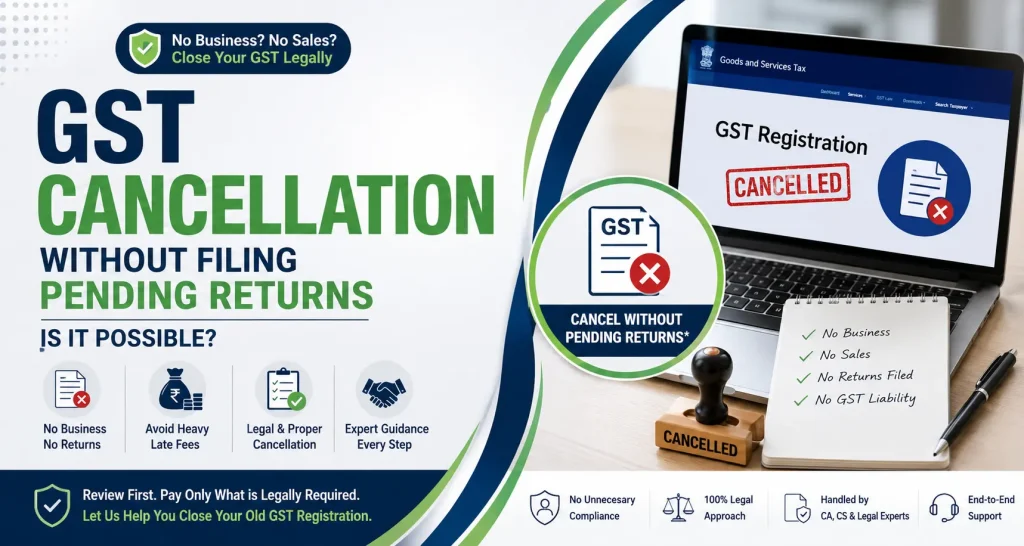
If you took GST registration but never started the business and made no taxable sales or GST supplies, you may not need to immediately file every pending GSTR-1 and GSTR-3B with accumulated late fees just to close the GST registration. Your actual business activity and GST records should first be checked.
This is particularly useful when an old or suspended GSTIN has pending returns and is also creating difficulty in obtaining a new GST registration. Before paying substantial late fees, a genuine no-business case can be reviewed and supported with the appropriate undertaking and GST cancellation application.
Download: GST Cancellation – No Business Undertaking Format
Important: This option is relevant only where the facts support that no business or taxable supply was carried out. It is not a method to avoid GST dues or statutory compliance where actual business activity took place.
Quick answer: If you obtained GST registration but genuinely never started business and made no taxable supplies, do not automatically assume that you must first file every old GSTR-1 and GSTR-3B with heavy late fees. First review the GSTIN status, return history, business activity and tax position to determine the appropriate cancellation route.
Do You Have to File All Pending GST Returns Before Cancellation?
When a GST registration is taken but the business never starts, GSTR-1 and GSTR-3B may continue to remain pending on the GST portal. If these returns are filed after a long delay, late fees and other compliance costs can become substantial.
However, do not start filing all pending returns blindly. First check whether there was actually any business, taxable supply, GST collection or ITC claim during the pending period. If there was genuinely no business activity, the cancellation case can be examined based on the actual facts and supporting documents.
The important point is that GST cancellation and pending return compliance must be reviewed together. The correct approach can help avoid unnecessary compliance costs in a genuine no-business case, while ensuring that any actual GST liability is properly addressed.
Old GST Registration Causing Problems With Your New GST Registration?
This is another common problem. A business owner may close an old venture and later apply for GST registration for a new business, only to face questions about the earlier GSTIN, its cancellation status or pending compliance.
CBIC has instructed officers to examine earlier GST registrations on the same PAN and the reasons for their cancellation while processing a new registration. Therefore, an old GSTIN should not simply be ignored.
If the earlier registration was never used, first establish that fact and properly address the old GSTIN before proceeding with the new registration.
GST Cancellation With Pending Returns – What Is the Actual Position?
Pending returns do not all represent the same situation. A GST registration used for actual business is different from a registration obtained for a proposed business that never commenced.
Where there was actual taxable activity, the applicable returns, tax, interest and late fee must be properly examined. Where the registration was genuinely unused, the taxpayer should first establish the no-business facts and seek the appropriate cancellation treatment.
The final decision is taken by the GST department based on the facts, records and applicable provisions. Therefore, this should not be treated as an automatic waiver of pending return obligations.
GST Cancellation for a Business That Never Started
If you obtained GST registration but never started the business, first verify that there were no sales, taxable supplies, GST collections or ITC claims after registration. This is different from a running business that simply failed to file its returns.
In a genuine no-business case, the facts can be explained to the GST department through a suitable undertaking and cancellation application. This may provide a practical way to deal with the unused GST registration instead of automatically filing years of pending returns and paying substantial late fees.
We first check the GST return history, registration status and actual business activity before deciding the appropriate cancellation process. This is important because the undertaking should reflect the true facts and should not be used where taxable business activity or GST liability actually existed.
Can GST Registration Be Cancelled Without Paying Heavy Late Fees?
If your GST registration was taken but no business was carried out after registration, paying years of accumulated late fees should not be your first step. The actual GST activity and pending compliance should be reviewed before deciding how to close the registration.
For a genuine no-business and no-supply case, a proper undertaking explaining that the business never commenced and that no goods or services were supplied can support the cancellation request. The GST officer may examine the facts and documents before accepting the cancellation.
This is why we recommend a GST registration review before filing old returns. It can identify whether there is a practical cancellation route available in your case and prevent unnecessary compliance work where the registration was never actually used.
GST Cancellation When an Old GSTIN Is Suspended
If your old GST registration is suspended because returns were not filed, the problem can become more serious when you later try to obtain GST registration for a new business. The pending returns and earlier GSTIN status may need to be addressed before the new application can move forward.
Before filing all the old returns and paying accumulated late fees, first check why the GSTIN was suspended, whether any business was actually carried out and whether any GST liability exists. If the registration was never used and there was genuinely no business activity, the facts can be presented to the GST department through the appropriate cancellation process and supporting undertaking.
We review the old GSTIN status, pending returns, business activity and available records and then determine the practical compliance route. This is particularly useful for business owners who need to resolve an old GST registration before starting a new business.
What Should You Check Before Applying for GST Cancellation?
Before closing an old GST registration, check the GSTIN status and complete return history. Do not rely only on the number of pending returns shown on the portal.
- Whether the business actually started
- Whether any goods or services were supplied
- Whether GST invoices were issued
- Whether GST was collected from customers
- Whether any input tax credit was claimed
- Whether any GST notice or order is pending
- Whether the GSTIN is active, suspended or already cancelled
These checks help determine whether your case is a genuine no-business GST cancellation case or whether pending GST returns and liabilities must first be addressed.
Do You Need to File GSTR-10 After GST Cancellation?
GSTR-10 is the final return associated with cancellation of GST registration in applicable cases. It should not be confused with the regular GSTR-1 and GSTR-3B returns that may be pending before cancellation.
Whether and how the final return applies depends on the actual cancellation status and circumstances. Therefore, the GST registration should be reviewed from the beginning of the pending period through the cancellation order rather than looking at only one return.
GST Cancellation Undertaking for a No-Business Case
Where the GST registration was obtained but business never commenced, a written undertaking can explain the actual position to the GST department. It should clearly state that no taxable goods or services were supplied after registration and that the GST registration was not used for business activity.
The undertaking should contain true and verifiable facts and should be supported by the relevant GST records. It is a supporting document for the cancellation request, not a general waiver of GST return or tax liability.
We have prepared a simple GST cancellation undertaking format that can be used as a reference for a genuine no-business case. Before submitting it, the GST registration history and pending compliance should be reviewed based on the individual case.
Download GST Cancellation Undertaking Format
What Happens After the GST Cancellation Application?
After the cancellation application is submitted, the GST officer may review the registration history, pending returns and supporting explanation. If clarification or additional documents are required, the taxpayer must respond within the prescribed time.
For a genuine no-business GST registration, the supporting undertaking and factual explanation can help the officer understand why the registration was never used. The final decision, however, remains with the GST department based on the records and facts of the case.
We follow up on the application and handle the required GST officer clarification or response so that the client does not have to navigate the cancellation process alone.
GST Cancellation vs GST Registration Closure
People commonly search for “GST closure”, “GST cancellation” and “close GST registration” for the same problem. In practice, the formal process is cancellation of the GST registration through the applicable GST procedure.
If the business has stopped permanently, or the registration was obtained but the business never commenced, the reason and supporting facts should be correctly stated in the cancellation application.
GST Cancellation Form – Which Form Is Used?
GST registration cancellation is generally applied through FORM GST REG-16. The application should contain the correct reason for cancellation and relevant details of the business and GST registration.
Where the registration was never used and there was genuinely no business or taxable supply, the cancellation application should be supported by a clear factual explanation and appropriate documents.
Can an Old GSTIN Stop You From Getting a New GST Registration?
Yes, an old or suspended GST registration with pending compliance can create practical difficulties when a business owner later applies for another GST registration. The new application may require clarification regarding the earlier GSTIN and its pending obligations.
Instead of immediately filing every old return, first review the old GSTIN status, return history and actual business activity. If the earlier registration was never used, the facts can be properly presented to the GST department.
GST Cancellation or Pending Returns – What Should You Do First?
If there was actual business activity, pending returns and tax liability must be properly examined. But if the GST registration was taken and the business never commenced, it is sensible to review the cancellation position before creating additional compliance costs by filing old returns.
The correct decision depends on the actual facts, GST portal history, tax position and notices or orders, not simply on the number of pending returns appearing on the portal.
When Should You Not Use the No-Business Cancellation Route?
This approach should not be used where the business actually operated or GST liability was created. If there were sales, taxable supplies, GST collection, invoices, ITC claims or undisclosed transactions, the pending compliance needs to be properly addressed.
A no-business undertaking should contain only true and verifiable facts. It is not a method for avoiding genuine GST tax, interest or statutory liabilities.
Documents to Keep Ready for GST Cancellation Review
- GST registration certificate and GSTIN details
- GST return filing history
- Electronic cash and credit ledger details
- Sales and purchase records, where applicable
- Previous GST notices or cancellation/suspension orders
- Proof or explanation showing that business did not commence, where applicable
- No-business undertaking/affidavit, where appropriate
These documents help establish whether the registration was actually used and what compliance position needs to be addressed.
Real GST Cancellation Case Handled by Our Team
We have handled cases where a client had taken GST registration for a proposed business, but the business never actually commenced. Later, the client found that several GST returns were pending and was concerned about the accumulated late fees involved in closing the registration.
Instead of immediately asking the client to file every pending return, we first reviewed the GST registration history, business activity and available records. The no-business facts were then documented and the appropriate GST cancellation representation was prepared.
The important lesson: if your GST registration was never used, first examine the facts and available cancellation options before assuming that years of late returns must automatically be filed.
GST Cancellation Without Filing Pending Returns – Frequently Asked Questions
Can I cancel GST registration without filing pending returns?
In a genuine no-business case, the cancellation position should be reviewed before automatically filing all pending returns. The GST department will consider the facts and supporting documents.
Can I cancel GST if my business never started?
Yes, a registration obtained for a business that never commenced can be considered for cancellation. The no-business facts should be properly established.
Can I cancel GST without paying late fees?
Do not assume that late fees are automatically waived. First determine whether your case genuinely qualifies for a different cancellation approach and whether any statutory liability exists.
Can a suspended GST registration be closed?
The reason and status of the suspension must first be checked. The appropriate action depends on the GST history and whether there was any actual business activity.
My old GSTIN is causing a problem with a new GST registration. What should I do?
First resolve the status and pending compliance of the old GSTIN. If the old registration was never used, the no-business facts should be reviewed before incurring substantial old-return filing costs.
Can I use an undertaking for GST cancellation?
An undertaking can be used as supporting documentation where the facts genuinely support a no-business case. It should accurately state the actual position and should not be used to conceal business activity or GST liability.
Should I file all old GSTR-1 and GSTR-3B immediately?
Not before reviewing the case. Check the actual business activity, GSTIN status, pending periods, ITC and tax liability first. The correct compliance route depends on these facts.
Have an Old GSTIN With Years of Pending Returns?
Do not pay substantial GST late fees simply because the portal shows old pending returns. If the business never started or the GST registration was never actually used, get the registration history and facts reviewed first.
At DSCSign, our CA, CS and legal team in Bangalore reviews the old GSTIN, pending returns, business activity and GST status, prepares the required representation and undertaking where appropriate, and handles the cancellation process and GST officer clarification.
GST Registration Cancellation Support – Bangalore
Sahakarnagar, Bangalore – 560092
Help Desk: 6362877942
Email: one@dscsign.com
Important: Every GST cancellation case is fact-specific. The no-business route should be considered only where the taxpayer’s actual records support the statements made in the undertaking and application.
Does GST Cancellation Remove Earlier GST Liability?
No. GST cancellation should not be treated as a way to erase an earlier tax liability. If taxable supplies, GST collection, incorrect ITC or other statutory liability existed, cancellation does not make those obligations disappear.
The purpose of reviewing a no-business case is different: to establish that the GST registration was genuinely unused and that there was no underlying taxable activity or GST liability requiring concealment.
Before Paying Years of GST Late Fees, Check These 8 Things
- Was any business actually started?
- Were any sales or taxable supplies made?
- Were GST invoices issued?
- Was GST collected from customers?
- Was any ITC claimed?
- Is the GSTIN active, suspended or cancelled?
- Are any GST notices or orders pending?
- Is the old GSTIN affecting a new GST registration?
If the answer to these questions shows that the GST registration was genuinely unused, obtain a professional review before deciding to file years of pending returns.
Written & Reviewed By: Sai Suresh, CA, CS & Legal Advisor
Experience: 20+ years in GST, Income Tax, MCA/ROC and business compliance
Last Updated: September 2026
More Business Compliance Services
- Private Limited Company Registration – Start your new company with proper compliance.
- MCA & ROC Filing – Stay compliant with company and ROC requirements.
- Income Tax Filing in Bangalore – Professional tax filing and compliance support for businesses.
- Payroll Services in Bangalore – Manage payroll and related statutory compliance.
- CA Services in Bangalore – Get CA, tax and business compliance support from an experienced team.