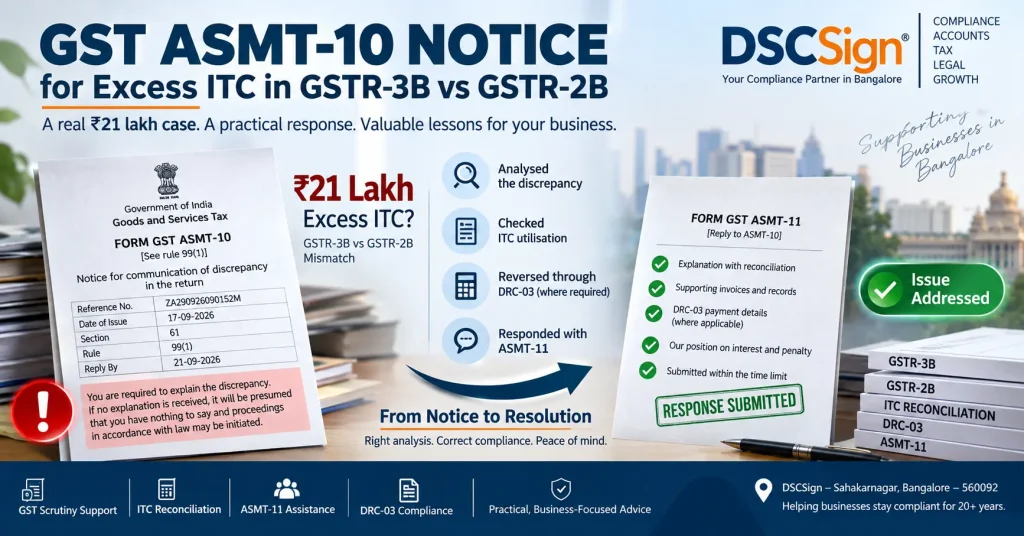
Received a GST ASMT-10 Notice for Excess ITC? Check the Mismatch Before It Becomes a Demand
A GST ASMT-10 notice for excess ITC can quickly become a serious compliance issue if the GSTR-3B versus GSTR-2A/2B difference is not properly examined. The notice means that the GST officer has identified a discrepancy during scrutiny of the return and wants the taxpayer to explain it. If the discrepancy is genuine and remains unresolved, the department may proceed further under the GST law, including recovery of applicable tax, interest and penalty.
The right first step is not to copy a standard GST reply. Reconcile the figures first. Compare the department’s calculation with your purchase register, invoices, GSTR-2B, GSTR-3B and Electronic Credit Ledger. This helps establish whether the difference is actually excess ITC, a timing difference, an amendment or reporting issue, or an amount that genuinely needs to be reversed.
We recently handled a real GST scrutiny case of SWITCH Pvt Ltd in Bengaluru for FY 2022-23. The company received a GST ASMT-10 notice under Section 61 on 17 September 2026. The notice compared ITC reported in GSTR-3B with ITC available in GSTR-2A/2B and identified a substantial difference. The department’s notice required the taxpayer to explain the discrepancy and directed reversal of the identified ITC along with applicable interest and penalty.
The important part of this case was not merely filing an ASMT-11. We first examined the month-wise ITC figures, considered the nature of the mismatch and reviewed the company’s Electronic Credit Ledger. After the review, the company reversed the identified CGST and SGST amount of ₹21,15,814 through Form GST DRC-03 and submitted the payment details along with its ASMT-11 reply.
The ASMT-11 also placed an important factual point before the department: the company’s Electronic Credit Ledger had maintained an unutilised balance exceeding the disputed credit until the reversal. On that basis, the taxpayer requested the department to take the reversal on record and drop the proposed interest and penalty. The DRC-03 filed in the case recorded zero interest and zero penalty.
Got an ASMT-10 notice? Your first question should be: “Is the department’s ITC mismatch actually correct?”
Before accepting the figure or paying tax, check the invoice-level reconciliation, return-period differences, eligible ITC, reversals and Electronic Credit Ledger utilisation. A proper review can tell you whether the right response is an explanation, reconciliation, ITC reversal, payment through DRC-03, or a combination of these steps.
DSCSign helps businesses in Bengaluru and Karnataka handle this process from notice review to response. Our GST team examines the scrutiny notice, verifies the underlying figures, works through the ITC reconciliation, evaluates the payment and utilisation position, and prepares the appropriate response rather than submitting a generic template.
What Exactly Is a GST ASMT-10 Notice?
FORM GST ASMT-10 is a scrutiny notice issued when the GST department finds a discrepancy in a taxpayer’s return. In practical terms, the officer is telling the taxpayer: “We have identified something in your GST return that needs an explanation.” It is therefore important to read the notice carefully and understand exactly what has been questioned before deciding whether to pay, reverse ITC or submit an explanation.
The scrutiny mechanism operates under Section 61 of the CGST Act, 2017, read with Rule 99 of the CGST Rules, 2017. The department may examine the return and communicate discrepancies identified during scrutiny through FORM GST ASMT-10. The taxpayer can then submit an explanation in FORM GST ASMT-11.
An ASMT-10 should not be confused with a final GST demand notice or DRC-01. At the scrutiny stage, the taxpayer has an opportunity to explain the discrepancy or correct the position. However, ignoring the notice is risky because the notice itself can lead to further proceedings if the discrepancy is not satisfactorily addressed.
Why Are Businesses Receiving ASMT-10 Notices for ITC Mismatch?
One common scrutiny issue is a difference between the Input Tax Credit claimed in GSTR-3B and the ITC reflected in GSTR-2A/2B. When the department’s data indicates that the credit claimed in the return is higher than the credit available in the corresponding records, the taxpayer may receive an ITC mismatch notice.
But a difference in two GST reports does not by itself explain why the difference occurred. GST data can change because of supplier reporting, amendments, credit notes, invoice timing and differences in the period in which ITC is accounted for or claimed. Therefore, a proper scrutiny response should establish the reason for the difference instead of merely accepting or rejecting the department’s calculation.
ASMT-10 in Simple Terms
Department identifies discrepancy → GST ASMT-10
Taxpayer examines and explains/corrects it → GST ASMT-11
If payment/reversal is required → Appropriate payment process, including DRC-03 where applicable
Department considers the response → Further action depends on the explanation, compliance and applicable GST provisions
What Should You Check Immediately After Receiving ASMT-10?
Do not start by drafting the reply. Start by checking the notice reference number, tax period, discrepancy identified, department’s calculation and response deadline. Then compare those figures with your own GST records.
For an ITC-related notice, the review should normally cover GSTR-3B, GSTR-2B/2A, purchase register, tax invoices, ITC reversals and the Electronic Credit Ledger. The objective is to establish the actual reason for the mismatch and determine whether the amount mentioned in the notice is fully payable, partly payable, or explainable through supporting records.
This distinction matters because a GST scrutiny response is not simply about submitting a form before the deadline. The explanation and supporting reconciliation should address the exact discrepancy raised by the officer.
What Happened in the SWITCH Case?
In the SWITCH case, the ASMT-10 specifically identified excess ITC availed in GSTR-3B compared with ITC available in GSTR-2A/2B. The department provided a month-wise comparison for April 2022 to March 2023 rather than giving only a single annual figure.
The notice stated that the difference represented excess ITC and directed the taxpayer to reverse the identified amount with applicable interest and penalty and submit an explanation through FORM GST ASMT-11. This made the month-wise figures and the taxpayer’s underlying credit records particularly important while preparing the response.
Practical point: Never assume that the figure in an ASMT-10 is automatically the final amount payable. First understand how the department arrived at the figure and reconcile it with your own records. If there is a genuine mismatch, correct it; if there is a valid explanation, document it properly.
Inside the ₹21 Lakh ITC Mismatch: What Did the GST Officer Actually Find?
The most important part of an ASMT-10 notice for ITC mismatch is often hidden inside the working attached to the notice. In the SWITCH case, the GST officer did not merely mention an annual difference. The notice contained a month-wise comparison of ITC reported in GSTR-3B against ITC available in GSTR-2A/2B for April 2022 to March 2023.
This distinction is important for any business receiving a GSTR-3B vs GSTR-2B mismatch notice. A month in which GSTR-3B is higher than the corresponding 2B figure does not, by itself, explain the entire annual position. The surrounding months also have to be examined because supplier reporting, timing and return-period differences can affect the comparison.
The Month-Wise Figures in the Notice
The following is a simplified presentation of the figures appearing in the actual ASMT-10 issued to SWITCH. The purpose is to show how the department’s scrutiny working was structured.
| Month | CGST ITC in 2B | CGST in GSTR-3B | Difference |
|---|---|---|---|
| April | ₹1,03,998 | — | ₹1,03,998 |
| May | ₹7,27,092 | — | ₹7,27,092 |
| June | ₹13,907 | ₹6,97,166 | -₹6,83,259 |
| July | ₹39,022 | — | ₹39,022 |
| August | ₹5,07,736 | — | ₹5,07,736 |
| September | ₹10,70,940 | ₹24,22,874 | -₹13,51,934 |
| October | ₹1,27,385 | — | ₹1,27,385 |
| November | ₹37,764 | — | ₹37,764 |
| December | ₹1,06,752 | ₹6,99,833 | -₹5,93,081 |
| January | ₹63,559 | — | ₹63,559 |
| February | ₹40,876 | — | ₹40,876 |
| March | ₹7,089 | ₹84,154 | -₹77,065 |
| Total | ₹28,46,120 | ₹39,04,027 | ₹10,57,907 |
The same comparison was made for SGST, with the notice showing the same ₹10,57,907 difference. The detailed table also showed an IGST figure of ₹1,612. The department ultimately stated in the notice that excess ITC was required to be reversed and referred to Section 73, interest under Section 50 and penalty provisions.
Why the Month-Wise Comparison Matters
Look closely at the figures. In some months, the department’s table showed substantial ITC in 2B while no corresponding amount appeared in the GSTR-3B column. In other months, the GSTR-3B figure was significantly higher than the 2B figure. This is precisely why an annual ITC mismatch should not be analysed by looking at only one month’s return.
For example, the June figures in the notice showed CGST ITC of ₹13,907 in 2B against ₹6,97,166 in GSTR-3B. September showed ₹10,70,940 in 2B against ₹24,22,874 in GSTR-3B. December and March also showed differences in the opposite direction.
For a professional GST review, these movements raise an important practical question: does the apparent difference represent genuinely ineligible or excess ITC, or does the monthly comparison need to be understood together with the underlying invoices, accounting records and subsequent reporting?
Do not reconcile GST only by looking at the final number.
A good GST scrutiny review follows the difference back to the invoice, supplier return, purchase register, GSTR-2B, GSTR-3B and credit ledger. The objective is to understand the transaction trail behind the number.
What Was the Practical Issue in This Case?
The department treated the comparison as excess ITC and directed reversal. The notice stated that the taxpayer was liable to reverse the identified amount and submit an explanation through FORM GST ASMT-11.
Our review therefore had two separate objectives. First, we had to determine the amount that needed to be addressed from a compliance perspective. Second, we had to examine the Electronic Credit Ledger position because the question of utilisation can become relevant when considering the department’s proposed interest.
This is an important distinction for businesses. Tax reversal, interest and penalty are not necessarily the same question. Each component should be examined separately against the facts and applicable provisions rather than simply accepting the entire figure mentioned in a scrutiny notice.
The Next Step: Reconciliation Before Reply
Once the department’s working was understood, the next step was to prepare the taxpayer’s own reconciliation and determine the appropriate compliance action. In this case, the company proceeded with reversal of ₹21,15,814 of CGST and SGST through DRC-03 and referred to that payment in its ASMT-11 response.
The ASMT-11 also explained the Electronic Credit Ledger position and requested that the proposed interest and penalty be dropped. The response was therefore based on the actual compliance undertaken and the taxpayer’s specific factual position rather than a generic statement disputing the notice.
How We Analysed and Responded to the GST ASMT-10
Once the ASMT-10 was received, the immediate priority was to understand what the GST department had actually compared and how the disputed ITC figure had been arrived at. We did not begin by preparing a standard reply. The notice, month-wise ITC comparison and the company’s GST records had to be considered together.
Step 1: Read the Notice Before Accepting the Figure
We first checked the tax period, notice reference, section under which the scrutiny was initiated, discrepancy identified and the response deadline. In the SWITCH case, the system-generated ASMT-10 was issued on 17 September 2026 under Section 61 for FY 2022-23 and required the reply by 21 September 2026.
The notice specifically alleged excess ITC in GSTR-3B compared with GSTR-2A/2B. It also contained a month-wise calculation. This meant that the response needed to address the underlying figures rather than merely state that the taxpayer disagreed with the department’s observation.
Step 2: Reconcile GSTR-3B With GSTR-2A/2B
The next step was to examine the ITC data against the taxpayer’s records. For an ITC mismatch notice, we look beyond the total figure and examine the purchase records, tax invoices, supplier reporting and the period in which the credit was reflected or claimed.
This helps separate a genuine excess ITC claim from a difference that requires further factual examination. A reconciliation should answer a simple question: “Can the difference shown in the notice be traced and explained from the taxpayer’s records?”
Step 3: Examine the Electronic Credit Ledger
The next issue was the taxpayer’s Electronic Credit Ledger. This becomes particularly important when the department proposes interest on allegedly excess or wrongly availed ITC. The relevant factual question is whether the disputed credit was actually utilised for payment of output tax.
In the SWITCH case, the ASMT-11 reply specifically stated that the Electronic Credit Ledger had maintained an unutilised balance exceeding the disputed credit amount throughout the relevant period until reversal. The taxpayer therefore requested that interest should not be levied on the basis that the disputed credit had not been utilised.
Important GST point: Do not calculate interest on an ITC mismatch merely from the amount mentioned in ASMT-10. First examine the facts surrounding availment, utilisation, ledger balance and reversal. The applicable GST provisions must then be applied to those facts.
Step 4: Decide Whether Explanation or Reversal Is Required
After reviewing the discrepancy, the taxpayer needs to decide what action is appropriate. There are cases where the figures can be explained through supporting records. There are also cases where part or all of the ITC needs to be reversed.
In the SWITCH case, the company proceeded with reversal of the identified CGST and SGST amount of ₹21,15,814. The payment was made through FORM GST DRC-03 on 17 September 2026 and was linked to the scrutiny reference mentioned in the ASMT-10.
Step 5: Coordinate DRC-03 With the ASMT-11 Reply
Making a payment alone does not explain the discrepancy. The ASMT-11 reply should tell the department what action has been taken and provide the relevant payment reference wherever payment has been made.
In this case, the ASMT-11 referred to the DRC-03 ARN AD290926044260Y dated 17 September 2026. The reply recorded the CGST and SGST amounts paid and stated the taxpayer’s position regarding the unutilised Electronic Credit Ledger balance.
The taxpayer therefore requested the department to take the DRC-03 payment on record, consider the explanation and drop the proposed interest and penalty. This kept the tax reversal and the taxpayer’s position on interest and penalty clearly separated within the response.
Step 6: Keep Proof of Every Compliance Action
A GST scrutiny file should contain a complete trail of what was received, what was reconciled, what was paid and what was submitted. In the SWITCHNET matter, the DRC-03 payment record and ASMT-11 reply provided documentary evidence of the action taken on the scrutiny notice.
This becomes especially useful if the matter requires further communication with the department. Instead of reconstructing the case later, the taxpayer has a clear compliance file containing the ASMT-10, reconciliation, DRC-03, payment ARN and ASMT-11 response.
Our Practical ASMT-10 Review
Notice received → Understand the exact allegation
Figures checked → Compare GSTR-3B, GSTR-2B and books
ITC reviewed → Identify the reason for the discrepancy
Ledger examined → Check utilisation position
Tax action taken → Reverse/pay the amount where required
ASMT-11 filed → Explain the action and place the evidence on record
This is the difference between merely “replying to a GST notice” and actually analysing a GST scrutiny case. The objective is to ensure that the department’s allegation, the taxpayer’s records, the tax reversal and the legal position on interest and penalty are all addressed in one coherent response.
Is Interest Automatically Payable on Excess ITC?
Not every ITC mismatch should be treated as an automatic interest calculation. When a GST scrutiny notice alleges wrongly availed or excess ITC, the taxpayer should separately examine three questions: Was the ITC wrongly availed? Was it actually utilised? When was it reversed or paid?
This distinction is important because the GST rules contain a specific mechanism for interest on wrongly availed and utilised ITC. Under Rule 88B, interest in such a case is calculated from the date of utilisation of the wrongly availed ITC until the date of reversal or payment. The rule also provides a method for determining when wrongly availed ITC is treated as utilised by reference to the balance in the Electronic Credit Ledger.
Availment and Utilisation Are Not the Same Question
A business may find that the ITC shown in its GSTR-3B is higher than the ITC identified by the department from GSTR-2A/2B. That creates a question regarding the eligibility or correctness of the credit. But the interest analysis requires a further examination of whether the disputed credit was actually utilised.
The Electronic Credit Ledger therefore becomes an important document in an ITC scrutiny case. If the ledger balance remained sufficient and the disputed credit did not result in the utilisation contemplated under the applicable rule, the taxpayer may have a factual basis to contest the proposed interest. This has to be established from the actual ledger and return history; it should not be assumed merely because the taxpayer says the credit was unused.
Practical check before accepting GST interest:
Review the Electronic Credit Ledger around the relevant periods and determine whether the balance fell below the amount of wrongly availed ITC. The calculation should be based on the actual ledger movement and applicable GST provisions, not simply on the amount mentioned in the ASMT-10.
What Did We Place Before the GST Officer in the SWITCH Case?
In the SWITCH case, the ASMT-11 reply specifically stated that the company’s Electronic Credit Ledger consistently maintained an unutilised balance exceeding the disputed credit amount until reversal. The taxpayer relied on this factual position while requesting that interest should not be levied.
The company also reversed the identified CGST and SGST amount through FORM GST DRC-03. The DRC-03 filed on 17 September 2026 recorded CGST of ₹10,57,907 and SGST of ₹10,57,907, with zero interest and zero penalty.
The ASMT-11 therefore did two things separately: it recorded the tax compliance through DRC-03 and placed the taxpayer’s factual and legal position on interest and penalty before the department. This is an important approach when responding to a scrutiny notice because payment of tax does not mean that every additional amount proposed in the notice should automatically be accepted without examination.
When Should a Business Be Careful?
The unutilised-credit argument should not be used as a blanket formula. If the disputed ITC was actually utilised, the interest analysis can be different. Similarly, other facts surrounding the ITC may affect the liability, including the nature of the discrepancy, eligibility of the credit, reversal requirements and the applicable statutory provisions for the relevant period.
For this reason, a GST professional should review the Electronic Credit Ledger, GSTR-3B filing dates, ITC amounts, reversal entries and payment dates before advising whether interest is payable. A one-line statement that “ITC was not utilised” without supporting ledger analysis is not sufficient for a serious scrutiny response.
Tax, Interest and Penalty Should Be Analysed Separately
A common mistake in GST notice handling is to treat the figure in the notice as one single liability. In practice, the response should identify the tax amount, interest position and penalty exposure separately.
For example, where an ITC reversal is accepted, the taxpayer can comply with the tax component while separately explaining why the proposed interest requires examination. Likewise, the applicability of penalty depends on the relevant statutory provision and facts of the case. The response should therefore not concede all three components merely because the taxpayer decides to correct the ITC.
Important: An unutilised Electronic Credit Ledger balance is a factual issue to be demonstrated, not a universal exemption from GST interest. The exact liability should be determined from the applicable provisions and the taxpayer’s actual ledger and return records.
In the SWITCH case, the taxpayer specifically requested that the proposed interest and penalty be dropped. The documents available to us establish that request and the corresponding DRC-03 payment; they do not establish a final departmental order accepting that request. For that reason, this case study should present the interest issue as the taxpayer’s documented position rather than claim that the department has finally ruled in its favour.
How to Reply to GST ASMT-10: What Should You Include in ASMT-11?
Receiving ASMT-10 is only the first stage; the quality of your ASMT-11 reply can determine how clearly your position is placed before the GST officer. A proper reply should address the specific discrepancy mentioned in the notice, explain the factual position, provide the supporting reconciliation and record any corrective action already taken.
For an ITC mismatch notice, avoid replying with a general statement such as “the ITC is correct” or “the difference is due to 2B.” The response should demonstrate how the figures were examined and, wherever necessary, identify the amount accepted for reversal and the basis on which any remaining amount is disputed or explained.
ASMT-11 Reply Checklist for ITC Mismatch
| Part of Reply | What to Address |
|---|---|
| Notice details | ASMT-10 reference number, date, tax period and section. |
| Discrepancy | Clearly identify the ITC mismatch raised by the department. |
| Reconciliation | Explain the difference using GSTR-3B, GSTR-2B/2A and underlying records. |
| Tax compliance | State the amount reversed or paid, where applicable. |
| DRC-03 details | Quote the DRC-03 ARN and payment date where payment has been made. |
| Interest | Address utilisation and the Electronic Credit Ledger position where relevant. |
| Penalty | State the taxpayer’s position based on the applicable provisions and facts. |
| Request | Clearly state what action is requested from the department. |
What Did the SWITCH ASMT-11 Reply Contain?
The SWITCH response provides a useful real-world example of how the reply can be structured. The ASMT-11 identified the original scrutiny reference and tax period and then directly addressed the alleged excess ITC.
The company stated that it had reversed ₹21,15,814, comprising CGST of ₹10,57,907 and SGST of ₹10,57,907, through FORM GST DRC-03. The reply specifically quoted the DRC-03 ARN AD290926044260Y dated 17 September 2026 and stated that the payment receipt was attached.
The response then dealt separately with the interest issue. It stated that the company’s Electronic Credit Ledger had consistently maintained an unutilised balance exceeding the disputed credit amount until reversal. On that factual basis, the taxpayer stated its position that interest was not legally leviable.
The reply also stated that the reversal was made immediately upon the scrutiny communication and requested the department to take the DRC-03 payment on record, consider the explanation and drop the proposed interest and penalty.
Why the DRC-03 ARN Should Be Clearly Mentioned
If tax has already been paid or ITC has been reversed through DRC-03, the payment should not be left disconnected from the ASMT-11 reply. The officer reviewing the scrutiny proceedings should be able to identify what was paid, under which proceeding, when it was paid and how it relates to the discrepancy in ASMT-10.
In the SWITCH case, the DRC-03 itself recorded the cause of payment as “Scrutiny”, referred to the Section 61 proceedings and quoted the ASMT-10 scrutiny reference. This created a clear documentary connection between the notice and the payment.
Documents to keep ready for an ASMT-10 reply
- Copy of GST ASMT-10
- GSTR-3B for the relevant tax period
- GSTR-2B / relevant GSTR-2A data
- Purchase register and invoice-level reconciliation
- ITC reversal working, wherever applicable
- Electronic Credit Ledger details
- DRC-03 payment receipt and ARN, if payment is made
- ASMT-11 reply and supporting documents
Do Not Submit a Generic ASMT-11
A generic reply may technically respond to the notice but fail to answer the officer’s actual question. If the notice contains a detailed month-wise ITC comparison, the response should address that calculation with equally clear supporting records.
Similarly, if the taxpayer accepts a particular amount for reversal but disputes interest or penalty, the reply should clearly separate those positions. Tax payment should not automatically be treated as acceptance of every other component proposed in the notice.
For this reason, our approach at DSCSign is to prepare the response only after understanding the notice, reconciliation, payment position and ledger utilisation. The ASMT-11 then becomes a concise record of the taxpayer’s actual compliance and explanation rather than a standard template.
What Happens If You Ignore a GST ASMT-10 Notice?
Ignoring a GST ASMT-10 is not a safe option. The purpose of the notice is to give the taxpayer an opportunity to explain a discrepancy identified during scrutiny. If the taxpayer does not respond within the specified time, the department can proceed further in accordance with the GST law.
This is particularly important where the notice concerns excess ITC, GSTR-3B vs GSTR-2B mismatch or another return discrepancy. A business may believe that the difference is only a reconciliation issue, but if the department does not receive the explanation and supporting records, that position may never be placed on record during the scrutiny stage.
ASMT-10 Is an Opportunity to Explain the Discrepancy
An ASMT-10 should be understood as part of the GST return scrutiny process. The officer communicates the discrepancy and the taxpayer gets an opportunity to submit an explanation through FORM GST ASMT-11.
Where the taxpayer provides a satisfactory explanation or complies with the discrepancy identified, the scrutiny process can move towards closure in accordance with the applicable procedure. Where the discrepancy remains unresolved, the department may take further action under the relevant provisions of the GST law.
Think of ASMT-10 as the stage where you should establish the facts.
Do not wait for a formal demand proceeding before collecting invoices, reconciling ITC and checking the Electronic Credit Ledger. The earlier the discrepancy is properly analysed, the easier it is to determine the appropriate response.
ASMT-10, ASMT-11 and Further Proceedings: What Is the Difference?
| Form / Stage | Purpose |
|---|---|
| ASMT-10 | Department communicates discrepancies identified during scrutiny of the return. |
| ASMT-11 | Taxpayer submits an explanation to the discrepancies communicated in ASMT-10. |
| ASMT-12 | Used by the proper officer to communicate acceptance of the taxpayer’s explanation where the scrutiny discrepancy is satisfactorily addressed. |
| Further GST proceedings | If the discrepancy is not satisfactorily resolved, the department may proceed under the applicable demand provisions and follow the prescribed procedure. |
What Did the SWITCH ASMT-10 Say?
The actual SWITCH ASMT-10 stated that the taxpayer was required to explain the discrepancy and report compliance. It also specifically stated that if no explanation was received, it would be presumed that the taxpayer had nothing to say and proceedings in accordance with law could be initiated without further reference.
The system-generated notice dated 17 September 2026 specified 21 September 2026 as the date by which the reply had to be submitted. This left only a short period for the company to understand the notice, review the ITC position and prepare its response.
This is why businesses should not leave an ASMT-10 until the last day. The time between receiving the notice and the response deadline may be needed for collecting old invoices, downloading GST reports, reconciling purchase records and reviewing the credit ledger.
What Can Happen After an Unresolved Discrepancy?
The exact next step depends on the nature of the discrepancy and the applicable statutory provisions. In an ITC case, the department may examine whether the credit was admissible, whether any amount remains recoverable and whether interest or penalty provisions apply.
The taxpayer should therefore avoid treating an ASMT-10 as if it were already a final demand. At the same time, it should not be treated as an informal communication that can be ignored. It is a formal scrutiny communication and should be answered with a fact-based response.
A Poor Reply Can Create a Second Problem
A weak reply may simply repeat that “ITC is correct” without explaining the figures. Another common mistake is accepting the entire amount mentioned in the notice without checking the underlying calculation, utilisation position or supporting records.
The better approach is to divide the issue into separate components: What amount is actually disputed? What amount is accepted? What amount can be explained? What has already been reversed or paid? Is interest applicable based on the actual utilisation position? What is the taxpayer’s position on penalty?
That approach was particularly relevant in the SWITCH matter because the department’s notice contained a detailed month-wise calculation, while the taxpayer’s response dealt separately with the tax reversal and the interest and penalty position.
Do not ignore the notice. Do not blindly accept it either.
First verify the calculation, establish the factual position, and then decide whether the appropriate response is explanation, reconciliation, reversal, payment, or a combination of these actions.
Our Practical Approach to GST Scrutiny Notices
For businesses in Bangalore, a GST scrutiny notice can involve records from an earlier financial year that are no longer immediately available with the accounts team. Our role is to reconstruct the relevant transaction trail, understand the department’s calculation and prepare the response based on the records available.
At DSCSign, we handle GST scrutiny from the notice stage through reconciliation, response preparation and compliance documentation. Where a matter requires further proceedings or representation, the case can be evaluated separately based on the notice and facts.
How to Prevent GSTR-3B vs GSTR-2B ITC Mismatch
The best way to avoid another GST scrutiny notice is to reconcile ITC before filing GSTR-3B. Do not wait for an ASMT-10 to discover that the credit claimed in the return does not match the available GST data.
Businesses should regularly compare GSTR-2B, purchase records and GSTR-3B, identify invoices that are missing or incorrectly reported, and track ITC reversals separately. The Electronic Credit Ledger should also be reviewed where an ITC issue may later involve interest.
- Reconcile GSTR-2B before GSTR-3B filing.
- Match invoices with the purchase register.
- Follow up with suppliers for missing or incorrect invoice reporting.
- Track ITC reversals with proper working papers.
- Review the Electronic Credit Ledger for significant ITC issues.
- Keep monthly reconciliation records instead of preparing them only after receiving a notice.
For Bangalore businesses, maintaining this reconciliation discipline can make a significant difference when responding to a future GST scrutiny notice, ITC mismatch notice or ASMT-10.
Documents to Keep Ready for a GST ASMT-10 Reply
A proper GST scrutiny response depends on records. Before preparing ASMT-11, keep the notice and supporting GST records together so that the discrepancy can be checked against actual transactions.
ASMT-10 Document Checklist
- GST ASMT-10 notice with reference number and discrepancy details
- GSTR-3B returns for the relevant period
- GSTR-2B / GSTR-2A data
- Purchase register and ITC reconciliation
- Relevant tax invoices and supporting records
- ITC reversal working, wherever applicable
- Electronic Credit Ledger for utilisation analysis
- DRC-03 payment receipt and ARN, where payment/reversal is made
- ASMT-11 reply with supporting documents
The exact documents required will depend on the discrepancy mentioned in the notice. For a simple ITC mismatch, invoice-level reconciliation may be central; for other GST scrutiny issues, additional books, returns or transaction records may be necessary.
Key Takeaway From the SWITCH GST Scrutiny Case
An ASMT-10 should not be answered mechanically. The department’s calculation should first be understood and reconciled with the taxpayer’s records.
In the SWITCH case, the response involved reviewing the ITC discrepancy, considering the Electronic Credit Ledger, reversing the identified CGST and SGST amount through DRC-03 and submitting the corresponding ASMT-11 with the payment details and the taxpayer’s position on interest and penalty.
The practical lesson: When you receive a GST scrutiny notice, check the numbers first, establish the facts, and then decide whether the correct response is an explanation, reconciliation, reversal, payment or a combination of these actions.
Received a GST ASMT-10 Notice in Bangalore?
Do not accept the amount mentioned in an ITC mismatch notice without checking the calculation. If your business has received an ASMT-10 for excess ITC, GSTR-3B vs GSTR-2B mismatch or another GST scrutiny issue, the first step is to understand exactly what the department has identified.
DSCSign helps businesses review GST scrutiny notices, reconcile ITC, examine the Electronic Credit Ledger, coordinate DRC-03 compliance where required and prepare ASMT-11 responses based on the actual records and facts of the case.
Need Your GST Notice Reviewed?
Share your ASMT-10 notice with our team for an initial review. We can identify the discrepancy, explain what records are required and advise on the appropriate compliance response.
DSCSign – Sahakarnagar, Bangalore – 560092
Help Desk: 6362877942
Email: one@dscsign.com
Working Hours: Monday–Saturday | 11:00 AM–8:00 PM
GST ASMT-10 – Frequently Asked Questions
These are some of the common questions businesses ask after receiving a GST scrutiny notice for ITC mismatch.
1. What is GST ASMT-10?
GST ASMT-10 is a notice used to communicate discrepancies identified by the GST officer during scrutiny of a return under Section 61. The taxpayer is given an opportunity to explain or address the discrepancy through ASMT-11.
2. How do I reply to an ASMT-10 notice?
First understand the discrepancy and reconcile it with your GST records. Depending on the facts, the response may involve an explanation, supporting reconciliation, reversal/payment of tax or other corrective action, followed by submission of FORM GST ASMT-11.
3. What is the difference between ASMT-10 and ASMT-11?
ASMT-10 is the discrepancy notice issued by the department. ASMT-11 is the taxpayer’s reply explaining how the discrepancy has been addressed. The two forms therefore represent different stages of the scrutiny process.
4. Can excess ITC be reversed through DRC-03?
Where reversal or payment is required, DRC-03 may be used in the appropriate circumstances. The payment details should be properly connected with the scrutiny proceedings and referred to in the ASMT-11 response.
5. Is interest automatically payable on excess ITC?
The interest position requires examination of the applicable GST provisions and the actual facts, including whether wrongly availed ITC was utilised. The Electronic Credit Ledger should therefore be reviewed before accepting an interest calculation.
6. What happens if I do not reply to ASMT-10?
If the taxpayer does not respond within the specified time, the department may proceed further in accordance with the applicable GST provisions. It is therefore advisable to examine and respond to the notice within the prescribed period rather than leaving the discrepancy unanswered.
7. Is a GSTR-3B vs GSTR-2B difference always an excess ITC claim?
Not necessarily. The difference should be investigated against invoices, purchase records, supplier reporting, return periods, amendments and ITC reversals. The correct position can only be determined after examining the underlying records and the nature of the discrepancy.
8. Will filing DRC-03 automatically close the GST scrutiny proceedings?
Not automatically. Payment through DRC-03 addresses the payment/reversal aspect, but the taxpayer should also respond to the scrutiny notice and place the relevant explanation and documents on record. The subsequent departmental action depends on the facts and applicable procedure.
About the Author
Sai Suresh – CA, CS & Legal Advisor, has 20+ years of professional experience in GST, Income Tax, MCA/RoC, company law, intellectual property and legal compliance. His work focuses on helping businesses address practical tax and regulatory issues with proper documentation and compliance.
DSCSign has been serving businesses in Bangalore for more than 20 years across GST, accounting, income tax, company registration, trademark and legal compliance services.
Last Updated: September 2026