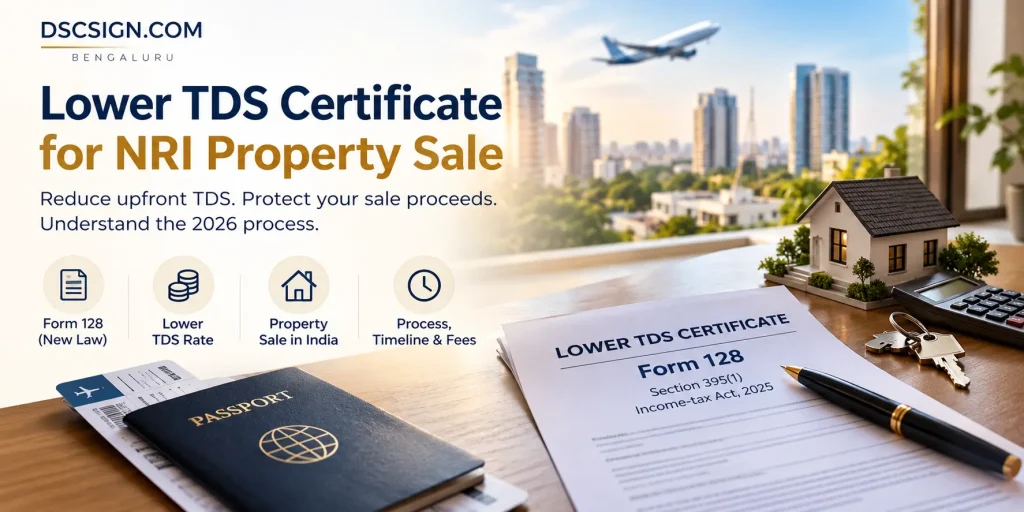
Reduce Unnecessary TDS Outgo on Your Indian Property Sale
Selling a flat, house or other immovable property in India while living abroad? A substantial amount may be deducted as tax at source from your sale proceeds, even when your estimated final capital gains tax liability may be lower.
A Lower TDS Deduction Certificate (LDC) may allow the buyer to deduct tax at an approved lower rate. Our team assists with tax estimation, document verification, online application, departmental follow-up and certificate-related compliance.
Already working under the new Income-tax Act, 2025 framework, effective from 1 April 2026: We have successfully handled multiple LDC applications and assist clients through the revised process.
Why Apply for a Lower TDS Certificate Before Selling?
When an NRI sells property in India, the buyer’s TDS obligations can significantly affect the amount received at the time of sale. If the tax deducted is higher than the seller’s final tax liability, recovering the excess may require a subsequent income-tax return and refund process.
Applying for an LDC in advance can help you plan the transaction and seek a deduction rate based on your estimated tax liability. The approval and rate depend on the facts of your case and the Income Tax Department’s decision.
- Review property acquisition cost and available supporting documents.
- Estimate capital gains and assess the applicable tax provisions.
- Prepare the LDC application and supporting information.
- Assist with online filing and responses to departmental queries.
- Help coordinate the approved certificate details with the buyer for correct TDS compliance.
Important: LDC Rules and Forms Changed Under the New Income-tax Act
From 1 April 2026, the Income-tax Act, 2025 introduced a revised and renumbered framework for income-tax forms and procedures. For Tax Year 2026–27, the application for a lower or nil deduction certificate is made in Form 128 under Section 395(1), through the applicable electronic filing process.
Earlier guidance commonly refers to Form 13 under Section 197 of the Income-tax Act, 1961. These are the corresponding provisions for the LDC application under the respective laws. Other transaction-related forms and reporting procedures have also been revised, so the correct form must be identified for the transaction and tax year.
How we help: Our team has handled multiple applications under the revised process and assists with the applicable form, supporting documents, online submission and follow-up. We focus on accurate preparation and practical compliance rather than relying on outdated forms or instructions.
Our LDC Assistance: Fees and Expected Timeline
Our professional fee generally ranges from ₹40,000 to ₹70,000, depending on the estimated TDS rate, property transaction value, tax computation, documentation and complexity of the application. We confirm the scope and applicable fee after reviewing the basic case details.
For a properly documented case, we generally plan for a 6–10 day processing window. This is an indicative timeline, not a guaranteed approval period. The actual time depends on the completeness of the application, any additional information requested and the Income Tax Department’s processing and decision.
An LDC is not an automatic entitlement. The Department determines whether a certificate should be issued and the applicable deduction rate. The certificate also does not, by itself, determine or reduce your final income-tax liability.
Speak to Our Team Before Finalising Your Property Sale
Share your proposed sale value, purchase details and expected registration date. We can review the basic facts and explain the documents and next steps for your LDC application.
Call / WhatsApp: +91 63628 77942
Email: one@dscsign.com
Office: DSCSign.com, Sahakarnagar, Bengaluru – 560092, Karnataka
Professional fees are subject to confirmation of scope. Government charges, if any, and additional services should be confirmed before engagement. Approval and the final certificate rate are determined by the Income Tax Department.
How We Secured an NRI Property Sale LDC in Bengaluru
An actual property transaction handled by our team demonstrates why a properly prepared lower TDS certificate application can make a meaningful difference to the seller’s cash flow.
A non-resident Indian approached our team for assistance with the sale of a residential flat in Bengaluru. The proposed sale value was substantial, and the seller wanted the tax deduction to reflect the estimated tax liability rather than face an unnecessarily high upfront deduction.
We reviewed the available property records, purchase cost and proposed sale consideration, prepared the application under the applicable new-law procedure, and responded to the Income Tax Department’s requirements.
Key Details of the Bengaluru Case
| Property | Residential flat situated on Sarjapura Road, Bengaluru East |
|---|---|
| Proposed sale consideration | ₹2,32,00,000 |
| Documented acquisition cost | ₹1,05,66,839, including stamp duty and registration charges |
| LDC application filed | 1 October 2026 |
| Certificate approved | 9 October 2026 |
| Approved deduction rate | 8.21%, excluding applicable surcharge and cess |
| Application framework | Form 128 under Section 395(1) of the Income-tax Act, 2025 |
What Did We Do to Obtain the Certificate?
- Reviewed the property documents: Examined the purchase deed, acquisition cost and proposed sale details.
- Assessed the estimated tax liability: Used the available transaction information to prepare the tax working for the application.
- Filed the application: Submitted the application electronically under the applicable LDC procedure.
- Handled departmental requirements: Provided supporting information and documents in response to the query raised during processing.
- Obtained the approval: The Department issued the certificate with an approved deduction rate of 8.21%, excluding surcharge and cess.
The approved rate in this case was lower than the 12.5% base rate used in the order’s comparison of withholding on the sale consideration. The certificate enabled the buyer to apply the approved rate, subject to the certificate’s terms and applicable statutory requirements.
This is an illustration of a real case—not a standard rate or guaranteed result for other property sales.
Does Every NRI Property Sale Qualify for the Same Rate?
No. The appropriate rate depends on the transaction facts, estimated tax liability, applicable provisions, supporting documents and the Department’s assessment. Purchase cost, capital gains, eligible expenses and any available exemptions must be examined individually.
Our role is to prepare a well-supported application, identify documentation gaps, respond to departmental queries and assist with the compliance process. The Income Tax Department retains the authority to approve, reject or determine the certificate rate.
Planning to Sell Your Property in India?
Let us review your proposed sale value, purchase documents and expected registration date to assess the next steps for a Lower TDS Certificate.
Call / WhatsApp: +91 63628 77942
Email: one@dscsign.com
Client details have been generalised to protect confidentiality. The case figures reflect the transaction and certificate particulars; the approved rate excludes surcharge and cess. The final deduction must be calculated in accordance with the certificate and applicable law.
How Much Can an NRI Save on Upfront TDS?
When an NRI sells property in India, the amount deducted as tax at source may be substantially higher than the seller’s eventual tax liability. This can affect the funds available for a new property purchase, loan repayment or other financial commitments.
A Lower TDS Certificate does not automatically reduce your final tax liability. It allows the buyer to deduct tax at the rate specified in the approved certificate, subject to its terms and applicable law. The potential benefit is that less money may need to be withheld at the time of sale.
A Real Example from Our Bengaluru LDC Case
In the case discussed above, the property sale consideration was ₹2.32 crore. The Income Tax Department approved a certificate rate of 8.21%, excluding surcharge and cess.
Illustrative Base-Rate Comparison
Sale consideration: ₹2,32,00,000
Potential reduction in the base amount withheld, before accounting for applicable surcharge and cess in the actual transaction.
This comparison uses the base rates reflected in the case order. It is intended to explain the potential cash-flow impact; it is not a calculation of the seller’s final tax saving or the final all-inclusive TDS amount.
Why Is the Difference Important?
When a substantial amount is withheld at the time of registration, the seller may have to wait until the applicable return and refund process to recover any excess, if a refund is due. That can create a cash-flow burden even when the final tax liability is lower.
Depending on the circumstances, an approved LDC may help the seller:
- Retain more funds at the time of the transaction than would be withheld at a higher deduction rate.
- Plan payments towards another property, construction or outstanding liabilities.
- Reduce the amount potentially tied up in an excess-TDS refund claim.
- Give the buyer clear instructions for deduction at the rate authorised by the certificate.
The certificate determines the permitted deduction rate; it does not establish the final capital gains tax payable. Your final liability depends on the applicable tax provisions, the correctly computed capital gains, eligible expenses, available exemptions and other relevant facts. Any excess TDS refund depends on the final tax computation and applicable procedures.
Will Every NRI Receive the Same Lower TDS Rate?
No. There is no universal LDC rate for every NRI property sale. The Department considers the facts and supporting documents in the individual application. The outcome may differ depending on the acquisition cost, sale consideration, estimated taxable gains, applicable provisions and other relevant circumstances.
At DSCSign.com, we review the transaction details, estimate the tax position, organise the supporting documents and assist with the application under the applicable procedure. We explain the likely implications before proceeding, without promising a particular approval rate.
Find Out Whether an LDC May Help Your Transaction
Before you finalise the sale, let our team review your purchase cost, proposed sale price and expected registration date.
Call / WhatsApp: +91 63628 77942
Email: one@dscsign.com
How to Apply for a Lower TDS Certificate for NRI Property Sale
Under the Income-tax Act, 2025, applications for a lower or nil deduction certificate are made using Form 128 under Section 395(1), where applicable. At DSCSign.com, we assist with reviewing your transaction, preparing the application, submitting supporting documents and responding to departmental queries.
You can begin with the estimated sale value, purchase details and proposed registration date. We will explain the next steps after reviewing your information.
Details Required from the Seller
- Seller details: Name, PAN, country of residence and contact details.
- Property details: Property address, type of property and ownership share.
- Estimated sale value: Expected sale consideration and proposed registration date.
- Purchase details: Purchase date, purchase price and registered sale deed.
- Purchase expenses: Available stamp duty, registration charges and supporting records for eligible expenses.
- Capital gains information: Details of improvement costs, selling expenses and any potentially relevant exemption or reinvestment.
- Buyer details, if available: Buyer’s name and PAN, and other details needed for the transaction.
- Tax records: Relevant previous returns and other information requested after the initial review.
The final document list depends on your property transaction and the requirements of the Income Tax Department. Please do not send sensitive documents through an unsecured channel before confirming the appropriate submission method with our team.
What Happens Next?
- We review the details and available documents.
- We estimate the tax position and confirm the professional fee and scope.
- After engagement, we prepare and submit the applicable LDC application.
- We assist with departmental queries and communicate the outcome.
- If approved, we guide you and the buyer on using the certificate according to its terms.
Start with Your Property Details
Send us your estimated sale value, purchase year, purchase price and expected registration date. We will guide you on the next steps for your LDC application.
Call / WhatsApp: +91 63628 77942
Email: one@dscsign.com
How Long Does It Take to Get a Lower TDS Certificate?
At DSCSign.com, we generally plan for an indicative 6–10 day processing window for a properly documented application. In one of our Bengaluru property-sale cases, the certificate was approved within 8 calendar days of filing.
Please plan ahead: The actual processing time depends on document completeness, departmental queries and the Income Tax Department’s review. Approval within a particular period cannot be guaranteed.
What Happens After the LDC Is Approved?
- Review the certificate: Check the approved deduction rate, validity, transaction details and other conditions.
- Share it with the buyer: Provide the certificate details in time for the property transaction.
- Calculate the applicable TDS: The buyer must follow the certificate and applicable law, including surcharge and cess where relevant.
- Complete the required compliance: The buyer must use the applicable tax deduction, payment and reporting procedure for the transaction.
- Retain the records: Keep the certificate, sale documents and TDS evidence for tax-return and reconciliation purposes.
An approved LDC is not an exemption from tax. The buyer should deduct tax only as permitted by the certificate and applicable law. The seller must still calculate and report the final tax liability correctly.
Selling Property Soon?
Contact us before the proposed registration date so there is time to review the documents, apply where appropriate and coordinate the certificate requirements with the buyer.
Call / WhatsApp: +91 63628 77942
Email: one@dscsign.com
Office: Sahakarnagar, Bengaluru – 560092, Karnataka
Documents Required for Lower TDS Certificate for NRI
Preparing the relevant documents in advance can help avoid unnecessary delays in your Lower TDS Certificate (LDC) application. The exact list depends on your property transaction and the information required by the Income Tax Department.
1. Seller and Tax Details
- PAN card and basic identity details.
- Current overseas address and contact details.
- Relevant income-tax returns and tax computation, where available.
- Residential-status and other tax information, if required.
2. Property Purchase Documents
- Registered purchase deed or sale deed.
- Purchase price and payment details.
- Stamp duty and registration fee receipts, where available.
- Supporting records for eligible improvement costs or other claimed expenses.
3. Proposed Sale Documents
- Draft sale agreement or memorandum of understanding, if available.
- Expected sale consideration and proposed registration date.
- Property details and ownership share.
- Buyer details, including PAN, when available.
4. Capital Gains and Supporting Information
- Details of acquisition cost and relevant expenses.
- Details of any proposed or completed reinvestment that may be relevant to a tax exemption claim.
- Previous departmental notices or correspondence, if any.
- Any additional documents requested for the application.
You can start with your PAN, purchase deed, estimated sale value, purchase year and expected registration date. Our team will review the available information and guide you on the documents needed for your case.
Get Your LDC Application Reviewed
DSCSign.com assists NRIs with document review, tax estimation, application preparation and follow-up under the applicable LDC procedure.
Call / WhatsApp: +91 63628 77942
Email: one@dscsign.com
Office: Sahakarnagar, Bengaluru – 560092, Karnataka
This is an initial preparation checklist, not an exhaustive statutory list. The documents required depend on the facts of the transaction and the Department’s requirements.
What If Your Lower TDS Certificate Is Delayed or Not Approved?
If your property registration date is approaching and your Lower TDS Certificate (LDC) is still pending, do not assume that the buyer can automatically apply a lower rate. The buyer must follow the applicable tax law and the terms of any certificate actually issued.
If Your LDC Application Is Still Pending
- Check the application status and whether the Department has requested additional information.
- Respond promptly to any outstanding departmental query.
- Inform the buyer about the application status and planned registration date.
- Obtain professional advice on the applicable TDS obligations before completing the transaction.
Important: Filing an LDC application does not itself authorise the buyer to deduct tax at a lower rate. The applicable deduction must be determined under the law and any valid certificate conditions.
What If Excess TDS Has Already Been Deducted?
If the TDS deducted and deposited is more than your final income-tax liability, you may be able to claim a refund through the applicable income-tax return process, subject to the relevant filing requirements and verification.
Before claiming a refund, your tax position should be reviewed, including:
- Correct computation of capital gains from the property sale.
- Eligible acquisition costs and supporting expenses.
- Any exemption or reinvestment claim for which you qualify.
- TDS credit reflected in your tax records and the amount of tax actually payable.
The final result depends on your tax computation, eligibility for any exemptions, available TDS credit and compliance with the applicable return procedures.
Why Apply Before the Sale Is Finalised?
Starting early gives you time to organise purchase records, estimate capital gains, prepare the application and respond to departmental queries. It also gives the buyer more clarity when planning TDS compliance for registration.
At DSCSign.com, Bengaluru, we assist with LDC applications, supporting documentation, departmental follow-up and guidance on the next steps. We recommend contacting us as soon as you have a proposed sale value and expected registration date.
Need Help With a Pending LDC or Excess TDS?
Contact our team to review your property transaction and discuss the appropriate next steps.
Call / WhatsApp: +91 63628 77942
Email: one@dscsign.com
Office: Sahakarnagar, Bengaluru – 560092, Karnataka
NRI Property Sale: What Must the Buyer Do After LDC Approval?
Obtaining a Lower TDS Certificate is only one part of an NRI property sale. The buyer must also follow the applicable tax deduction, payment and reporting procedure under the Income-tax Act, 2025.
For specified purchases of immovable property from a non-resident by a resident individual or HUF, the new framework provides for Form 141, Schedule E, under Section 393(2). Its applicability depends on the buyer, transaction and relevant statutory conditions.
Key Steps for the Buyer
- Verify the certificate: Check the approved rate, validity period, transaction details and conditions.
- Apply the correct TDS treatment: Calculate deduction in accordance with the valid certificate and applicable law, including surcharge and cess where relevant.
- Complete the prescribed reporting: Use the applicable form and procedure for deduction, payment and reporting.
- Maintain transaction records: Retain the certificate, payment details and supporting documents for future reference.
An LDC application alone does not authorise a lower deduction. The buyer should rely on a valid certificate and comply with the applicable statutory requirements. Confirm the correct form and filing procedure before completing the transaction.
At DSCSign.com, we assist with LDC applications and can guide clients on coordinating certificate details with the buyer. The buyer’s filing and payment obligations should be confirmed separately according to the transaction.
Need assistance?
Call / WhatsApp: +91 63628 77942
Email: one@dscsign.com
For the current procedure, refer to the Income Tax Department’s Form 141 Schedule E guidance. Applicability and filing requirements should be checked against the latest official instructions.
Frequently Asked Questions About Lower TDS Certificates
Planning to sell property in India as an NRI or non-resident seller? Find answers about reducing upfront TDS, the application process, professional fees and timelines.
1. Can an NRI reduce TDS when selling property in India?
Yes, an NRI may apply for a Lower TDS Deduction Certificate where eligible. The Income Tax Department assesses the application and determines whether a lower or nil deduction certificate can be issued and at what rate. The approved rate depends on the individual transaction and tax position; approval is not automatic.
2. Is TDS deducted on the full property sale value or only on capital gains?
For a property purchased from a non-resident, the applicable withholding rules generally operate on the amount paid or credited, rather than automatically limiting TDS to the seller’s capital gains. An approved lower deduction certificate may permit deduction at the rate and on the terms specified in it. The correct treatment depends on the applicable law and transaction facts.
3. How much can I save by obtaining a Lower TDS Certificate?
The potential benefit depends on the difference between the otherwise applicable TDS and the rate approved in your certificate. For example, in one Bengaluru case handled by DSCSign, the sale consideration was ₹2.32 crore and the certificate rate was approved at 8.21%, excluding surcharge and cess. This was a case-specific result, not a standard rate or guaranteed saving for other sellers.
4. What is the professional fee for an NRI Lower TDS Certificate?
Our professional fee generally ranges from ₹40,000 to ₹70,000, depending on the transaction, estimated TDS rate, tax computation, documentation and complexity. We confirm the scope and fee after an initial review. Please confirm separately whether GST, government charges or additional services apply.
5. How many days does it take to obtain an LDC?
We generally plan for an indicative 6–10 day processing window for a properly documented application. One of our Bengaluru cases was approved in eight calendar days. Actual processing depends on the completeness of the application, departmental queries and the Income Tax Department’s decision. This is not a guaranteed approval timeline.
6. Which form applies under the new Income-tax Act from April 2026?
For the applicable lower or nil deduction certificate procedure under the Income-tax Act, 2025, the application is made in Form 128 under Section 395(1). Older articles may refer to Form 13 under Section 197 of the previous Act. The applicable form and related buyer-side compliance must be checked against the transaction date and relevant provisions.
7. What documents should I provide to start my LDC application?
Start with your PAN, registered property purchase deed, purchase price, estimated sale consideration, proposed registration date and ownership share. Details of stamp duty, registration charges, eligible expenses, tax returns and buyer information may also be required. The final checklist depends on your case.
8. Should I apply before signing the sale deed or registering the property?
It is advisable to start as early as possible once you have an estimated sale value and proposed transaction date. An application alone does not authorise the buyer to deduct TDS at a lower rate. The buyer must follow the applicable law and any valid certificate conditions.
9. Can I get a refund if TDS deducted is higher than my final tax liability?
You may be eligible to claim a refund through the applicable income-tax return process if your available TDS credit exceeds your final tax liability. The result depends on the correct capital gains computation, eligible exemptions, tax credits and compliance requirements. A refund is not automatic.
10. Can DSCSign help if I live abroad and cannot visit Bengaluru?
Contact our team to discuss your property details and available documents. We can explain the applicable application process, documentation and engagement requirements remotely, subject to verification and the requirements of your case.
Call / WhatsApp: +91 63628 77942
Email: one@dscsign.com
Want to Know Your Likely TDS Position?
Share your estimated property sale value, purchase price and proposed registration date. Our team can review your case and explain the next steps.
Call / WhatsApp: +91 63628 77942
Email: one@dscsign.com
Office: Sahakarnagar, Bengaluru – 560092, Karnataka