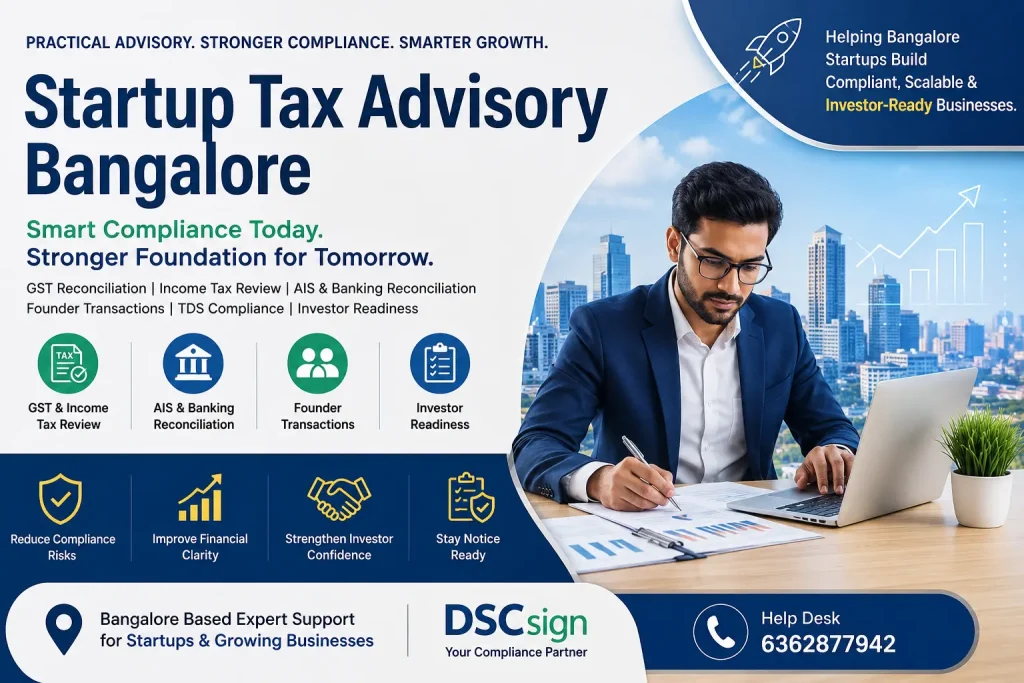
Why Startup Income Tax Compliance Has Become More Complex in Bangalore
Bangalore startups today operate with multiple financial structures involving funding rounds, SaaS subscriptions, online receipts, foreign remittances, ESOP structures, GST turnover, vendor payments, TDS compliance, and digital transactions. Because of this, startup tax compliance has become significantly more complicated than traditional business filing.
Many founders initially focus only on company incorporation, GST registration, or investor discussions without building proper Income Tax compliance systems from the beginning. In practical situations, poor tax structuring during the early stage may later create AIS mismatch, scrutiny concerns, GST reconciliation problems, refund delays, or tax notices.
Important Practical Risk: Startup founders often realize tax compliance problems only after notices, funding due diligence, GST mismatch, or investor review stages begin.
Common Startup Tax Compliance Risks Found During Practical Review
Startups frequently face tax compliance risks because accounting systems, GST filings, founder withdrawals, vendor structures, investment entries, or SaaS receipts are not reviewed properly from both Income Tax and practical business compliance perspectives.
GST & Income Tax Mismatch
Turnover disclosures reflected in GST filings may not reconcile properly with Income Tax records or financial statements.
Founder Expense & Withdrawal Issues
Personal and business expenses often get mixed during early startup stages without proper documentation review.
TDS & Vendor Compliance Gaps
Vendor payments, contractor payouts, or freelancer transactions may create TDS non-compliance risk.
AIS & Banking Mismatch
Online receipts, foreign remittances, banking entries, or investment transactions may require reconciliation review.
Why Practical Startup Tax Review Matters Beyond Basic Filing
Many startups complete basic GST filing or Income Tax filing without reviewing whether the business structure, founder transactions, SaaS revenue, investments, TDS compliance, and GST turnover are practically aligned for future scalability and investor review.
Practical startup tax review generally focuses on analysing business operations, compliance structure, accounting systems, GST reconciliation, founder transactions, vendor payments, banking entries, and Income Tax disclosures together before future compliance risks increase.
Practical Benefit: Early-stage startup tax review often helps improve compliance clarity, reduce future notice risk, strengthen investor confidence, and organize financial systems properly before scaling operations.
Common Tax Concerns Faced by Bangalore Startup Founders
Will GST & Income Tax Data Match Properly?
Startups often worry whether SaaS receipts, subscriptions, invoices, and GST disclosures fully reconcile with tax filings.
Can Founder Transactions Create Problems?
Improper expense routing, withdrawals, or undocumented transactions may later affect compliance clarity.
Will Investor Due Diligence Identify Tax Gaps?
Funding review often examines GST consistency, TDS compliance, accounting systems, and Income Tax records together.
Can Startup Notices Be Prevented Early?
Proper review of AIS entries, GST turnover, TDS compliance, and banking disclosures may reduce future notice risk.
Who Commonly Needs Startup Tax Advisory Support in Bangalore
Startup tax advisory becomes increasingly important where founders manage SaaS billing, digital receipts, subscription revenue, funding entries, online transactions, foreign remittances, ESOP structures, GST turnover, or investor reporting obligations together.
Bangalore startups working in technology, AI, SaaS, fintech, consulting, ecommerce, software development, and global service sectors often require deeper compliance review because Income Tax, GST, banking records, AIS systems, and investor due diligence now cross-verify multiple financial disclosures together.
✔ SaaS startups with subscription revenue
✔ Technology startups receiving foreign remittances
✔ Founders preparing for funding or investor due diligence
✔ Startups handling ESOP or founder equity structures
✔ Online businesses managing GST & Income Tax reconciliation
✔ Founders seeking legally structured tax planning
Common Startup Tax & Compliance Mistakes Found During Review
Many startups unknowingly create future tax problems because business operations grow faster than compliance systems. In practical situations, accounting entries, GST filings, founder expenses, banking records, vendor payments, or funding disclosures often remain unstructured during early business stages.
GST & Income Tax Mismatch
Sales turnover reported under GST may not fully reconcile with Income Tax disclosures or financial records.
Improper Founder Transactions
Founder withdrawals, reimbursements, or personal expenses may get mixed with business accounts without proper structure.
TDS & Vendor Compliance Errors
Freelancer payments, contractor payouts, or vendor transactions may create TDS non-compliance exposure.
AIS & Banking Reconciliation Gaps
Online receipts, investment entries, or banking transactions reflected in AIS may require deeper review.
Practical Observation: Most startup tax issues do not begin from intentional non-compliance. They usually arise because operational growth happens faster than accounting, GST, and Income Tax systems are organized.
Important Areas Commonly Reviewed During Startup Tax Advisory
Practical startup tax review generally focuses on analysing operational, financial, GST, Income Tax, founder transaction, and investor-related records together before future compliance risk increases.
Practical Benefit: Structured startup tax review often helps founders improve compliance clarity, strengthen investor confidence, organize accounting systems properly, and reduce future GST or Income Tax notice exposure.
Why Startup Funding & Growth Can Create Future Tax Compliance Problems
Many Bangalore startups initially focus heavily on product growth, investor meetings, customer acquisition, and scaling operations. During this stage, tax compliance systems, GST reconciliation, TDS tracking, accounting structures, and Income Tax planning often receive limited attention.
As startups begin receiving funding, foreign remittances, SaaS revenue, ESOP structures, subscription income, or online payments, multiple compliance systems start cross-verifying banking records, GST filings, Income Tax disclosures, and financial statements together.
Important Practical Risk: Weak accounting systems or improper founder transaction handling during the early growth stage may later create investor due diligence concerns, GST mismatch, AIS notices, or Income Tax scrutiny exposure.
How GST, AIS & Income Tax Mismatch Affects Startups Practically
Modern compliance systems increasingly compare GST turnover, banking receipts, SaaS subscriptions, invoice values, TDS records, AIS disclosures, and Income Tax filings together. Even where startups file returns regularly, reconciliation gaps may still create future compliance complications.
GST Turnover Mismatch
SaaS billing, online subscriptions, or invoice reporting may not fully reconcile with Income Tax disclosures.
AIS & Banking Reconciliation
Banking entries, online receipts, investment transactions, or foreign remittances reflected in AIS may require clarification review.
TDS & Vendor Review
Freelancer payments, consultants, contractors, and marketing payouts may create TDS mismatch exposure.
Founder Expense Classification
Operational and personal expenses often require structured accounting segregation review.
Why Practical Compliance Systems Matter for Startup Scalability
Many startups attempt to organize accounting and tax systems only after notices, investor review, or funding discussions begin. In practical situations, compliance systems become much harder to correct once large transaction volumes and historical entries accumulate.
Practical startup advisory generally focuses on improving compliance structure early by reviewing accounting systems, GST reporting, founder transactions, vendor payments, TDS compliance, investor documentation, and Income Tax disclosures together before scaling complications increase.
Practical Benefit: Organized tax and compliance systems often help startups improve investor readiness, maintain financial clarity, reduce future notice exposure, and support smoother business scaling.
Common Questions Bangalore Startup Founders Frequently Ask
Can startup GST and Income Tax mismatch create notices later?
Yes. Modern compliance systems increasingly reconcile GST turnover, AIS disclosures, banking entries, and Income Tax filings together.
Why do startups face tax problems during investor due diligence?
Funding reviews often analyse GST consistency, accounting systems, founder transactions, TDS compliance, banking records, and Income Tax disclosures together.
Can founders legally optimize startup tax planning?
Proper business structuring, expense review, TDS planning, GST alignment, and practical compliance systems may help improve legally supported tax efficiency.
Why is early startup compliance review important?
Early review often helps startups organize accounting systems, GST reporting, banking reconciliation, founder transactions, and Income Tax disclosures before future scaling complications arise.
20+
Years Practical Experience
1000+
Businesses Supported
GST + IT
Integrated Compliance Review
Startup
Founder Focused Advisory
Bangalore
Local Practical Support
Recent Practical Startup Tax Compliance Situation Handled in Bangalore
A Bangalore-based SaaS startup approached our office during investor discussion stages after discovering GST turnover mismatch, founder reimbursement confusion, TDS gaps, and banking reconciliation inconsistency across their accounting records and Income Tax filings.
The startup had initially focused on rapid growth, subscriptions, product scaling, and foreign customer onboarding. However, during practical review, GST disclosures, online receipts, founder expenses, vendor payouts, and AIS-linked banking records required deeper reconciliation before investor due diligence discussions could proceed smoothly.
Practical Review Process: GST turnover reconciliation, accounting structure review, founder transaction analysis, TDS verification, banking reconciliation, AIS review, and Income Tax disclosure consistency were analysed together before restructuring the compliance approach.
After systematic compliance review, the startup improved reporting clarity, organized accounting systems properly, corrected reconciliation gaps, and strengthened investor-readiness documentation before proceeding further with scaling and funding activities.
Practical Benefit: Early startup tax advisory often helps founders identify compliance gaps before GST notices, investor due diligence issues, AIS mismatch, or Income Tax scrutiny risks become more complicated.
Need Startup Income Tax Advisory Support in Bangalore?
Startup tax compliance involving SaaS revenue, GST reconciliation, funding transactions, founder withdrawals, AIS mismatch, TDS compliance, online receipts, investor due diligence, ESOP structures, or banking reconciliation often requires deeper practical review before future risks increase.
At DSCsign Bangalore, practical startup tax advisory generally involves analysing GST disclosures, Income Tax records, founder transactions, accounting systems, banking entries, AIS records, TDS compliance, and investor-related documentation together before proceeding with structured compliance support.
Head Office: Sahakarnagar, Bangalore – 560092
Branches: Mathikere | Jakkur | Kalyan Nagar | Frazer Town
Email: one@dscsign.com
Help Desk: 6362877942
Office Hours: Monday to Saturday | 11:00 AM – 8:00 PM
Practical Guidance: Startups should generally organize GST reconciliation, founder transactions, TDS systems, banking records, accounting structures, and Income Tax disclosures early instead of waiting until notices or investor reviews begin.
Why Startup Tax Compliance Problems Usually Begin Slowly
Most startups do not intentionally ignore tax compliance. In practical situations, founders usually focus heavily on customer acquisition, technology development, product scaling, hiring, investor meetings, and business survival during the early growth stage.
As operations grow, GST filings, SaaS subscriptions, founder reimbursements, online receipts, banking entries, TDS deductions, vendor payouts, and accounting systems often become disconnected because structured compliance systems were not organized early.
Important Practical Risk: Small compliance gaps during the startup stage may later become major investor due diligence concerns, GST mismatch exposure, AIS notices, or Income Tax scrutiny issues once transaction volumes increase.
Why Startups Need Safe & Structured Tax Planning Instead of Reactive Filing
Many startups initially complete GST filing or Income Tax filing only to satisfy basic compliance deadlines. However, practical startup tax advisory focuses on whether the overall financial structure, accounting systems, founder transactions, and reporting positions are legally sustainable as the business scales.
Structured startup tax review generally analyses GST reconciliation, TDS systems, founder reimbursements, banking entries, online receipts, SaaS revenue, vendor payments, and Income Tax disclosures together before future notice or funding risks increase.
GST & Income Tax Alignment
Review of turnover consistency between GST filings, accounting records, and Income Tax disclosures.
Founder Transaction Structuring
Segregation review of founder reimbursements, withdrawals, and operational business expenses.
TDS & Vendor Compliance
Analysis of freelancer, contractor, consultant, and vendor payment compliance structures.
AIS & Banking Reconciliation
Review of online receipts, foreign remittances, investment entries, and banking disclosures.
Why Investor Readiness Depends on Practical Tax & Compliance Systems
Investor discussions increasingly involve detailed review of GST consistency, Income Tax disclosures, accounting systems, banking reconciliation, founder transactions, ESOP structures, statutory compliance, and operational financial clarity.
Many startups discover hidden compliance gaps only during funding stages because historical transactions, unstructured accounting entries, vendor payouts, or tax inconsistencies become difficult to reorganize later.
Practical Startup Review Usually Involves:
✔ GST turnover reconciliation review
✔ Income Tax filing consistency analysis
✔ Founder reimbursement review
✔ Banking & AIS reconciliation
✔ SaaS revenue structure review
✔ Vendor & freelancer TDS analysis
✔ Funding & investment entry verification
✔ Accounting system organization review
✔ Investor due diligence readiness support
Professional Startup Income Tax Advisory Support in Bangalore
Startup tax compliance involving SaaS revenue, GST reconciliation, founder transactions, online receipts, funding entries, investor due diligence, TDS compliance, banking reconciliation, AIS mismatch, or startup scaling structures often requires deeper practical review before future complications increase.
At DSCsign Bangalore, practical startup tax advisory generally involves analysing GST disclosures, accounting systems, founder transactions, banking records, AIS entries, vendor compliance, Income Tax reporting, and investor-readiness structures together before proceeding with systematic compliance support.
Head Office: Sahakarnagar, Bangalore – 560092
Branches: Mathikere | Jakkur | Kalyan Nagar | Frazer Town
Email: one@dscsign.com
Help Desk: 6362877942
Office Hours: Monday to Saturday | 11:00 AM – 8:00 PM
Practical Guidance: Startups should generally organize GST reconciliation, accounting systems, founder transactions, TDS compliance, banking disclosures, and Income Tax structures early instead of waiting until investor review or tax notices arise.
Why Basic GST & Tax Filing Alone Is Not Enough for Startups
Many startups initially believe regular GST filing and annual Income Tax filing are sufficient for compliance. In practical situations, startup operations involve multiple interconnected financial areas such as SaaS subscriptions, online receipts, founder reimbursements, vendor payments, banking transactions, TDS deductions, foreign remittances, and investment reporting.
As modern compliance systems increasingly reconcile GST turnover, AIS records, banking entries, TDS filings, and Income Tax disclosures together, startups may later face mismatch complications even where returns were filed regularly through automated systems.
Important Practical Risk: Reactive filing without structured compliance review may later create GST mismatch, investor due diligence concerns, AIS notices, TDS exposure, or banking reconciliation complications.
Why Startup Scaling Requires Strong Compliance Systems Early
During the early growth stage, startups usually prioritize customer acquisition, technology development, hiring, product launch, and fundraising. However, without proper accounting systems and tax review structures, operational growth may later create compliance confusion across GST, Income Tax, TDS, and banking reconciliation.
Practical startup advisory generally focuses on organizing financial systems before transaction volume becomes difficult to control. This includes GST consistency review, founder transaction segregation, vendor compliance, SaaS billing review, AIS reconciliation, and banking analysis together.
Structured GST Reconciliation
Review of SaaS billing, invoice consistency, and GST turnover alignment with accounting systems.
Founder Transaction Clarity
Segregation review of personal expenses, reimbursements, operational payouts, and founder withdrawals.
Banking & AIS Review
Analysis of online receipts, investment entries, foreign remittances, and banking disclosures reflected through AIS.
Vendor & TDS Structuring
Review of contractor payouts, freelancer payments, and TDS deduction compliance structures.
Recent Practical Startup Compliance Review Handled in Bangalore
A Bangalore-based AI startup approached our office while preparing for a major investor discussion after discovering inconsistencies between GST turnover, accounting entries, founder reimbursements, and banking disclosures across different financial systems.
The startup had scaled rapidly with SaaS subscriptions, foreign customer receipts, online vendor payments, contractor payouts, and digital banking activity. During practical review, AIS-linked entries, GST turnover, founder transactions, and TDS deductions required deeper reconciliation before investor due diligence discussions could proceed confidently.
Practical Review Process: GST filings, accounting systems, banking entries, founder reimbursements, AIS disclosures, vendor payouts, TDS records, and Income Tax reporting consistency were reviewed together before restructuring the compliance framework properly.
After practical restructuring review, the startup improved accounting clarity, strengthened compliance documentation, corrected reconciliation gaps, and organized investor-ready financial reporting systems before proceeding with funding activities.
Practical Guidance: Startups should generally review GST reconciliation, banking records, founder transactions, vendor payments, AIS disclosures, and Income Tax structures early instead of waiting until notices or investor due diligence identifies hidden compliance gaps.
Why Startup Tax & Compliance Problems Usually Surface During Growth Stage
Many startups appear operationally successful during early growth because revenue, customer onboarding, SaaS subscriptions, and investor discussions progress quickly. However, underlying compliance systems involving GST, Income Tax, TDS, accounting entries, founder transactions, and banking reconciliation may remain unstructured internally.
As transaction volume increases, modern compliance systems begin cross-verifying GST turnover, AIS disclosures, online receipts, banking records, funding entries, vendor payments, and Income Tax filings together. This is often the stage where hidden reconciliation gaps start becoming visible practically.
GST Turnover Inconsistency
SaaS revenue, invoice reporting, and GST disclosures may not fully reconcile with accounting or Income Tax records.
AIS & Banking Mismatch
Foreign remittances, online receipts, investment entries, or banking transactions reflected in AIS may require clarification review.
Founder Transaction Exposure
Founder reimbursements, withdrawals, or mixed personal-business expenses may create accounting inconsistency.
TDS & Vendor Compliance Gaps
Contractor payments, freelancer payouts, and consultant transactions may create TDS mismatch exposure.
Why Practical Startup Tax Advisory Is Different from Basic Filing Services
Basic filing services generally focus only on GST filing, annual return submission, or accounting entry completion. Practical startup tax advisory focuses on whether the startup’s financial structure, founder transactions, SaaS revenue systems, banking records, and tax disclosures are operationally sustainable for future scaling and investor review.
This becomes especially important for Bangalore startups operating in SaaS, AI, fintech, consulting, ecommerce, software development, and global service sectors where funding, online transactions, foreign remittances, and investor due diligence increasingly require structured financial clarity.
Practical Startup Review Usually Involves:
✔ GST & Income Tax reconciliation review
✔ SaaS revenue & subscription structure analysis
✔ Founder reimbursement & withdrawal review
✔ AIS & banking reconciliation analysis
✔ Vendor & freelancer TDS review
✔ Funding & investment entry verification
✔ Accounting system organization review
✔ Investor due diligence preparation support
✔ Compliance risk identification before scaling
Practical Observation: Startup tax advisory today increasingly involves operational financial structuring and compliance reconciliation rather than only return filing support.
Professional Startup Income Tax Advisory Support for Bangalore Founders
Startup compliance involving SaaS subscriptions, GST reconciliation, founder reimbursements, funding entries, banking transactions, online receipts, AIS mismatch, TDS compliance, investor due diligence, or startup scaling structures often requires deeper practical review before future risks increase.
At DSCsign Bangalore, practical startup tax advisory generally involves analysing GST filings, accounting systems, founder transactions, banking entries, AIS disclosures, vendor payments, TDS structures, Income Tax records, and investor-readiness documentation together before proceeding with systematic compliance support.
Head Office: Sahakarnagar, Bangalore – 560092
Branches: Mathikere | Jakkur | Kalyan Nagar | Frazer Town
Email: one@dscsign.com
Help Desk: 6362877942
Office Hours: Monday to Saturday | 11:00 AM – 8:00 PM
Practical Guidance: Startup founders should generally organize GST reconciliation, accounting systems, founder transactions, TDS structures, banking records, and Income Tax disclosures early instead of waiting until investor review or tax notices expose hidden compliance gaps.
Why Startup Operational Growth Often Creates Hidden Tax Compliance Risks
During the startup growth phase, founders usually prioritize product development, SaaS subscriptions, investor meetings, digital marketing, hiring, customer acquisition, and scaling operations quickly. In many practical situations, accounting systems and tax compliance processes are updated much later than business growth itself.
As transaction volumes increase, modern compliance systems begin cross-verifying GST filings, Income Tax disclosures, AIS records, online receipts, foreign remittances, banking entries, TDS deductions, vendor payouts, and accounting statements together. Small reconciliation gaps that initially appear manageable may later create significant operational complications.
Important Practical Risk: Startups frequently discover compliance issues only during investor due diligence, GST scrutiny, Income Tax notices, banking verification, or funding review stages.
Key Financial & Tax Areas Commonly Reviewed During Startup Advisory
Practical startup tax advisory generally focuses on reviewing the actual operational structure of the business rather than only annual return filing. This often involves analysing accounting systems, GST reporting, founder transactions, banking reconciliation, investor records, and Income Tax disclosures together before scaling risks increase.
GST & SaaS Revenue Review
Review of subscription revenue, invoice reporting, GST turnover consistency, and online billing structures.
AIS & Banking Reconciliation
Analysis of banking entries, online receipts, investment records, and foreign remittance disclosures reflected through AIS systems.
Founder Transaction Structuring
Review of founder reimbursements, withdrawals, operational expenses, and business transaction segregation.
Vendor & TDS Compliance
Review of freelancer payments, contractor payouts, consultant invoices, and TDS deduction consistency.
Funding & Investor Readiness
Review of investment entries, founder equity structures, compliance clarity, and due diligence preparedness.
Accounting System Organization
Practical review of bookkeeping systems, reporting consistency, reconciliation workflows, and compliance tracking.
How Early Startup Tax Advisory Helps Founders Practically
Many founders attempt to reorganize accounting and compliance systems only after notices, investor review, GST mismatch, or funding discussions begin. In practical situations, correcting historical transaction structures becomes more difficult once operations scale rapidly.
Early startup advisory generally focuses on identifying compliance gaps before they become larger operational or legal problems. This often helps startups maintain stronger financial clarity while improving investor confidence and reducing future compliance exposure.
Better GST Consistency
Improved reconciliation between GST filings, SaaS billing systems, and accounting disclosures.
Stronger Investor Confidence
Better organized compliance systems often improve investor due diligence readiness and operational credibility.
Reduced Notice Exposure
AIS mismatch, GST inconsistency, and TDS-related issues may be identified earlier through structured review.
Operational Financial Clarity
Structured accounting review often improves founder visibility into business financial health practically.
Practical Observation: Startup tax advisory today increasingly focuses on operational financial structuring, investor readiness, GST reconciliation, and compliance clarity rather than only annual return filing.
Professional Startup Income Tax Advisory Support in Bangalore
Startup compliance involving SaaS revenue, GST reconciliation, AIS mismatch, founder reimbursements, funding entries, investor due diligence, TDS compliance, banking records, foreign remittances, and scaling operations often requires deeper practical review before future compliance complications increase.
At DSCsign Bangalore, practical startup tax advisory generally involves analysing GST filings, accounting systems, banking entries, founder transactions, AIS disclosures, vendor compliance, funding records, and Income Tax reporting together before proceeding with systematic compliance support.
Head Office: Sahakarnagar, Bangalore – 560092
Branches: Mathikere | Jakkur | Kalyan Nagar | Frazer Town
Email: one@dscsign.com
Help Desk: 6362877942
Office Hours: Monday to Saturday | 11:00 AM – 8:00 PM
Practical Guidance: Startup founders should generally organize GST reconciliation, founder transactions, accounting systems, TDS compliance, banking reconciliation, and Income Tax disclosures early instead of waiting until investor reviews or notices identify hidden compliance gaps.