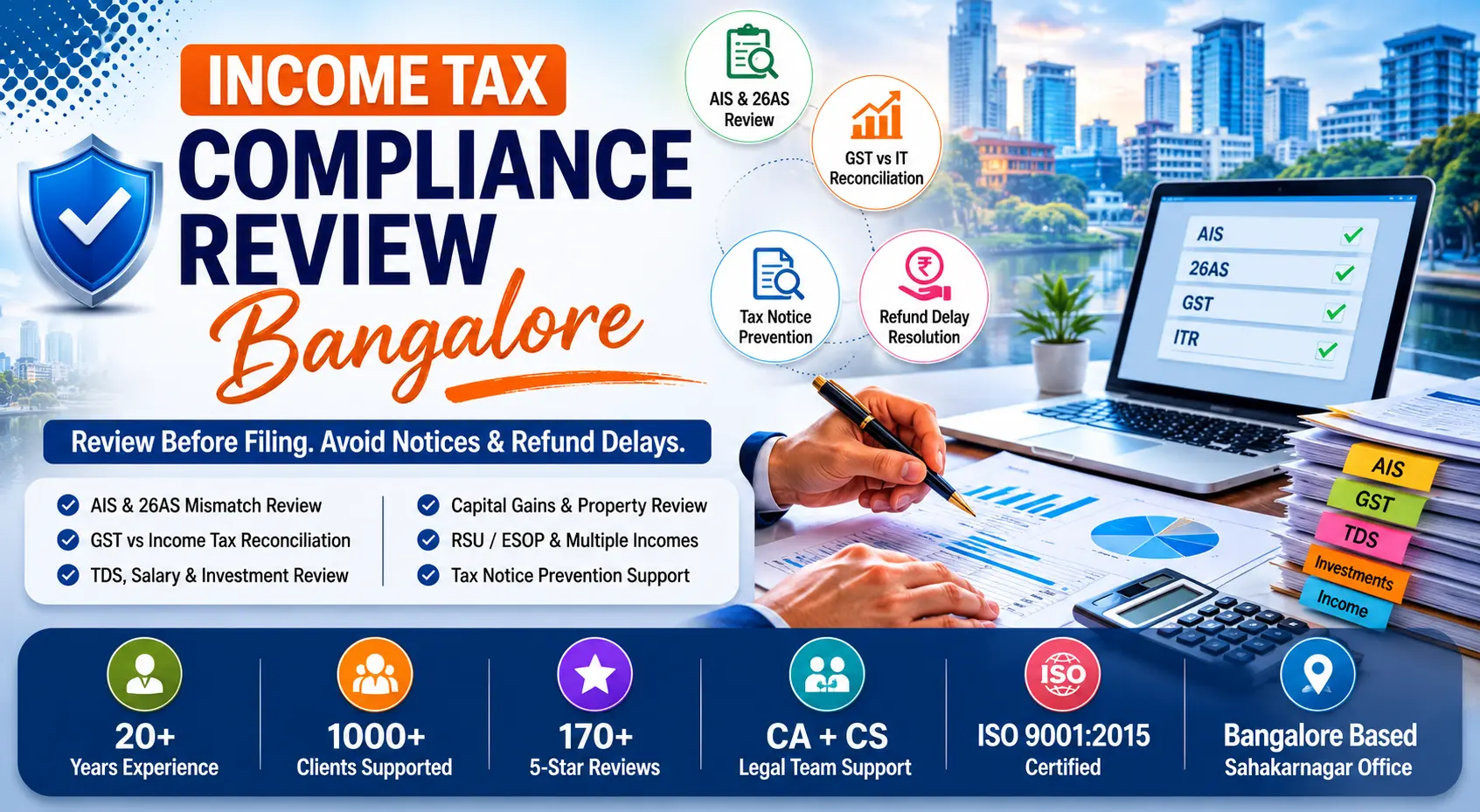
Why ITR Filing for Bangalore Salaried Employees Has Become More Complex
Many Bangalore salaried professionals now receive income beyond basic salary structure. ESOPs, RSUs, foreign stock holdings, startup compensation, bonuses, consulting receipts, stock market activity, rental income, and overseas investments are increasingly creating complicated tax reporting situations during ITR filing.
Most employees initially assume Form 16 alone is sufficient for filing. In practical situations, AIS records, investment disclosures, stock transactions, dividend income, foreign assets, banking entries, and tax credits may require deeper review before filing the return properly.
Important Practical Risk: Incorrect reporting of RSUs, ESOPs, foreign investments, capital gains, or AIS disclosures may later create refund delays, defective return communication, or Income Tax notices.
Common ESOP & RSU Tax Filing Problems Faced by Salaried Employees
Employees working in Bangalore IT companies, MNCs, startups, and technology firms increasingly face tax complexity because stock compensation structures are often linked with foreign entities, overseas brokerage accounts, vesting schedules, and multiple taxation events.
RSU Disclosure Confusion
Employees often struggle to understand how vested RSUs, sold shares, and foreign brokerage statements should be reported properly.
ESOP Taxation Complexity
ESOP taxation may involve perquisite taxation, capital gains, foreign exchange conversion, and multiple transaction dates.
AIS & Investment Mismatch
Stock market entries, dividend income, or investment disclosures reflected in AIS may not reconcile fully with filed returns.
Refund & TDS Issues
Improper tax credit matching or reporting inconsistency may later affect refund processing or create tax demand notices.
Why Smart Tax Review Matters Before Filing Salary ITR
Many salaried employees focus only on quick filing or maximum refund expectation without reviewing whether the tax position is practically correct, legally supported, and properly reconciled with AIS disclosures, Form 16 entries, investments, RSUs, ESOPs, or banking records.
Practical salary tax review generally focuses on legally allowed tax planning, proper disclosure analysis, investment reconciliation, TDS verification, foreign asset review, and identifying eligible deductions before filing the return systematically.
Practical Benefit: Proper review before filing often helps salaried employees improve compliance clarity, avoid reporting mistakes, identify eligible tax benefits legally available, and reduce future notice or refund complications.
Who Commonly Needs Professional Salary Tax Review in Bangalore
Salary tax filing is becoming increasingly complicated for Bangalore professionals because compensation structures now involve stock-based benefits, overseas investments, startup equity, multiple Form 16 entries, consulting income, bonuses, and digital financial activity beyond regular salary.
Employees working in technology companies, startups, MNCs, product firms, and global organizations often require deeper practical review because AIS systems, brokerage platforms, foreign disclosures, banking records, and Income Tax reporting are now highly interconnected.
✔ IT employees with RSUs, ESOPs, or foreign stock holdings
✔ Startup employees with stock-based compensation
✔ Professionals with multiple Form 16 or job changes
✔ Salaried employees with stock market investments
✔ Employees receiving foreign income or overseas credits
✔ Professionals expecting proper refund optimization legally
Common Tax Filing Mistakes Salaried Employees Frequently Make
Many salaried employees unknowingly create future notice or refund complications because filing is often done quickly using automated portals without reviewing whether investments, AIS entries, RSUs, ESOPs, or stock market disclosures are properly reconciled.
Ignoring AIS Entries
Investment income, dividends, banking transactions, or stock entries reflected in AIS may remain unmatched.
Incorrect RSU & ESOP Reporting
Employees often misunderstand perquisite taxation, vesting disclosures, foreign shares, or capital gains treatment.
Missing Eligible Deductions
Without review, legally available deductions and tax planning opportunities may remain unused.
Refund & TDS Mismatch
Improper TDS reconciliation or disclosure inconsistency may later create refund delays or tax demand issues.
Practical Observation: Filing ITR quickly is different from filing it correctly. Modern salary tax filing increasingly requires reconciliation of AIS records, investments, RSUs, ESOPs, banking disclosures, and TDS credits together.
Important Documents Commonly Reviewed During Salary ITR Filing
Professional salary tax review generally involves analysing multiple financial disclosures together instead of relying only on Form 16 or basic salary details.
Practical Benefit: Reviewing salary income, RSUs, ESOPs, investments, AIS disclosures, and TDS entries together often helps improve legal compliance clarity while identifying eligible tax-saving opportunities properly.
Why Smart Salary Tax Planning Matters Before Filing ITR
Many salaried employees focus only on filing returns quickly or expecting maximum refund without understanding whether the tax position is legally optimized, practically supported, and correctly reconciled with AIS disclosures, RSUs, ESOPs, investments, or TDS credits.
In Bangalore, professionals working in IT companies, startups, global product firms, and MNCs increasingly require deeper salary tax review because salary structures now involve bonuses, stock compensation, overseas investments, foreign brokerage reporting, capital gains, and multiple financial disclosures beyond standard payroll entries.
Practical Tax Benefit: Proper salary tax review often helps identify legally eligible deductions, improve refund clarity, reconcile TDS properly, and reduce avoidable future compliance issues.
How AIS, RSU & Investment Mismatch Can Create Future Tax Notices
Modern Income Tax systems increasingly cross-verify salary disclosures, RSUs, ESOPs, stock market transactions, dividend income, banking entries, foreign assets, and investment activity through AIS reporting systems.
Even where salary tax filing appears completed successfully, mismatch between brokerage reports, AIS disclosures, Form 16 entries, TDS credits, or capital gains reporting may later create refund delays, defective return communication, or Income Tax notices.
RSU & Foreign Brokerage Review
Vesting disclosures, sold shares, foreign holdings, and brokerage statements may require detailed reconciliation review.
Capital Gains & Dividend Reporting
Stock transactions, mutual fund gains, and dividend disclosures reflected in AIS may require proper tax treatment review.
TDS & Form 16 Reconciliation
Multiple employers, job switches, or payroll inconsistency may create TDS mismatch during filing.
AIS & Banking Verification
Interest income, banking transactions, and investment disclosures reflected in AIS require proper review before filing.
How Practical Salary ITR Review Helps Bangalore Professionals
Practical salary tax filing review generally focuses on analysing salary disclosures, AIS entries, RSUs, ESOPs, TDS credits, investments, foreign assets, capital gains, and banking records together before filing the Income Tax Return systematically.
Different salaried professionals require different review approaches depending on job changes, stock compensation structures, overseas holdings, investment activity, refund expectations, and available deduction opportunities legally permitted under Income Tax provisions.
Practical Observation: Filing salary ITR correctly today involves much more than uploading Form 16. AIS reconciliation, RSU disclosures, investments, foreign assets, banking entries, and TDS matching increasingly require deeper practical review.
Suitable For:
IT Employees | Startup Professionals | MNC Employees | Product Company Staff | RSU Holders | ESOP Employees | Stock Market Investors | High Salary Professionals | Foreign Asset Holders
Frequently Asked Questions on Salary ITR Filing with ESOP & RSU Income
Is Form 16 alone enough for salaried employee ITR filing?
Not always. Employees with RSUs, ESOPs, stock investments, foreign assets, banking interest, dividend income, or multiple salary sources may require deeper AIS and investment reconciliation review before filing.
Can RSU and ESOP reporting create Income Tax notices later?
Yes. Incorrect disclosure of RSUs, ESOPs, foreign brokerage entries, stock sales, or capital gains may later create AIS mismatch notices, defective return communication, or refund delays.
Can salaried employees legally improve tax savings during ITR filing?
Yes. Proper review of deductions, investments, HRA, housing loan benefits, capital gains, and salary structure may help identify legally eligible tax-saving opportunities before filing.
Why do salaried employees face refund delays even after filing?
Refund delays may arise because AIS disclosures, TDS credits, RSU reporting, investment entries, banking records, or foreign asset disclosures do not fully reconcile with the filed return.
Why is practical salary tax review important today?
Modern salary tax filing increasingly involves AIS reconciliation, RSU disclosures, stock investments, TDS matching, banking entries, foreign assets, and legally supported tax planning review beyond standard Form 16 filing.
Who Commonly Needs Practical Salary Tax Review in Bangalore
Professional salary tax review is increasingly important for Bangalore employees managing stock compensation, investment activity, overseas disclosures, or multiple financial reporting obligations beyond basic payroll salary structures.
✔ Employees with RSUs, ESOPs, or foreign stock holdings
✔ Professionals with high salary and multiple investments
✔ Employees changing jobs during the financial year
✔ Startup professionals with equity compensation
✔ Stock market traders and mutual fund investors
✔ Employees expecting proper legally supported refunds
Practical Observation: Bangalore salaried professionals increasingly face tax complexity because salary structures now combine payroll income, stock compensation, investments, foreign assets, bonuses, and digital financial reporting together.
20+
Years Practical Experience
1000+
Professionals Supported
RSU + ESOP
Advanced Salary Tax Review
AIS Review
Investment Reconciliation
Bangalore
Local Professional Support
Recent Practical Salary Tax Filing Situation Handled in Bangalore
A Bangalore-based senior software engineer working for a multinational technology company approached our office after facing confusion regarding RSU disclosures, foreign brokerage reporting, AIS mismatch, and delayed refund processing despite filing through an online tax platform earlier.
During practical review, AIS records reflected dividend entries, foreign stock disclosures, capital gains transactions, and banking interest entries that were not fully reconciled with the filed return position. Multiple vesting transactions and TDS matching also required clarification review before corrective filing analysis could proceed properly.
Practical Review Process: RSU statements, foreign brokerage reports, AIS disclosures, capital gains entries, Form 16, TDS credits, and banking disclosures were analysed together before preparing the revised compliance approach.
After reconciliation review, the salary tax filing position was reorganized systematically with legally supported disclosures and proper reporting consistency. Early review helped reduce future notice risk while improving refund clarity practically.
Need Professional Salary ITR Filing Support in Bangalore?
Salary tax filing involving RSUs, ESOPs, foreign investments, stock market gains, AIS mismatch, multiple Form 16 entries, TDS reconciliation, refund review, or startup compensation structures often requires deeper practical compliance analysis before filing properly.
At DSCsign Bangalore, practical salary ITR review generally involves analysing salary disclosures, AIS entries, RSUs, ESOPs, investments, foreign assets, TDS credits, deductions, and banking records together before proceeding with systematic filing support.
Head Office: Sahakarnagar, Bangalore – 560092
Branches: Mathikere | Jakkur | Kalyan Nagar | Frazer Town
Email: one@dscsign.com
Help Desk: 6362877942
Office Hours: Monday to Saturday | 11:00 AM – 8:00 PM
Practical Guidance: Salaried employees with RSUs, ESOPs, stock investments, foreign assets, or multiple income disclosures should generally review AIS entries, TDS matching, investment reporting, and legally eligible tax planning carefully before filing ITR.
Why Bangalore Salaried Professionals Increasingly Need Advanced ITR Review
Bangalore professionals working in global technology companies, startups, MNCs, SaaS firms, AI companies, fintech organizations, and product-based businesses increasingly receive compensation structures beyond normal salary. RSUs, ESOPs, bonuses, foreign stock holdings, stock market investments, overseas brokerage accounts, and multiple income disclosures are now commonly linked with salary tax filing.
Modern Income Tax systems now cross-verify salary disclosures, AIS records, investments, dividend income, banking transactions, foreign assets, capital gains, and TDS entries together. Because of this, salary filing has become much more than simply uploading Form 16 into an online portal.
Important Practical Risk: Incorrect reporting of RSUs, ESOPs, stock sales, foreign investments, or AIS entries may later create refund delays, defective return communication, or Income Tax notices even where the return was originally accepted.
What Salaried Employees Actually Want – Safe, Legal & Smart Tax Filing
Most salaried employees are not looking for aggressive or risky tax filing. They usually want legally supported tax planning, proper refund optimization, safe disclosures, and confidence that the return is correctly filed without future compliance problems.
Practical salary tax review generally focuses on understanding the employee’s actual financial structure before filing. This may involve reviewing salary disclosures, RSUs, ESOPs, AIS records, investments, housing loan benefits, deductions, TDS matching, capital gains, and foreign asset reporting together before finalizing the ITR properly.
Legally Supported Tax Planning
Review of eligible deductions, housing loan benefits, investments, and tax-saving opportunities permitted under law.
Refund Optimization Review
TDS matching, AIS reconciliation, and investment review to improve refund clarity and avoid mismatch.
RSU & ESOP Compliance Review
Review of vesting, foreign shares, brokerage disclosures, and capital gains reporting consistency.
AIS & Investment Reconciliation
Analysis of investments, dividends, banking entries, and financial disclosures reflected through AIS systems.
Common Salary Tax Filing Concerns Among Bangalore IT Employees
Will RSUs Create Tax Notice Later?
Many employees worry whether foreign stock disclosures or sold RSUs may later trigger AIS mismatch or notice communication.
Can Refund Get Delayed?
TDS mismatch, investment inconsistency, or incomplete disclosures may later affect refund processing timelines.
Is Form 16 Enough?
Employees with investments, stock activity, foreign assets, or multiple salary sources usually require deeper review.
Can Tax Savings Be Improved Legally?
Professional review may help identify legally available deductions and tax planning opportunities properly.
Professional Salary ITR Filing Support for Bangalore Employees
Salary ITR filing involving RSUs, ESOPs, foreign investments, stock market activity, multiple Form 16 entries, AIS mismatch, refund concerns, capital gains, or overseas disclosures often requires deeper practical review before filing properly.
At DSCsign Bangalore, practical salary tax review generally involves analysing salary disclosures, AIS entries, RSUs, ESOPs, TDS credits, investments, foreign assets, deductions, banking records, and refund positions together before proceeding with systematic filing support.
Head Office: Sahakarnagar, Bangalore – 560092
Branches: Mathikere | Jakkur | Kalyan Nagar | Frazer Town
Email: one@dscsign.com
Help Desk: 6362877942
Office Hours: Monday to Saturday | 11:00 AM – 8:00 PM
Practical Guidance: Salaried employees with RSUs, ESOPs, investments, foreign assets, multiple salary sources, or refund expectations should generally review AIS disclosures, TDS matching, investment reporting, and legally eligible tax planning carefully before filing ITR.
Why Automated Salary Tax Filing Platforms May Miss Important Disclosures
Many salaried employees use automated filing portals assuming salary tax filing is only about uploading Form 16 and generating refunds quickly. In practical situations, employees with RSUs, ESOPs, stock investments, foreign brokerage accounts, overseas assets, or multiple income disclosures often require deeper reconciliation review beyond automated filing systems.
Modern Income Tax systems now analyse AIS disclosures, banking entries, investment activity, foreign asset reporting, capital gains, dividend income, and TDS credits together. If these disclosures are not properly reconciled during filing, employees may later face refund delays, defective return communication, or Income Tax notices.
Important Practical Risk: Quick online filing may not always identify mismatch involving RSUs, ESOPs, foreign brokerage reports, capital gains, AIS entries, or multiple salary disclosures.
The Real Truth About Salary Tax Refunds for Bangalore Professionals
Most Bangalore salaried professionals want legally correct tax filing along with proper refund clarity. However, refund situations increasingly depend on whether AIS records, TDS entries, salary disclosures, investments, banking records, RSUs, ESOPs, and deductions are reconciled correctly before filing.
Professional review generally focuses on identifying legally eligible deductions, correcting disclosure mismatch, reconciling TDS credits properly, analysing investment entries, and improving filing accuracy before submission instead of using risky or unsupported refund approaches.
Safe & Legally Supported Filing
Focus on compliant tax positions supported through proper documentation and reporting consistency.
Refund Clarity Review
TDS reconciliation, AIS review, and investment matching to reduce refund processing complications.
Investment & Capital Gains Review
Analysis of stock investments, RSU sales, dividend income, and brokerage disclosures.
AIS & Foreign Disclosure Review
Review of AIS entries, overseas holdings, foreign assets, and financial disclosures before filing.
Recent Practical Salary ITR Filing Case from Bangalore
A Bangalore-based product company employee approached our office after filing salary ITR through an online portal and later discovering AIS mismatch relating to RSU disclosures, dividend entries, foreign brokerage statements, and stock market transactions.
The employee initially believed Form 16 filing alone was sufficient. During practical review, AIS records reflected investment disclosures, foreign stock entries, banking interest, and capital gains transactions that required deeper reconciliation with the filed return position.
Practical Review Process: RSU vesting reports, brokerage statements, AIS disclosures, capital gains summaries, Form 16 entries, TDS credits, and banking records were analysed together before reorganizing the compliance position properly.
After reconciliation review, the filing structure was corrected systematically with legally supported disclosures and improved reporting consistency. Early review helped reduce future compliance risk while improving refund clarity practically.
Practical Guidance: Salaried employees with RSUs, ESOPs, investments, foreign assets, stock market activity, or multiple salary disclosures should generally review AIS records, TDS entries, investment reporting, and legally eligible deductions carefully before filing ITR.
Why Salary Tax Filing Mistakes May Create Future Compliance Problems
Many salaried employees assume that once the Income Tax Return is filed successfully, the compliance process is fully complete. In practical situations, AIS systems, banking disclosures, investment records, foreign brokerage reports, stock transactions, dividend entries, RSU disclosures, and TDS credits may still be analysed internally through automated reconciliation systems later.
As Bangalore professionals increasingly receive compensation through ESOPs, RSUs, stock incentives, bonuses, overseas equity, and investment-linked salary structures, salary tax filing has become much more sensitive from a compliance perspective.
AIS Mismatch Risk
Dividend income, investments, stock sales, or banking entries reflected in AIS may remain unreconciled with the filed return.
RSU & ESOP Disclosure Errors
Incorrect reporting of vesting, foreign shares, brokerage accounts, or capital gains may create future clarification requirements.
Refund Processing Problems
TDS mismatch or incomplete financial disclosures may later affect refund processing or create tax demand situations.
Foreign Asset Reporting Risk
Employees holding overseas brokerage accounts or foreign shares may require proper disclosure analysis before filing.
Why Practical Salary Tax Review Is Different from Simple Online Filing
Automated filing portals generally focus on faster submission workflows. Professional salary tax review focuses on analysing the actual financial structure, investment disclosures, salary components, stock compensation, TDS consistency, AIS reconciliation, deductions, and compliance risks before filing systematically.
This becomes especially important for Bangalore professionals working in global technology companies, startups, SaaS businesses, AI firms, fintech organizations, and multinational companies where compensation structures are often more complicated than standard payroll salary.
Practical Review Usually Involves:
✔ AIS & 26AS reconciliation review
✔ RSU & ESOP disclosure analysis
✔ Foreign brokerage & overseas asset review
✔ TDS matching & refund clarity review
✔ Capital gains & stock transaction review
✔ Legally supported deduction analysis
✔ Banking disclosure verification
✔ Multiple Form 16 reconciliation
✔ Compliance risk identification before filing
Practical Observation: Salary ITR filing today increasingly requires financial reconciliation and disclosure analysis rather than only data entry from Form 16.
Professional Salary ITR Filing Support for RSU & ESOP Employees in Bangalore
Salary tax filing involving RSUs, ESOPs, foreign brokerage reports, stock market investments, capital gains, AIS mismatch, refund concerns, multiple salary disclosures, overseas assets, or startup compensation structures often requires deeper practical review before filing properly.
At DSCsign Bangalore, practical salary tax review generally involves analysing salary disclosures, AIS records, TDS credits, investments, RSUs, ESOPs, foreign assets, banking entries, deductions, and refund positions together before proceeding with systematic filing support.
Head Office: Sahakarnagar, Bangalore – 560092
Branches: Mathikere | Jakkur | Kalyan Nagar | Frazer Town
Email: one@dscsign.com
Help Desk: 6362877942
Office Hours: Monday to Saturday | 11:00 AM – 8:00 PM
Practical Guidance: Salaried employees with RSUs, ESOPs, stock investments, foreign assets, multiple Form 16 entries, or refund expectations should generally review AIS disclosures, TDS matching, capital gains reporting, and legally eligible tax planning carefully before filing ITR.