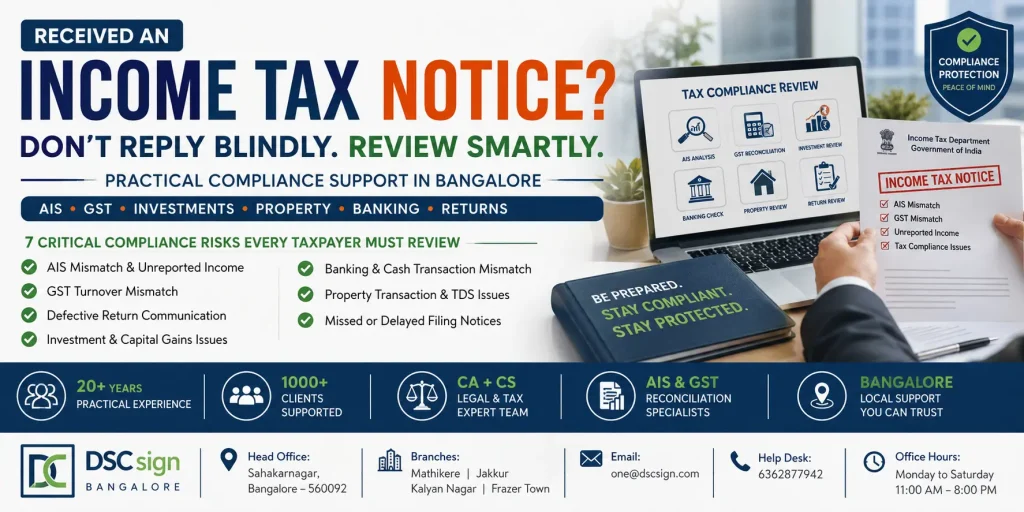
Why Income Tax Notices Are Increasing for Bangalore Taxpayers
Income Tax notices are increasingly generated through automated compliance systems comparing AIS entries, GST turnover, banking transactions, property reporting, investment disclosures, TDS records, and filed return information. Many taxpayers receive notices not because of intentional tax evasion, but because financial records appearing across different systems are not properly reconciled before filing.
Bangalore professionals, startup founders, GST businesses, consultants, stock market investors, and salaried employees with multiple income sources often face practical reporting complexity involving ESOPs, RSUs, online receipts, property transactions, and investment disclosures. Even small mismatch issues may later trigger clarification notices if compliance records are inconsistent.
Important Practical Concern: Many taxpayers ignore initial notice communication assuming it is only system-generated. However, delayed response or incomplete clarification may later increase compliance complications if the underlying mismatch remains unresolved.
Common Income Tax Notices Frequently Seen in Practical Situations
Different notices are issued for different compliance situations depending on the nature of mismatch, disclosure gaps, filing delay, or verification requirement. Understanding the actual reason behind the notice becomes important before responding.
AIS & 26AS Mismatch Notices
Generated where income, investments, TDS entries, or financial transactions appearing in AIS are not properly disclosed in the return.
Defective Return Notices
Issued where returns contain incomplete disclosures, missing schedules, incorrect ITR forms, or reporting inconsistencies.
GST & Turnover Verification Notices
Common for businesses and contractors where GST turnover differs from Income Tax disclosures or accounting records.
Capital Gains & Property Notices
Property sale, stock market activity, reinvestment claims, or capital gains disclosures may trigger verification communication.
How Practical Compliance Review Helps Before Responding to Tax Notices
Many taxpayers respond to notices quickly without reviewing whether AIS records, GST turnover, investments, banking entries, salary disclosures, and supporting documents are properly reconciled. In practical situations, incomplete responses may sometimes create additional compliance clarification requirements later.
Practical review generally involves analysing the actual mismatch reason, relevant assessment year, filing history, AIS disclosures, GST records, TDS entries, property reporting, and supporting financial documentation before preparing clarification or corrective compliance action.
Practical Compliance Benefit: Early review of Income Tax notices often helps taxpayers understand the actual reporting issue, organize supporting records properly, reduce avoidable mismatch confusion, and respond more systematically before the matter becomes more complicated.
Common Situations Where Income Tax Notice Risks Increase
Certain financial situations create higher verification sensitivity because multiple reporting systems independently capture financial disclosures through AIS, GST returns, banking records, stock exchanges, property registrations, and TDS reporting platforms.
In Bangalore, notice risks are increasingly seen among IT employees with RSUs or ESOPs, startup founders handling multiple income structures, contractors managing GST turnover, investors with stock trading activity, and property owners involved in capital gains transactions.
AIS & Banking Mismatch
Income or financial entries reflected in AIS and banking systems but not fully disclosed in returns.
GST vs Income Tax Differences
Mismatch between GST turnover, accounting records, and Income Tax disclosures.
Property & Capital Gains Reporting
Sale transactions, TDS deductions, reinvestment claims, and capital gains disclosures requiring clarification.
Stock Market & Investment Activity
Frequent trading, RSUs, ESOPs, dividends, and investment gains appearing in AIS or brokerage reports.
Common Mistakes Taxpayers Make While Responding to Notices
In many practical situations, taxpayers increase compliance complications not because of the original notice, but because the response was submitted without reviewing the underlying reporting issue properly.
Ignoring AIS mismatch before replying
Submitting incomplete supporting documents
Responding without GST reconciliation review
Using incorrect financial explanations
Ignoring response deadlines or portal communication
Correcting returns without reviewing disclosure impact
Practical Observation: Many notice situations involve multiple connected issues such as AIS mismatch, GST turnover differences, investment disclosures, and property reporting. Reviewing only one issue without checking related disclosures may later create further clarification requirements.
Documents Usually Reviewed During Income Tax Notice Analysis
Practical notice review generally involves analysing multiple supporting documents together to understand the actual reporting issue before preparing clarification or corrective response.
Practical Compliance Benefit: Proper notice review helps taxpayers understand the actual reporting mismatch, organize financial disclosures correctly, and avoid incomplete or inconsistent responses that may later increase compliance complications.
Why Income Tax Notice Complexity Is Increasing in Bangalore
Bangalore taxpayers increasingly deal with multiple-source income structures involving salary income, RSUs, ESOPs, startup compensation, GST turnover, consulting receipts, property investments, foreign assets, and stock market transactions. As these financial disclosures flow into AIS, GST systems, banking platforms, and investment reporting databases, notice-related verification complexity has increased significantly.
IT employees working in multinational companies, startup founders handling investor-linked compliance, contractors managing GST billing, and professionals with online income often face practical difficulties understanding the actual reason behind department notices because multiple reporting systems may be interconnected.
Practical Compliance Concern: Many notice situations are not limited to one isolated mismatch. AIS entries, GST turnover, banking disclosures, property reporting, and investment records may all require combined reconciliation review before preparing a proper clarification response.
Why Generic Online Notice Replies Often Create Further Problems
Many taxpayers try replying to notices quickly using generic online explanations without reviewing whether AIS entries, GST records, investments, banking transactions, or supporting financial documents actually reconcile with the filed return position.
In practical situations, incomplete clarification or partial response may later create additional notice communication, defective return complications, reassessment exposure, or demand-related confusion because the underlying reporting issue was never properly analysed.
AIS Not Properly Reviewed
Replies submitted without checking whether financial entries already appearing in AIS fully match the return disclosures.
GST Reconciliation Ignored
Business taxpayers frequently respond without reconciling GST turnover, accounting records, and Income Tax reporting.
Supporting Records Incomplete
Property documents, investment statements, banking records, or TDS proofs may not be properly organized before reply submission.
Incorrect Technical Clarification
Wrong factual explanations or incomplete disclosure understanding may later increase scrutiny or verification concerns.
How Practical Compliance Review Supports Better Notice Protection
Practical notice-response review generally focuses on understanding the actual reporting mismatch before preparing clarification. This often involves analysing AIS records, filed returns, GST disclosures, investments, banking entries, property reporting, TDS records, and supporting financial documents together instead of treating the notice as an isolated issue.
Different notices require different approaches depending on assessment year, notice category, prior filing history, mismatch type, and available supporting records. Early review often helps taxpayers organize disclosures more systematically before response timelines become critical.
Practical Compliance Protection: Proper review of Income Tax notices often helps reduce avoidable reporting confusion by reconciling AIS entries, GST turnover, investments, property disclosures, banking transactions, and supporting financial records before preparing clarification responses.
Frequently Asked Questions on Income Tax Notices
Why did I receive an Income Tax notice even after filing returns?
Many notices arise because AIS entries, GST turnover, investments, banking records, TDS disclosures, or property transactions appearing in reporting systems do not fully reconcile with the filed return position.
Can salaried employees also receive tax notices?
Yes. Salaried employees frequently receive notices relating to AIS mismatch, RSU or ESOP reporting, stock market activity, rental income, multiple Form 16 disclosures, or investment-related reporting gaps.
Can GST mismatch create Income Tax notice issues?
Yes. GST turnover and Income Tax disclosures are increasingly cross-verified through automated systems. Significant turnover mismatch may later create verification or clarification notices.
Should Income Tax notices be ignored if they appear system-generated?
Even system-generated notices may involve important reporting mismatch or verification issues. Ignoring portal communication or response timelines may later increase compliance complications.
Why is practical review important before replying to notices?
Notice situations often involve connected issues relating to AIS entries, GST reconciliation, investments, property reporting, banking disclosures, and TDS records. Practical review helps understand the actual reporting mismatch before preparing clarification responses.
Who Commonly Faces Income Tax Notice Complexity in Bangalore
Notice-related reporting complexity is increasingly seen among taxpayers managing multiple income sources, investment disclosures, GST reporting, startup transactions, or property-related financial activity.
✔ IT employees with RSUs, ESOPs, or overseas investments
✔ GST businesses and contractors with turnover mismatch
✔ Startup founders with multiple compensation structures
✔ Property investors with capital gains transactions
✔ Freelancers and consultants with online receipts
✔ Taxpayers with high-value banking transactions
Practical Observation: Notice-related issues today are increasingly connected with financial data reconciliation rather than only tax calculation. AIS, GST, banking, investment, and property reporting systems are now highly interconnected.
20+
Years Practical Experience
1000+
Clients Supported
AIS + GST
Compliance Review Support
CA + CS
Legal Advisory Team
Bangalore
Local Tax Compliance Focus
About DSCsign Bangalore – Practical Income Tax Notice Support
DSCsign Bangalore assists salaried employees, startup founders, GST businesses, consultants, contractors, investors, and property owners with practical Income Tax notice review and compliance clarification support. Many taxpayers approach the office after receiving AIS mismatch notices, defective return communication, GST turnover verification notices, capital gains clarification notices, or investment-related reporting queries.
Practical notice review generally focuses on analysing the actual mismatch reason before preparing clarification. This often involves reviewing AIS disclosures, GST turnover, banking records, investments, TDS entries, property transactions, filed returns, and supporting financial documentation together instead of treating the notice as a standalone issue.
Practical Reality: Many notice situations today are connected with reconciliation gaps between AIS, GST systems, banking records, investments, and filed returns rather than only tax calculation errors.
DSCsign Bangalore – Office & Compliance Support Contact
Head Office
DSCsign
Sahakarnagar, Bangalore – 560092
Branch Offices
Mathikere | Jakkur | Kalyan Nagar | Frazer Town
Support Contacts
Help Desk – Karan: 6362877942
Senior Team – Damodharaa: 8792858436
Manager Team – Sreedhar: 7892256853
Senior Team – Prakash: 7019827351
Email: one@dscsign.com
Office Hours
Monday to Saturday
11:00 AM – 8:00 PM
Practical Compliance Guidance: Taxpayers receiving AIS mismatch notices, GST turnover clarification notices, defective return communication, property transaction queries, or investment-related verification notices should generally review the underlying financial disclosures carefully before submitting clarification responses.
Why Many Taxpayers Panic After Receiving Income Tax Notices
Many taxpayers assume that receiving an Income Tax notice automatically means heavy penalties, prosecution, or major legal action. In practical situations, many notices are initially generated because automated systems identify mismatch between AIS disclosures, GST turnover, investments, banking transactions, TDS reporting, or filed return information.
The confusion usually increases because taxpayers are often unsure whether the issue relates to salary disclosures, stock investments, GST reconciliation, property transactions, capital gains, online receipts, or incorrect filing entries. Without proper review, many taxpayers either ignore the notice or respond without understanding the actual mismatch reason.
Practical Observation: In many cases, the larger compliance problem arises not from the original notice itself, but from delayed response, incomplete clarification, or failure to review connected AIS, GST, banking, and investment disclosures properly.
Important Financial Areas Usually Reviewed During Notice Analysis
Practical notice analysis generally requires reviewing multiple connected financial disclosures together because mismatch issues often originate from different reporting systems rather than from one isolated transaction.
AIS & Investment Entries
Review of stock trading, mutual funds, dividends, RSUs, ESOPs, and financial entries reflected through AIS systems.
GST & Business Reporting
Analysis of GST turnover, accounting records, contractor receipts, and Income Tax disclosure consistency.
Banking & Online Receipts
Large banking transactions, online receipts, freelance income, and unexplained financial movement requiring clarification.
Property & Capital Gains
Property sale disclosures, TDS deductions, reinvestment claims, and capital gains reporting analysis.
When Income Tax Notice Situations Become More Serious Practically
Certain notice situations require earlier and more careful compliance review because multiple years, large financial transactions, or interconnected reporting systems may already be involved. Delayed clarification in such cases may later increase verification complexity.
- Repeated notices for multiple assessment years
- High-value banking transactions or unexplained deposits
- GST turnover mismatch continuing across years
- Property sale or large capital gains disclosures
- Foreign investments or overseas asset reporting
- Large stock market or crypto transaction activity
- Pending defective return corrections
- Notices ignored for long periods without response
Practical review helps analyse whether the issue is limited to simple clarification or whether broader reconciliation of AIS records, GST turnover, investments, banking entries, and prior filing disclosures may be required before preparing response actions.
Practical Compliance Benefit: Early analysis of notice-related reporting gaps often helps taxpayers organize financial disclosures more systematically and reduce avoidable confusion before the matter escalates into larger scrutiny or reassessment complications.
Recent Practical Income Tax Notice Situation Handled in Bangalore
A Bangalore IT professional approached our office after receiving an Income Tax notice relating to AIS mismatch and investment disclosure differences. The taxpayer had already filed the return through an online platform and initially believed the notice was generated only because of minor system issues.
During practical review, AIS records reflected stock market transactions, dividend income, banking entries, and RSU-related disclosures that were not fully reconciled with the filed return position. Certain investment entries were partially disclosed, while supporting records required proper verification before clarification could be prepared.
Practical Compliance Risk: Many notice situations initially appear simple, but AIS, banking systems, investment disclosures, and supporting records may reveal broader reconciliation gaps when analysed properly.
After reviewing AIS entries, investment statements, banking disclosures, and filed return records together, the clarification response was prepared with proper reconciliation support. Early review helped organize the disclosures systematically before the matter progressed further.
Why Practical Compliance Review Matters More Than Generic Notice Reply
Many taxpayers focus only on replying to the notice quickly without understanding whether the underlying financial disclosures actually reconcile with AIS records, GST turnover, investments, property transactions, TDS entries, or banking data already available with the department.
In practical situations, notice-related issues are often connected with reporting inconsistency rather than only tax calculation errors. Generic responses submitted without reviewing connected disclosures may later create repeated clarification requests, defective return complications, or additional scrutiny concerns.
AIS & Financial Reconciliation
Review whether income, investments, banking transactions, and TDS disclosures properly match filed return records.
GST & Turnover Review
Analysis of turnover consistency between GST returns, accounting records, and Income Tax disclosures.
Investment & Capital Gains Analysis
Verification of stock trading, RSUs, ESOPs, property sales, reinvestment claims, and capital gains reporting.
Supporting Documentation Review
Organizing bank statements, agreements, invoices, property papers, and investment records before clarification.
Need Practical Income Tax Notice Review Support in Bangalore?
Income Tax notices involving AIS mismatch, GST turnover differences, defective return communication, investment disclosures, capital gains reporting, banking transactions, or delayed filing situations often require practical review before clarification is submitted.
At DSCsign Bangalore, the practical review process generally involves analysing notice reasons, AIS disclosures, GST reconciliation, investments, property reporting, banking records, filed returns, and supporting financial documentation before preparing clarification or corrective compliance support.
Head Office: Sahakarnagar, Bangalore – 560092
Branches: Mathikere | Jakkur | Kalyan Nagar | Frazer Town
Email: one@dscsign.com
Help Desk: 6362877942
Office Hours: Monday to Saturday | 11:00 AM – 8:00 PM
Practical Guidance: Taxpayers receiving notices should generally review AIS entries, GST turnover, investments, banking disclosures, and supporting financial records carefully before replying instead of assuming the issue is limited to a simple portal clarification.
Recent Practical Income Tax Notice Situation Handled in Bangalore
A Bangalore IT professional approached our office after receiving an Income Tax notice relating to AIS mismatch and investment disclosure differences. The taxpayer had already filed the return through an online platform and initially believed the notice was generated only because of minor system issues.
During practical review, AIS records reflected stock market transactions, dividend income, banking entries, and RSU-related disclosures that were not fully reconciled with the filed return position. Certain investment entries were partially disclosed, while supporting records required proper verification before clarification could be prepared.
Practical Compliance Risk: Many notice situations initially appear simple, but AIS, banking systems, investment disclosures, and supporting records may reveal broader reconciliation gaps when analysed properly.
After reviewing AIS entries, investment statements, banking disclosures, and filed return records together, the clarification response was prepared with proper reconciliation support. Early review helped organize the disclosures systematically before the matter progressed further.
Why Practical Compliance Review Matters More Than Generic Notice Reply
Many taxpayers focus only on replying to the notice quickly without understanding whether the underlying financial disclosures actually reconcile with AIS records, GST turnover, investments, property transactions, TDS entries, or banking data already available with the department.
In practical situations, notice-related issues are often connected with reporting inconsistency rather than only tax calculation errors. Generic responses submitted without reviewing connected disclosures may later create repeated clarification requests, defective return complications, or additional scrutiny concerns.
AIS & Financial Reconciliation
Review whether income, investments, banking transactions, and TDS disclosures properly match filed return records.
GST & Turnover Review
Analysis of turnover consistency between GST returns, accounting records, and Income Tax disclosures.
Investment & Capital Gains Analysis
Verification of stock trading, RSUs, ESOPs, property sales, reinvestment claims, and capital gains reporting.
Supporting Documentation Review
Organizing bank statements, agreements, invoices, property papers, and investment records before clarification.
Need Practical Income Tax Notice Review Support in Bangalore?
Income Tax notices involving AIS mismatch, GST turnover differences, defective return communication, investment disclosures, capital gains reporting, banking transactions, or delayed filing situations often require practical review before clarification is submitted.
At DSCsign Bangalore, the practical review process generally involves analysing notice reasons, AIS disclosures, GST reconciliation, investments, property reporting, banking records, filed returns, and supporting financial documentation before preparing clarification or corrective compliance support.
Head Office: Sahakarnagar, Bangalore – 560092
Branches: Mathikere | Jakkur | Kalyan Nagar | Frazer Town
Email: one@dscsign.com
Help Desk: 6362877942
Office Hours: Monday to Saturday | 11:00 AM – 8:00 PM
Practical Guidance: Taxpayers receiving notices should generally review AIS entries, GST turnover, investments, banking disclosures, and supporting financial records carefully before replying instead of assuming the issue is limited to a simple portal clarification.
Recent Practical Income Tax Notice Situation Handled in Bangalore
A Bangalore IT professional approached our office after receiving an Income Tax notice relating to AIS mismatch and investment disclosure differences. The taxpayer had already filed the return through an online platform and initially believed the notice was generated only because of minor system issues.
During practical review, AIS records reflected stock market transactions, dividend income, banking entries, and RSU-related disclosures that were not fully reconciled with the filed return position. Certain investment entries were partially disclosed, while supporting records required proper verification before clarification could be prepared.
Practical Compliance Risk: Many notice situations initially appear simple, but AIS, banking systems, investment disclosures, and supporting records may reveal broader reconciliation gaps when analysed properly.
After reviewing AIS entries, investment statements, banking disclosures, and filed return records together, the clarification response was prepared with proper reconciliation support. Early review helped organize the disclosures systematically before the matter progressed further.
Why Practical Compliance Review Matters More Than Generic Notice Reply
Many taxpayers focus only on replying to the notice quickly without understanding whether the underlying financial disclosures actually reconcile with AIS records, GST turnover, investments, property transactions, TDS entries, or banking data already available with the department.
In practical situations, notice-related issues are often connected with reporting inconsistency rather than only tax calculation errors. Generic responses submitted without reviewing connected disclosures may later create repeated clarification requests, defective return complications, or additional scrutiny concerns.
AIS & Financial Reconciliation
Review whether income, investments, banking transactions, and TDS disclosures properly match filed return records.
GST & Turnover Review
Analysis of turnover consistency between GST returns, accounting records, and Income Tax disclosures.
Investment & Capital Gains Analysis
Verification of stock trading, RSUs, ESOPs, property sales, reinvestment claims, and capital gains reporting.
Supporting Documentation Review
Organizing bank statements, agreements, invoices, property papers, and investment records before clarification.
Need Practical Income Tax Notice Review Support in Bangalore?
Income Tax notices involving AIS mismatch, GST turnover differences, defective return communication, investment disclosures, capital gains reporting, banking transactions, or delayed filing situations often require practical review before clarification is submitted.
At DSCsign Bangalore, the practical review process generally involves analysing notice reasons, AIS disclosures, GST reconciliation, investments, property reporting, banking records, filed returns, and supporting financial documentation before preparing clarification or corrective compliance support.
Head Office: Sahakarnagar, Bangalore – 560092
Branches: Mathikere | Jakkur | Kalyan Nagar | Frazer Town
Email: one@dscsign.com
Help Desk: 6362877942
Office Hours: Monday to Saturday | 11:00 AM – 8:00 PM
Practical Guidance: Taxpayers receiving notices should generally review AIS entries, GST turnover, investments, banking disclosures, and supporting financial records carefully before replying instead of assuming the issue is limited to a simple portal clarification.
Who Should Consider Early Practical Review After Receiving Tax Notices
Certain taxpayers face higher notice-related compliance complexity because multiple reporting systems may already contain interconnected financial disclosures requiring reconciliation review.
IT Professionals with RSUs & ESOPs
Foreign stock entries, RSUs, ESOPs, and investment disclosures may create AIS mismatch complexity if not properly reconciled.
GST Businesses & Contractors
Businesses with GST turnover differences, contractor receipts, or accounting mismatch may require deeper review.
Property Investors
Property purchase, sale, TDS deductions, and capital gains reporting often trigger verification notices.
Startup Founders & Consultants
Multiple-source income structures, reimbursements, and online receipts may create reporting inconsistencies.
Why Income Tax Notice Problems Often Repeat
Many taxpayers resolve only the immediate portal response requirement without reviewing the underlying reporting mismatch. As a result, similar clarification issues may continue appearing again in future years through AIS, GST systems, banking disclosures, investment reporting, or TDS reconciliation.
In practical situations, recurring notice problems are frequently connected with unresolved GST turnover mismatch, repeated AIS disclosure gaps, incorrect investment reporting, property transaction inconsistency, or incomplete accounting reconciliation.
Practical Observation: Replying to the notice alone may not fully solve the issue if the underlying AIS entries, GST turnover, banking disclosures, or investment records remain unreconciled in later filings.
Important Documents Taxpayers Commonly Ignore During Notice Response
Notice-related clarification often becomes difficult because taxpayers submit partial information without organizing all relevant financial disclosures and supporting records together.
Practical Compliance Benefit: Organizing AIS disclosures, GST records, investments, property documents, banking entries, and prior filing records together generally helps improve clarity before preparing Income Tax notice clarification responses.
20+
Years Practical Experience
1000+
Clients Supported
AIS + GST
Reconciliation Review Support
CA + CS
Legal Compliance Team
Bangalore
Local Practical Support
Who Commonly Faces Income Tax Notice Complexity in Bangalore
Notice-related compliance issues are increasingly common among taxpayers managing multiple income sources, GST reporting, startup compensation, investments, property transactions, or online financial activity. In practical situations, reporting complexity often increases because AIS, GST systems, banking records, and investment disclosures become interconnected.
✔ IT employees with RSUs, ESOPs, stock investments, or overseas income
✔ GST businesses and contractors with turnover mismatch concerns
✔ Startup founders handling multiple compensation structures
✔ Property investors with capital gains or TDS reporting issues
✔ Freelancers and consultants receiving online or foreign receipts
✔ Taxpayers with large banking transactions or investment activity
Why Practical Compliance Review Matters More Than Generic Notice Reply
Many taxpayers attempt to respond quickly through online portals without reviewing whether AIS disclosures, GST turnover, banking entries, investment records, TDS details, property transactions, and filed return information actually reconcile together. In practical situations, incomplete clarification may later create repeated notices or additional scrutiny concerns.
Modern notice-related issues are often connected with data reconciliation rather than only tax calculation. Reviewing only one mismatch without analysing related financial disclosures may leave larger reporting gaps unresolved.
Important Practical Difference: Submitting a reply successfully on the portal does not always mean the compliance issue is fully resolved. AIS mismatch, GST reconciliation, investments, banking disclosures, and property reporting may still require deeper practical analysis.
AIS & Financial Reconciliation
Review of investments, salary entries, TDS records, and banking disclosures appearing through AIS systems.
GST & Turnover Review
Analysis of turnover consistency between GST returns, accounting records, and Income Tax filings.
Capital Gains & Investments
Verification of stock trading, RSUs, ESOPs, property transactions, and reinvestment disclosures.
Supporting Documentation
Organizing agreements, bank statements, invoices, property papers, and prior filing records.
Need Practical Income Tax Notice Support in Bangalore?
Income Tax notices involving AIS mismatch, GST turnover verification, defective return communication, investment disclosures, banking transactions, property reporting, capital gains analysis, or delayed filing situations often require proper reconciliation review before clarification responses are submitted.
At DSCsign Bangalore, practical review generally involves analysing notice reasons, AIS records, GST turnover, investments, banking disclosures, filed returns, and supporting financial documents together before preparing clarification or corrective compliance support.
Head Office: Sahakarnagar, Bangalore – 560092
Branches: Mathikere | Jakkur | Kalyan Nagar | Frazer Town
Email: one@dscsign.com
Help Desk: 6362877942
Office Hours: Monday to Saturday | 11:00 AM – 8:00 PM
Practical Guidance: Taxpayers receiving Income Tax notices should generally review AIS disclosures, GST reconciliation, investments, banking records, property transactions, and supporting financial documents carefully before responding instead of assuming the issue is limited to a simple system clarification.