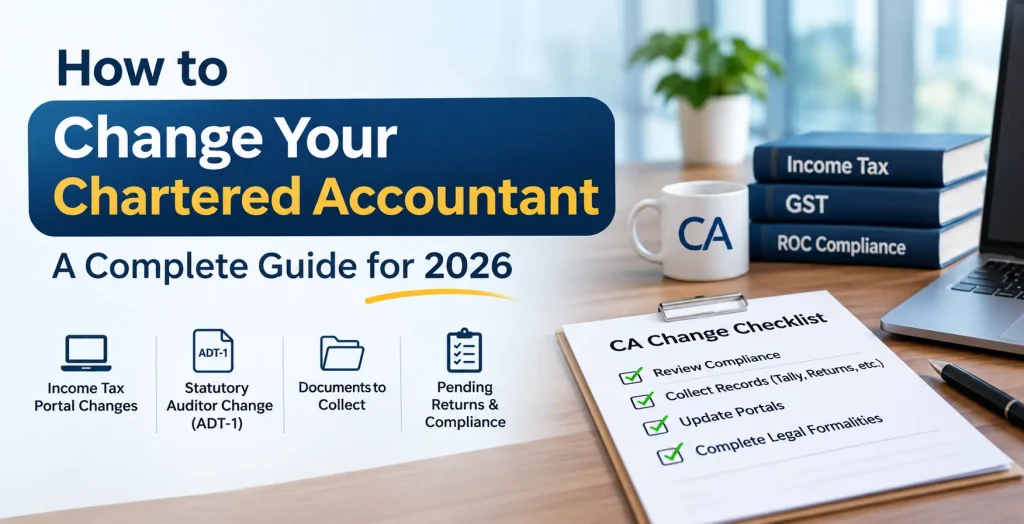
Change Your Chartered Accountant Without the Headache
CA Not Responding? Missed ROC Filings? Unexpected Tax Notices? It May Be Time for a Change.
You hired a Chartered Accountant to protect your business from tax and compliance problems. But what happens when you are the one chasing your CA for every update?
Your GST return is pending. Nobody explains the income-tax notice. Your company’s ROC annual filings are overdue. You call, send WhatsApp messages and follow up repeatedly, but still do not get a clear answer.
Enough is enough. Your business cannot wait indefinitely for professional support.
- Your CA is not responding to calls or messages, especially during important filing deadlines.
- Your previous CA filed ITR but failed to handle GST, TDS or ROC compliance.
- You discovered that company annual returns were never filed, despite paying professional fees.
- You received an Income Tax, GST or MCA notice and cannot get a proper explanation.
- Your books of accounts, tax computations and filing acknowledgements are not being handed over.
- You want a more responsive CA and CS team to manage your business under one roof.
If even one of these situations sounds familiar, you should consider a professional change and a complete compliance review.
You can change your Chartered Accountant. You do not need to remain with a professional simply because they handled your previous year’s returns. The transition can be completed through the appropriate Income Tax portal authorisation, professional handover and, where applicable, MCA auditor appointment procedures.
But do not just replace the CA. First identify what has been missed, what is pending and what needs correction.
What Does DSCsign Help You Resolve?
At DSCsign, our Bangalore-based CA, CS and Legal team helps individuals, proprietors, LLPs and private limited companies transition to a new professional arrangement with proper documentation and compliance checks.
Our first priority is to understand your existing compliance position. We then identify the required handover, portal changes, pending filings and corrective action. You get a clear picture of what needs to be done instead of another round of uncertainty.
Looking to Change Your CA in Bangalore?
Speak to our CA & CS compliance team. Tell us what went wrong with your existing CA arrangement. We will help you understand the correct replacement procedure and the pending compliance requirements.
WhatsApp: 6362877942DSCsign | No. 17/2, Sahakarnagar, Bangalore – 560092
Changing your CA is a business decision, not a personal battle. Make the change professionally, protect your records and keep your compliance on track.
Can I Change My CA Without an NOC?
Yes, you can decide to change your Chartered Accountant. Your previous CA does not have a general right to force you to continue the professional relationship merely because they handled your accounts, income tax returns or GST filings in earlier years.
However, there is an important distinction between changing a CA for routine tax and accounting work and changing an auditor for a formal audit assignment. The applicable professional requirements are different.
1. When You Want to Change Your CA for Regular Tax Work
If your requirement is to appoint another CA for income tax return filing, GST returns, bookkeeping, tax planning or routine compliance, you can generally move to another professional after settling the agreed contractual and professional obligations.
2. When You Are Changing Your Statutory or Tax Auditor
An audit appointment is different. Under Clause (8) of Part I of the First Schedule to the Chartered Accountants Act, 1949, a CA in practice must communicate in writing with the previous auditor before accepting an audit assignment previously held by another CA.
This professional communication helps the incoming auditor understand whether there are any professional reasons or unresolved matters that need to be considered before accepting the engagement.
3. What If Your Previous CA Has Unpaid Audit Fees?
This is an issue that should not be ignored. Under ICAI’s revised Code of Ethics, applicable from 1 April 2026, an incoming auditor must consider the specific restrictions relating to unpaid, undisputed statutory audit fees.
Where undisputed fees for a statutory audit under the Companies Act or another applicable statute remain unpaid, the incoming auditor should not accept the audit appointment until the relevant fees are paid, subject to the applicable exceptions and guidance.
However, a disagreement over unrelated professional charges, additional advisory fees or work outside the statutory audit should not automatically be treated as unpaid statutory audit fees. The nature of the assignment, agreed fee and supporting records must be examined.
4. What If the Previous CA Refuses to Cooperate?
A delayed response, refusal to issue a document described as an NOC, or disagreement over the handover should be handled through proper written communication. Do not allow the situation to continue indefinitely without documenting your requests.
- Send a written request: Clearly communicate your decision to change the CA and request the relevant books, records, working papers belonging to you and pending compliance details.
- Ask for a pending-work statement: Obtain details of returns filed, returns pending, notices received, audit status and fees claimed.
- Separate disputed and undisputed fees: Review the engagement terms, invoices and payment records before deciding the next step.
- Arrange professional communication: Where an audit is involved, the incoming CA should follow the applicable ICAI communication requirements.
- Protect statutory deadlines: Your new CA should independently review the filing position and identify urgent deadlines rather than waiting for the entire handover to be completed.
5. A Practical Situation We Commonly See
Consider a Bangalore-based private limited company whose directors discover that their previous CA was handling income tax returns but had not completed the company’s ROC annual filings. The directors receive an MCA notice and realise that the annual compliance position has not been properly monitored.
The first step is not simply to appoint another CA and start filing fresh forms. The new professional must review the company’s MCA master data, filing history, financial statements, pending annual returns, statutory registers and any outstanding notices. The company must also identify which work was actually covered under the earlier engagement.
This distinction matters: an income tax audit engagement does not automatically mean that the CA was appointed to handle every ROC filing. The engagement letter, correspondence and actual scope of work should be checked before responsibility is attributed.
6. How DSCsign Helps You Change Your CA Properly
At DSCsign, we approach a CA change as a compliance handover, not merely a portal-authorisation exercise. We first identify the services handled by the earlier CA, review pending work and then plan the transfer without overlooking statutory deadlines.
- Review of Income Tax, GST and ROC filing status.
- Identification of pending returns, notices, fees and compliance gaps.
- Guidance on Income Tax portal CA authorisation and assignment of forms.
- Professional coordination for audit-related communication, wherever applicable.
- Review of company records and statutory auditor appointment requirements, where relevant.
- A clear compliance action plan for the next filing period.
Want to Change Your CA Without Missing Compliance Deadlines?
Share your current CA arrangement and the issue you are facing. We can review the position and explain the correct handover procedure.
Discuss Your CA Change on WhatsAppDSCsign | No. 17/2, Sahakarnagar, Bengaluru – 560092
Legal reference: Clause (8), Part I of the First Schedule to the Chartered Accountants Act, 1949; ICAI Code of Ethics, 13th Edition (2026), including the guidance on communication with previous auditors and non-payment of undisputed audit fees. The legal procedure for changing a company’s statutory auditor must separately comply with the Companies Act, 2013.
How to Remove Your CA from the Income Tax Portal
Changing your Chartered Accountant does not require you to close your Income Tax e-Filing account or create a new PAN-based login. You can manage the authorised CA list directly from your existing account.
The Income Tax Department provides a dedicated My Chartered Accountant (CA) facility. Through this facility, you can add a new CA, deactivate an earlier CA, withdraw assigned forms and manage the validity of CA authorisations.
Step 1: Log in to Your Income Tax Account
Visit the official Income Tax e-Filing portal and log in using your PAN or other applicable user ID and password.
Make sure you are logging in to the correct taxpayer account. For a company, firm or other entity, use the entity’s own e-Filing account rather than an individual director’s or partner’s personal account.
Step 2: Open the My Chartered Accountant Section
After login, navigate to the authorised partner services.
Dashboard → Authorised Partners → My Chartered AccountantThe portal displays your authorised CAs under active and inactive categories. You can review the CA names and check the forms assigned to each CA.
Step 3: Review and Withdraw Earlier Form Assignments
Before deactivating the old CA, check whether any tax audit reports, statutory forms or other submissions are still assigned to that CA.
If an assignment is no longer required, use the portal’s withdrawal facility where available. Do not withdraw a form blindly if it is already under preparation, submitted or awaiting an action from you.
First identify the status of every pending assignment and decide whether it should be completed by the existing CA or reassigned to the new professional.
Step 4: Deactivate the Previous CA
From the My Chartered Accountant(s) page, locate the earlier CA under the Active CA list.
- Select the relevant CA record.
- Choose the Deactivate option available against that CA.
- Review the confirmation message and complete the action.
- Check that the CA is now reflected under the inactive list.
Step 5: Add Your New Chartered Accountant
Once you have decided to appoint the new CA, add their details through the same My Chartered Accountant facility.
- Click Add CA.
- Enter the new CA’s ICAI membership number.
- Check that the CA name displayed by the portal is correct.
- Select the applicable validity period, where the portal asks for it.
- Confirm and submit the request.
- Keep the transaction reference for future records.
The new CA must accept the authorisation request on their own e-Filing account. Until the request is accepted, the taxpayer may not be able to assign forms to that CA.
Step 6: Assign the Required Forms to the New CA
This is the step many taxpayers miss. Adding a CA does not automatically assign every tax form to that CA. You must separately assign the relevant forms and assessment years.
Authorised Partners → My Chartered Accountant → Assign Form(s)Select the new CA and add the required form details, such as:
- Applicable form name.
- Assessment Year or relevant period, as requested by the portal.
- Filing type, wherever applicable.
- Any other details required for that particular form.
Review the selection and submit the assignment. Keep the transaction ID or acknowledgement for your records.
Step 7: Confirm That the New CA Can Access the Assignment
Ask the new CA to check their e-Filing worklist after accepting the request and assignment. For certain forms, the CA must accept the assignment before proceeding with filing.
For example, tax audit forms such as Form 3CA-3CD or Form 3CB-3CD require the taxpayer to add the CA and assign the relevant form. The CA then acts on the assignment through their own portal account.
Common Problems While Changing Your CA
- New CA name is not appearing: Verify the ICAI membership number and whether the CA is registered on the e-Filing portal.
- CA request is pending: The new CA may not yet have accepted the authorisation request.
- Form is not visible to the new CA: Check whether the form has actually been assigned and submitted for assignment.
- Old CA is still showing as active: Review the active CA list and complete the deactivation process if appropriate.
- Form is already assigned to the old CA: Review its status before withdrawing or attempting a fresh assignment.
Important: Never Share Your Income Tax Password or OTP
Your Income Tax account contains confidential financial and tax information. You should retain control of the login credentials, registered mobile number and email access.
A professional may need authorised access and form assignments to complete the agreed work, but that does not mean you should casually share your password or OTP. Review the work performed and retain copies of filed returns, acknowledgements and notices.
- Check the existing authorised CA list.
- Review forms assigned to the previous CA.
- Check pending submissions and worklist actions.
- Deactivate the previous CA where appropriate.
- Add the new CA using the correct ICAI membership number.
- Ensure the new CA accepts the request.
- Assign the required forms and relevant assessment years.
- Confirm that the new CA can see the assigned work.
- Save transaction references and filing acknowledgements.
Need Help Changing Your CA in Bangalore?
If your earlier CA is not responding, you have pending tax audit forms, or the portal is not allowing you to assign work to the new CA, the issue should be examined before attempting repeated changes.
DSCsign can help review your existing authorisations, pending assignments and tax compliance position and guide you through the CA transition.
Change Your CA. Keep Your Tax Compliance on Track.
Speak to our team about changing your existing CA and transferring your Income Tax compliance work.
WhatsApp DSCsign – 6362877942Office: No. 17/2, Sahakarnagar, Bengaluru – 560092
Official reference: Income Tax Department – My Chartered Accountant (CA) User Manual and FAQ. Portal labels and available actions may change as the Department updates its services.
How to Change the Statutory Auditor of a Private Limited Company
Changing the statutory auditor of a private limited company is not the same as changing your CA for income tax filing. The company must follow the Companies Act, 2013, depending on whether the auditor is resigning, completing their term or being removed before the term ends.
1. When the Existing Auditor Resigns
When the statutory auditor resigns, the following steps generally apply:
- The auditor submits a resignation letter stating the reasons.
- The auditor files Form ADT-3 within 30 days of resignation with the ROC and provides the required statement to the company.
- The Board fills the casual vacancy within 30 days.
- Where the vacancy arises due to resignation, shareholders must approve the appointment at a general meeting within 3 months of the Board’s recommendation.
2. When the Company Wants to Remove the Auditor Before Term Expiry
A company cannot simply pass a Board Resolution and replace its statutory auditor before the end of the appointment term.
- Give the existing auditor a reasonable opportunity of being heard.
- Pass the necessary Board Resolution and apply for prior approval of the Central Government through the prescribed Form ADT-2 process within 30 days of the Board resolution.
- After receiving approval, convene a general meeting and pass a Special Resolution within 60 days of receiving the approval.
- Complete the consequential ROC filings and auditor appointment formalities.
3. When the Auditor’s Term Is Ending
If the auditor’s term is ending at the AGM, the company should review the appointment and reappointment requirements under Section 139. The company must also consider auditor eligibility, consent, certificate and applicable rotation provisions before appointing a new auditor.
Quick Comparison: Which Form and Procedure Apply?
| Situation | Applicable provision / form | Key requirement |
|---|---|---|
| Auditor resigns | Section 140(2), ADT-3 | Outgoing auditor files within 30 days |
| Casual vacancy due to resignation | Section 139(8) | Board appointment within 30 days and members’ approval within 3 months |
| Early removal by company | Section 140(1), ADT-2 | Prior approval and subsequent Special Resolution |
| Appointment / reappointment at AGM | Section 139 | Follow applicable appointment and ROC filing requirements |
4. Documents to Keep Ready
- Auditor’s resignation letter, where applicable.
- Board Meeting notice, agenda and minutes.
- Board Resolution recommending the appointment.
- Consent and eligibility certificate from the incoming auditor.
- Shareholders’ resolution, wherever required.
- Applicable ROC forms and supporting attachments.
Practical point: If your previous auditor has resigned but ADT-3 is still pending, coordinate with the outgoing auditor and verify the MCA filing position before proceeding with the new appointment. An incomplete auditor transition can delay the company’s annual audit and ROC compliance.
Need Help Changing Your Company’s Auditor?
We assist private limited companies in Bangalore with auditor transition, Board Resolutions, shareholder approvals and MCA filings.
Discuss Your Auditor ChangeDSCsign | No. 17/2, Sahakarnagar, Bengaluru – 560092
ADT-1 Filing: Due Date, Documents and ROC Fees
After appointing or reappointing a statutory auditor, a company must complete the applicable ROC intimation. For appointments covered by Section 139(1), this is done through Form ADT-1.
Documents Required for ADT-1
- Board or shareholders’ resolution, as applicable.
- Auditor’s written consent to the appointment.
- Auditor’s eligibility and qualification certificate.
- Auditor’s name, membership number and address.
- Company CIN, registered office details and appointment date.
- Details of the previous auditor and appointment tenure, wherever required by the form.
What Is the Government Fee for ADT-1?
The normal ROC filing fee is determined under the Companies (Registration Offices and Fees) Rules, 2014. It generally depends on the company’s nominal share capital and applicable filing category. Additional fees may apply when the form is filed late.
Do not rely on a fixed ADT-1 fee quoted without checking the company’s capital and filing status. Verify the applicable amount on the MCA portal before payment.
Common ADT-1 Filing Mistakes
- Entering an incorrect date of appointment or meeting.
- Using incorrect auditor membership or firm registration details.
- Uploading incomplete consent or eligibility documents.
- Filing after the statutory deadline without checking additional fees.
- Ignoring the previous auditor’s tenure and applicable rotation restrictions.
Get Your Auditor Appointment Filing Right
A correct Board Resolution, auditor consent and timely MCA filing help avoid unnecessary resubmissions and additional fees. DSCsign assists Bangalore companies with auditor appointment documentation, ADT-1 preparation and ROC compliance.
Get your auditor appointment documents and MCA filing reviewed before submission.
WhatsApp: 6362877942No. 17/2, Sahakarnagar, Bengaluru – 560092
Documents to Collect from Your Old CA Before Switching
Before appointing a new Chartered Accountant, collect your accounting data, tax records and pending compliance details. A proper handover helps your new CA continue the work without recreating accounts or missing important deadlines.
1. Accounting Software and Financial Records
- Tally backup: Complete company data backup, including ledgers, vouchers, inventory and cost centres, wherever maintained.
- Other accounting software: Zoho Books, Busy, Marg or other software data export and backup, as applicable.
- Trial Balance, Balance Sheet and Profit & Loss Account.
- Ledger accounts, debtor and creditor outstanding reports.
- Bank reconciliation statements and cash book.
- Fixed asset register and depreciation working.
- Stock and inventory details, where applicable.
2. Income Tax Records
- Filed ITR acknowledgements and computation statements.
- Tax audit reports and supporting audit workings, where applicable.
- Form 26AS, AIS and TIS records.
- TDS returns, challans and reconciliation details.
- Outstanding tax demand, notices and pending proceedings.
3. GST Records
- GSTR-1 and GSTR-3B filing acknowledgements.
- GSTR-9 and GSTR-9C, wherever applicable.
- Electronic cash ledger, credit ledger and liability ledger details.
- Input Tax Credit reconciliation and purchase register.
- GST notices, replies, orders and appeal records.
4. Company and ROC Records
- Filed AOC-4, MGT-7 / MGT-7A and other ROC forms.
- Financial statements, Board Reports and Auditor Reports.
- Board Meeting and AGM minutes and resolutions.
- Statutory registers and shareholding records.
- Auditor appointment and resignation documents, including ADT-1 / ADT-3, wherever applicable.
- MCA notices, adjudication orders and pending filing details.
5. Other Important Information
- Previous CA’s pending work statement and filing calendar.
- Details of professional fees paid and outstanding bills.
- Copies of important client correspondence and notices.
- Digital copies of documents submitted to government departments.
- List of pending compliances and upcoming due dates.
Switching Your CA? We Can Help With the Handover.
At DSCsign, we review the available accounting backup, tax records and pending compliance position before taking over the assignment. This helps identify missing records and urgent filing requirements at the beginning itself.
Speak with our team for a structured CA handover and compliance review.
WhatsApp: 6362877942No. 17/2, Sahakarnagar, Bengaluru – 560092
Old CA Did Not File Your Returns? What Should You Do?
Have you discovered that your previous CA did not file your GST returns, income tax returns or ROC annual returns? Do not wait for another notice. First identify what is pending, calculate the possible exposure and prepare a corrective filing plan.
1. Identify What Was Not Filed
- Income Tax: Pending returns, tax audit reports, TDS returns and outstanding demands.
- GST: Missing GSTR-1, GSTR-3B, annual returns, ITC mismatches and notices.
- ROC: Pending AOC-4, MGT-7 / MGT-7A, auditor-related forms and other annual filings.
2. Check the Penalty and Notice Exposure
The consequences depend on the form, financial year, delay and applicable law. There may be late fees, additional fees, interest, penalties or restrictions on further filings. An MCA notice or GST demand may also require a response within a specified time.
3. Prepare a Regularisation Plan
- Download the latest filing history from the Income Tax, GST and MCA portals.
- Reconcile accounting records with filed returns and financial statements.
- Identify missing documents and incomplete earlier filings.
- Calculate applicable late fees, interest and additional fees.
- Prepare and submit pending filings in the correct sequence.
- Respond to outstanding notices and track the proceedings until closure.
4. Can You Hold Your Previous CA Responsible?
That depends on the actual engagement and the work agreed upon. For example, a CA engaged only for income tax audit may not automatically be responsible for ROC annual filings. Review the engagement letter, fee invoices, emails and instructions before determining responsibility.
If you believe there was professional negligence, preserve the relevant records and obtain appropriate professional or legal advice. Changing your CA does not automatically cancel statutory liabilities already incurred by the taxpayer or company.
How DSCsign Helps Businesses in Bangalore
We review pending Income Tax, GST and ROC compliance, identify immediate risks and prepare a practical action plan. Our objective is to help businesses move from incomplete records and missed filings to a properly documented compliance position.
Share the notice or pending compliance details for an initial review.
Get Compliance Assistance – WhatsAppNo. 17/2, Sahakarnagar, Bengaluru – 560092
Frequently Asked Questions About Changing Your CA
1. Can I change my Chartered Accountant anytime?
Yes. You can appoint another CA for future professional work. However, statutory auditor changes must follow the applicable provisions of the Companies Act, 2013.
2. Can I change my CA without an NOC?
An NOC is not a universal legal requirement for every CA change. For audit assignments, the incoming CA must follow ICAI’s professional communication requirements with the previous auditor.
3. Can I change my CA after filing my Income Tax Return?
Yes. You can appoint another CA for future work, including responding to notices or handling eligible subsequent proceedings. The earlier filed return remains on record.
4. Can I add a new CA to my Income Tax portal?
Yes. Use the My Chartered Accountant facility to add the new CA. The CA must accept the request, and you may need to assign the relevant forms separately.
5. What if my old CA refuses to give my Tally backup?
Send a written request for your accounting data and supporting records. Review your engagement terms and payment position. Keep a record of all communication and seek appropriate professional advice if the issue remains unresolved.
6. Can I change my company’s statutory auditor without a Special Resolution?
It depends on the reason for the change. Removal before expiry of the auditor’s term requires the procedure under Section 140(1), including a Special Resolution. A resignation-related casual vacancy follows a different approval procedure.
7. What is the due date for filing ADT-1?
For an appointment covered by Section 139(1), Form ADT-1 must generally be filed within 15 days from the date of the meeting at which the auditor is appointed or reappointed.
8. Who is responsible for penalties if the previous CA missed ROC filings?
The company and its officers may have statutory responsibilities under the Companies Act. Whether the previous CA is professionally responsible depends on the agreed scope of work, instructions and evidence of the engagement.
9. How long does it take to change a CA?
Routine professional handovers can often be completed quickly once records and authorisations are available. A statutory auditor change may take longer because Board approvals, shareholder approvals or regulatory procedures may be required.
10. What should I collect before appointing a new CA?
Collect your Tally or other accounting software backup, financial statements, tax returns, GST records, ROC filings, notices, reconciliations and a list of pending compliance work.
Get help with CA transition, pending tax filings, GST compliance and ROC annual returns.
Talk to DSCsign – 6362877942No. 17/2, Sahakarnagar, Bengaluru – 560092
Change Your CA with Confidence – Get Your Compliance Back on Track
Changing your Chartered Accountant is an important business decision. Whether your existing CA is not responding, your accounts are not updated, ROC returns are pending or you simply need better professional support, make the transition in an organised manner.
Do not wait until you receive an Income Tax notice, GST demand or MCA communication to discover that important work has been missed. A timely review of your accounts and statutory compliance can help identify problems before they become more expensive.
Your CA Change Checklist – Before You Finalise the Switch
- Confirm the services you expect from your new CA.
- Collect your Tally or other accounting software backup.
- Obtain previous Income Tax, GST and ROC filing records.
- Check pending returns, notices, demands and statutory deadlines.
- Clarify outstanding professional fees and handover responsibilities.
- Complete the required Income Tax portal authorisation changes.
- Follow the Companies Act procedure if changing the statutory auditor.
- Obtain a written engagement letter and clear fee quotation from the new CA.
- Agree on a compliance calendar for the coming financial year.
How to Choose the Right CA for Your Business
Before changing your CA, do not select a professional based only on the lowest quotation. Ask whether the proposed engagement covers the actual compliance requirements of your business.
How DSCsign Handles Your CA Transition
At DSCsign, we understand that clients usually approach a new CA because something needs attention. Our first priority is to understand the existing position rather than immediately asking you to start filing everything again.
Our transition support covers:
- Reviewing your existing accounting records and software backup.
- Checking Income Tax, GST and ROC filing history.
- Identifying pending statutory returns and notices.
- Assisting with professional handover and portal authorisations.
- Planning statutory auditor changes wherever applicable.
- Preparing a practical compliance calendar and engagement scope.
We serve businesses in Sahakarnagar, Jakkur, Mathikere, Kalyan Nagar, Frazer Town and other parts of Bengaluru. Whether you are a startup, private limited company, LLP, partnership firm or established business, the transition should be based on your actual compliance requirements.
Looking for a New Chartered Accountant in Bangalore?
Let us review your existing compliance position and guide you through the change of CA, pending filings and future statutory requirements.
Contact DSCsign for a CA transition consultation.
WhatsApp: 6362877942
DSCsign – CA, CS, Tax and Legal Compliance Services
No. 17/2, Sahakarnagar, Bengaluru – 560092
Email: team@teamindia.co.in

CA, CS and Legal Advisor with over 20 years of professional experience in accounting, taxation, corporate compliance and business advisory. He works with businesses on practical tax and statutory compliance matters, including professional transitions and regulatory requirements.
Published by DSCsign – Bengaluru, Karnataka.
Disclaimer: This article provides general information on changing a Chartered Accountant and related compliance procedures. The applicable process depends on the nature of the engagement, the company’s auditor appointment status and the relevant statutory provisions. Obtain professional advice after reviewing your specific records and circumstances.