Most people we meet after college or a job don’t lack the idea — they have a plan they’ve already thought through. What they’re missing is the legal shell to run it through: a properly registered Private Limited company or LLP, recognised under Startup India, that a bank, an investor or a government scheme will actually take seriously. We’re DSC Sign | Sreedhara & Co, working out of Sahakarnagar and three other North Bangalore locations for 20 years — and startup company registration Bangalore founders can actually rely on is the part we spend the most time getting right.
What Counts as a “Startup” Under the 2026 DPIIT Framework
DPIIT’s definition was revised in 2026, and it’s wider than most people assume. Your company qualifies if it is:
General Startups
- Incorporated as a Private Limited Company, LLP, partnership firm, or (newly eligible) a registered cooperative society
- Within 10 years of incorporation
- Annual turnover not exceeding ₹200 crore in any financial year since incorporation
- Working on an innovative, scalable business — not a straightforward trading or franchise resale of an existing product
Deep-Tech Startups
- Same entity types as above
- Within 20 years of incorporation
- Annual turnover ceiling raised to ₹300 crore
- Must show genuine R&D depth and IP creation, not just a tech-sounding pitch deck
DPIIT Startup Recognition Benefits — What’s Automatic and What Isn’t
This is where we differ from most “register your startup” pages: we’ll tell you plainly what you get immediately versus what needs a separate application.
Section 80-IAC Tax Holiday
A 100% profit deduction for any 3 consecutive years out of your first 10. Not automatic on DPIIT recognition — it needs a separate Certificate of Eligible Business from the Inter-Ministerial Board, backed by Form 10-CCB CA certification filed with your original ITR. This is exactly the paperwork most founders skip, which is why uptake is under 2%.
Angel Tax — Already Gone For Everyone
Section 56(2)(viib) “angel tax” was fully abolished for all investor classes from FY 2024-25 — so this isn’t a special DPIIT perk anymore, it’s the law for every unlisted company. What DPIIT recognition still buys you is credibility with banks, public-procurement eligibility, and access to the schemes below.
Government-Backed Funding Routes
PM Mudra Yojana (Shishu up to ₹50,000, Kishor up to ₹5 lakh, Tarun up to ₹10 lakh, and the new Tarun Plus up to ₹20 lakh for repeat borrowers), MSME loan schemes, and the Startup India Seed Fund Scheme — up to ₹20 lakh grant for validation/proof-of-concept and up to ₹50 lakh as convertible debentures via approved incubators.
Duty Concessions & Reimbursements
Depending on the specific scheme and your sector, recognised startups can access concessional lending rates, customs-duty relief on qualifying imports, and reimbursement routes for trademark filing and certain branding costs — each scheme-specific, so we check current eligibility before promising anything.
Real Fund Sanctions, Not Just a Pitch
We don’t just file your paperwork and disappear once the certificate arrives. Several of our registered startups have gone on to get actual bank funding sanctioned in their first year of operation — before they’d raised a single external investor round.
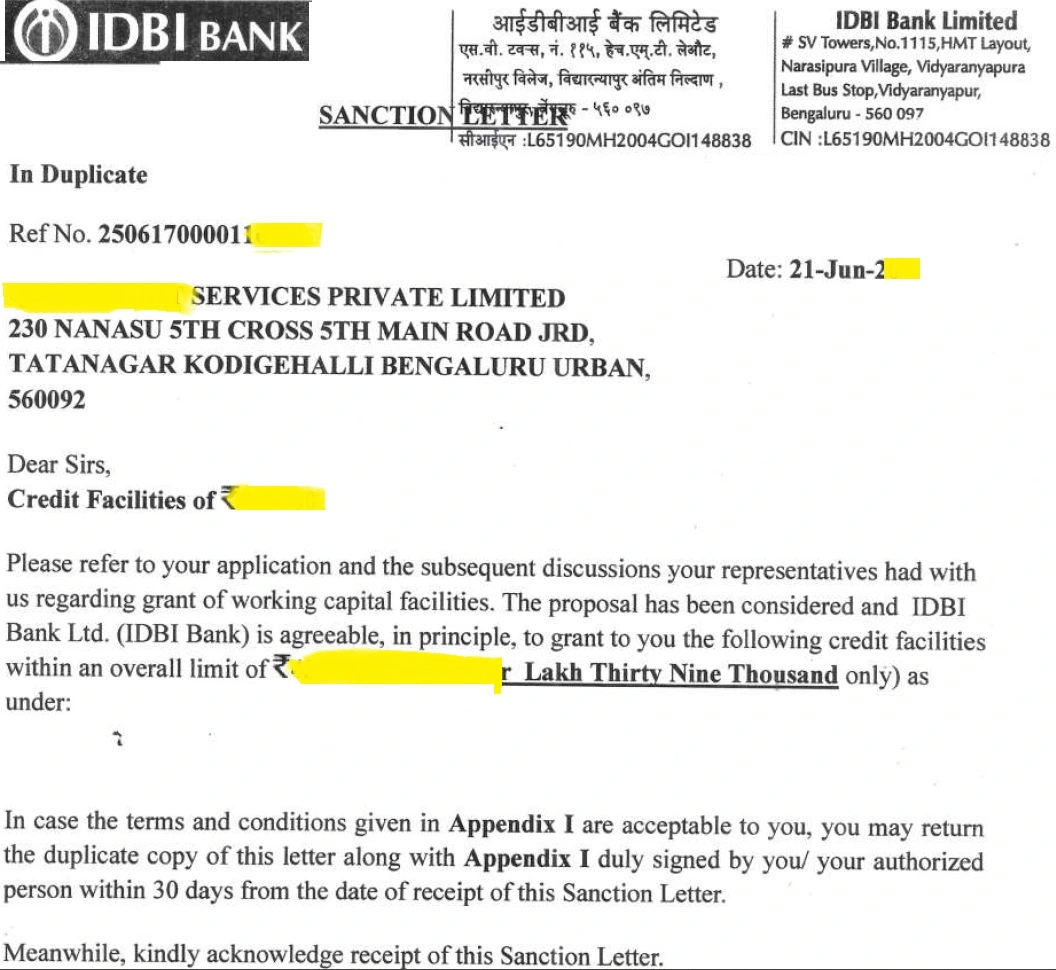
A sample fund-sanction letter from one of our startup clients’ banking relationships. Amounts and identifying details vary by case — this is shown to illustrate the outcome, not a promised figure.
Check Your Startup Registration Readiness
Tick what you already have. Most founders are closer to ready than they think.
- A clear business objective — 2–3 lines on what the company will actually do
- One proposed company name shortlisted
- At least 2 promoters ready to sign on (a woman co-founder adds priority scheme access)
- PAN, Aadhaar, 1-month bank statement & photo for each promoter
- An address to register at — home or rented is fine, no office lease needed yet
- Expected turnover will stay under ₹200 crore/year (₹300 crore if deep-tech)
Startup Company Registration Bangalore — Documents Required (Genuinely This Short)
This is the entire list. We’re not holding anything back to upsell you later.
From You
- Your business objective, in brief
- One unique proposed company name
- Minimum 2 promoters
- PAN, Aadhaar, latest 1-month bank statement and photo — for each promoter
- An address (home or rented — we handle the formalities)
We Take It From There
- Digital Signature Certificates (DSC) for all promoters
- Director Identification Numbers (DIN)
- MOA & AOA drafting
- SPICe+ incorporation filing, GST registration
- DPIIT recognition application
Timeline: 5 to 10 working days for company incorporation with PAN, TAN, MOA, AOA, DSC, DIN and GST — assuming your documents are ready and MCA doesn’t raise a query.
Startup Company Registration Bangalore — What It Actually Costs
| Particular | Amount |
|---|---|
| Our professional fee for incorporation | ₹6,000 |
| Government / MCA fees | As actuals, based on your capital structure and state |
| Initial paid-up capital | As low as ₹10,000 is enough to open your company bank account |
You don’t need office rent or an advance deposit to begin — an existing home address or a rented place both work for registration. Keep that saved capital for the business itself; you can always update your registered office later.
We’ve registered startups across genuinely different sectors — QuestRight HR Services Pvt Ltd (HR services), Attika Gold Jewellery, Trukem Pharmaceuticals Pvt Ltd, and LEON Construct, among others. QuestRight secured bank funding in its very first year of operation — before it had a long invoicing history — because the company profile and project report we prepared gave the bank enough to underwrite against, not just a pitch deck.
Beyond Registration — What We Actually Help With Next
A Certificate of Incorporation on its own doesn’t run a business. After registration, we typically move to: opening your company bank account, preparing the project report your funding application will actually need, and setting up ongoing compliance so nothing lapses in year one.
Money & Compliance
Bank account opening, GST registration, and monthly bookkeeping — see our accounting & GST filing service and our outsourced accounting services — plus advice on quoting and billing your first clients correctly.
Brand & IP Protection
Once you’re registered, someone can legally use your business name before you trademark it. We handle that through our trademark registration service, and route any legal-service GST questions through our GST on legal services guide.
Company Secretarial & Governance
As you bring in investors or plan toward a larger raise — even an eventual IPO — cap table structuring, shareholder agreements and ROC filings matter early. Our sister practice covers this in depth: CS-led startup company registration support.
Banking Relationships
We work alongside IDBI Bank, Bank of Maharashtra, SBI, Karnataka Bank, Canara Bank and Union Bank, plus Startup India and Startup Karnataka, to move funding conversations along faster once your paperwork is in order.
Frequently Asked Questions
Can a brand-new startup get a Mudra loan with zero sales?
Yes — Shishu and Kishor Mudra loans are collateral-free and assessed on your business profile and project report, not invoicing history. Tarun and the newer Tarun Plus (up to ₹20 lakh) come later, once you have a repayment track record — that’s when GST billing history genuinely helps.
Is the 80-IAC tax holiday automatic once I get DPIIT recognition?
No. DPIIT recognition and the 80-IAC tax exemption are two separate applications. The exemption needs a Certificate of Eligible Business from the Inter-Ministerial Board and Form 10-CCB CA certification — we prepare and file this as a distinct step, not an assumption.
Is angel tax exemption still a reason to register as a DPIIT startup?
Not specifically — angel tax under Section 56(2)(viib) was abolished for all companies and investors from FY 2024-25. DPIIT recognition still matters for the 80-IAC tax holiday, public-procurement eligibility and funding-scheme access.
Do I need a commercial office to register my startup?
No. Your home address or a rented residence works for registration — there’s no requirement to sign a commercial lease before you’ve validated the business.
Startup company registration Bangalore: how long does it take?
Typically 5 to 10 working days for the company itself — PAN, TAN, MOA, AOA, DSC, DIN and GST — assuming your documents are ready and the name clears without an MCA query.

Sai Suresh
CA, CS & Legal Advisor · 20+ Years in Income Tax, GST, MCA/ROC & IP Law
Writes and reviews DSC Sign | Sreedhara & Co’s startup registration content alongside our compliance pillars — Karan S, Mohan Raj, Sreedhara S, Satish, Mahesh S and Prakasha — who handle DSC/DIN issuance, MCA filings and client onboarding across our Bangalore branches.
Page reviewed for accuracy against the 2026 DPIIT startup framework, Section 80-IAC and the current status of Section 56(2)(viib).
Ready to Turn Your Plan Into a Registered Company?
Send us your business idea in a few lines and your promoter details — our startup executive will call you back for a free startup company registration Bangalore consultation, no obligation.